
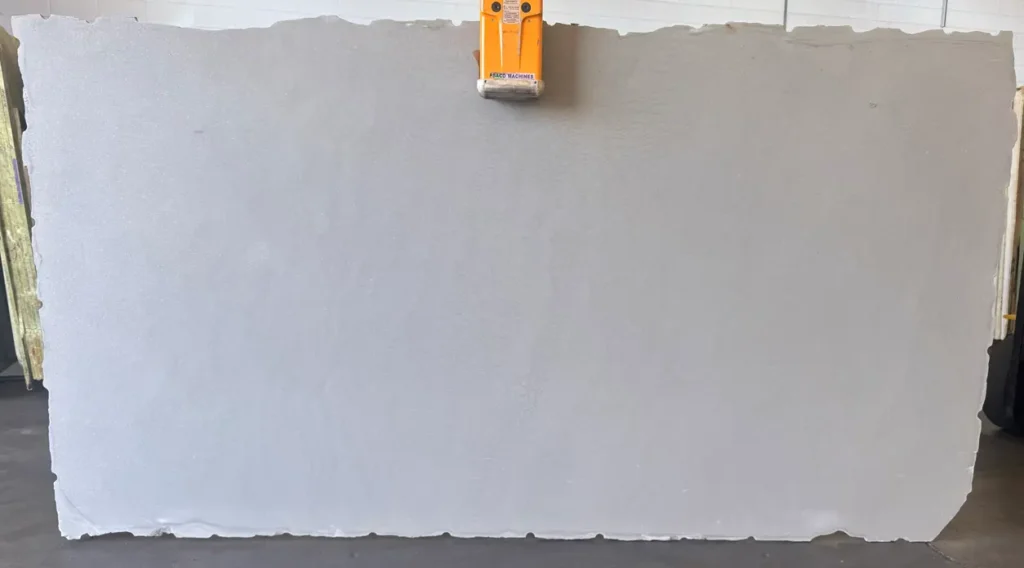
Pietra Serena – Italian Sandstone Slabs
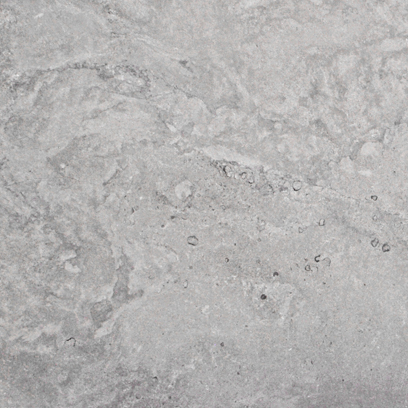
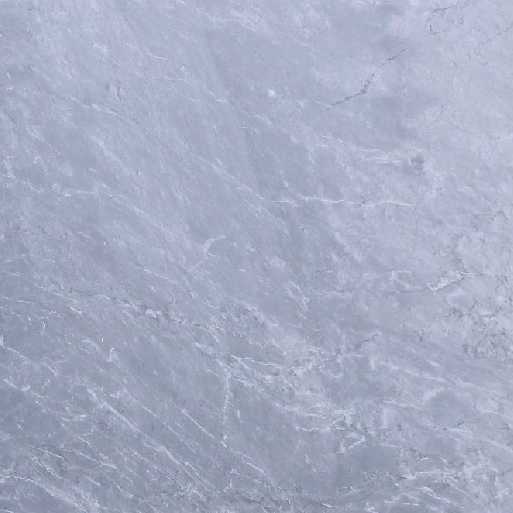
Pietra Serena is a classic Italian sandstone prized for its distinctive blue-gray color, fine grain and understated architectural character. Quarried in Tuscany and closely associated with the architecture of Renaissance Florence, it has been used for centuries in flooring, stairways, fireplaces and carved architectural details. The World of Stone stocks Pietra Serena in both 2cm (¾”) slabs and unusually substantial 6.5cm (2.5″) slabs, providing exceptional possibilities for custom and dimensional stone applications.
About Pietra Serena
Pietra Serena has been used in Italian architecture for centuries and is particularly associated with the buildings of Florence and the Tuscan Renaissance. Its remarkably consistent blue-gray color and fine, subtle grain give it a quiet architectural quality that works equally well in traditional and contemporary settings.
Unlike stones selected for dramatic veining or movement, Pietra Serena is valued for its uniformity, texture and ability to create strong architectural forms without visually dominating a space. Historically used for columns, stairways, flooring, fireplaces, moldings and carved details, it remains especially well suited to projects where the stone itself becomes part of the architecture.
The availability of both 2cm (¾”) and 6.5cm (2.5″) slabs expands those possibilities considerably. Standard slabs accommodate conventional surface applications, while the unusually thick 6.5cm material allows for substantial stair treads, hearths, benches, tables and custom dimensional elements where the visible thickness of the stone is an intentional part of the design.
A Stone of Renaissance Florence
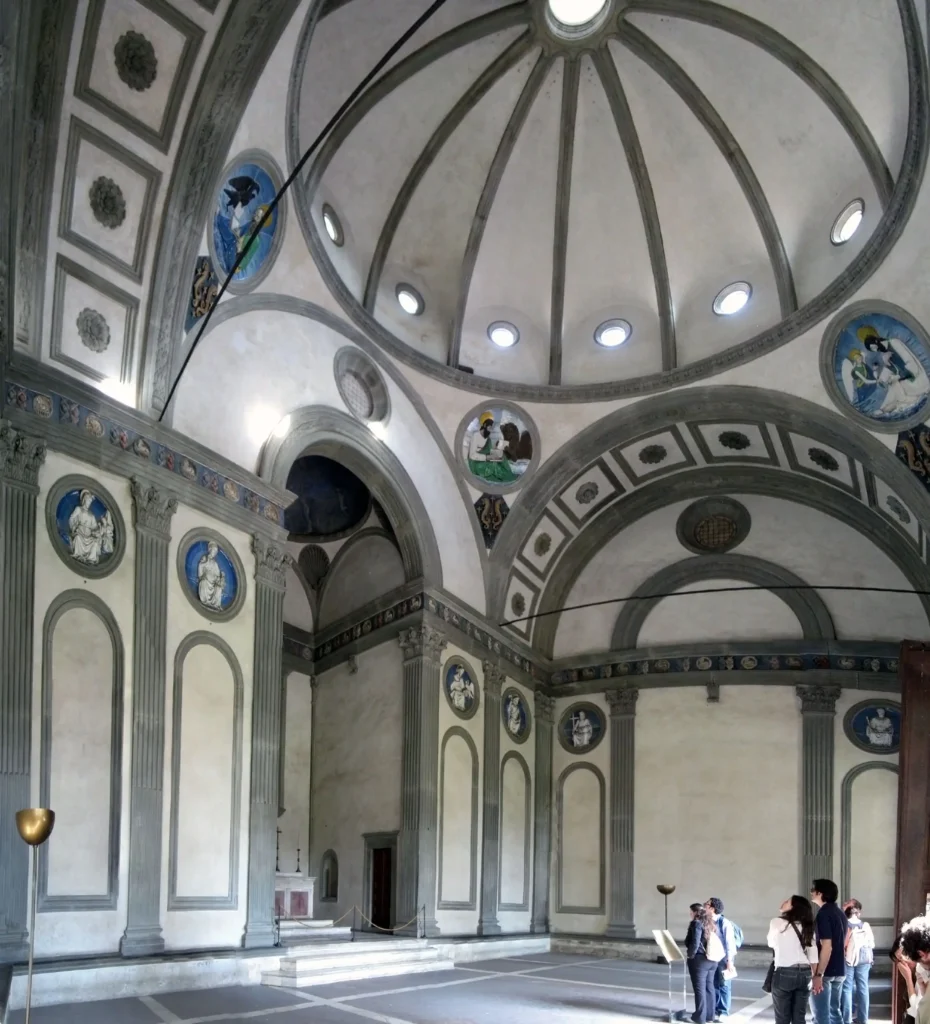
Pietra Serena is inseparable from the architectural identity of Florence. During the Renaissance, its cool blue-gray color was used in deliberate contrast with pale plaster walls, allowing columns, arches, cornices, door surrounds and other architectural elements to clearly define the structure of an interior.
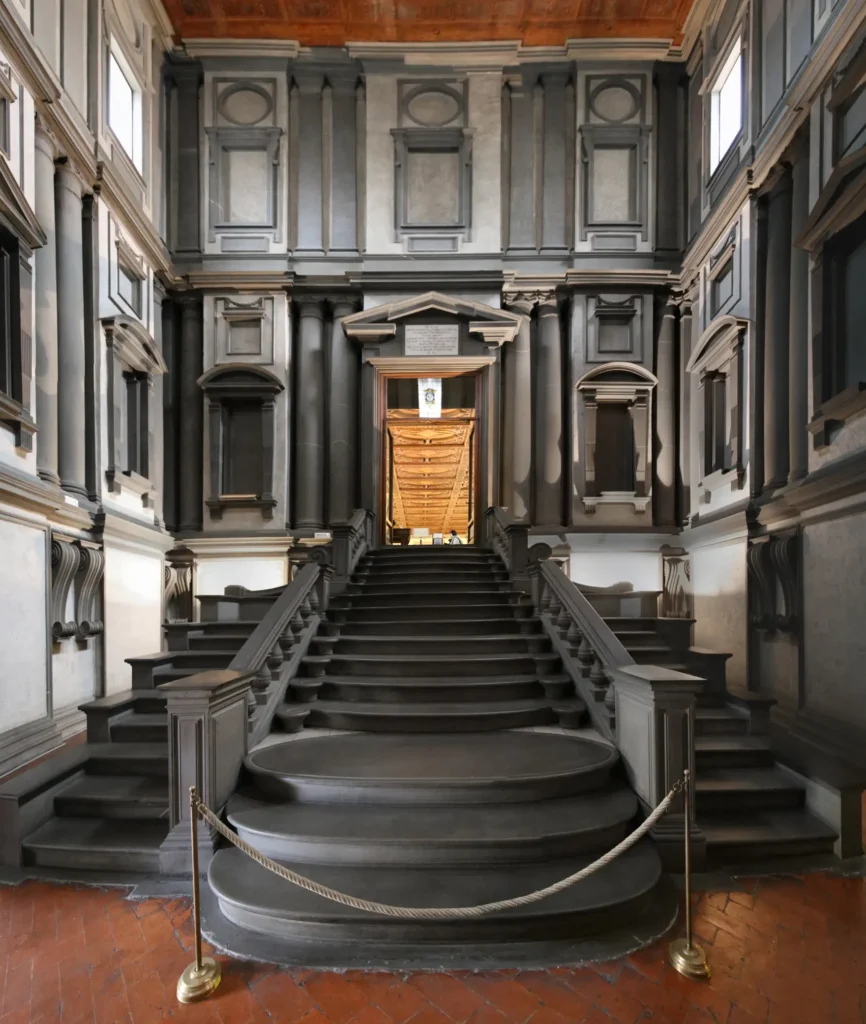
The stone is particularly associated with the work of Filippo Brunelleschi, who used Pietra Serena extensively in buildings such as the Basilica of San Lorenzo, the Old Sacristy and the Pazzi Chapel. Its restrained color and ability to be precisely carved made it an ideal material for the clean geometry and proportion that characterized Florentine Renaissance architecture.
Centuries later, that same quality remains relevant. Pietra Serena can provide architectural definition without the visual movement of heavily veined stone, making it equally appropriate for historic-inspired interiors and highly contemporary spaces.
Pietra Serena Slabs
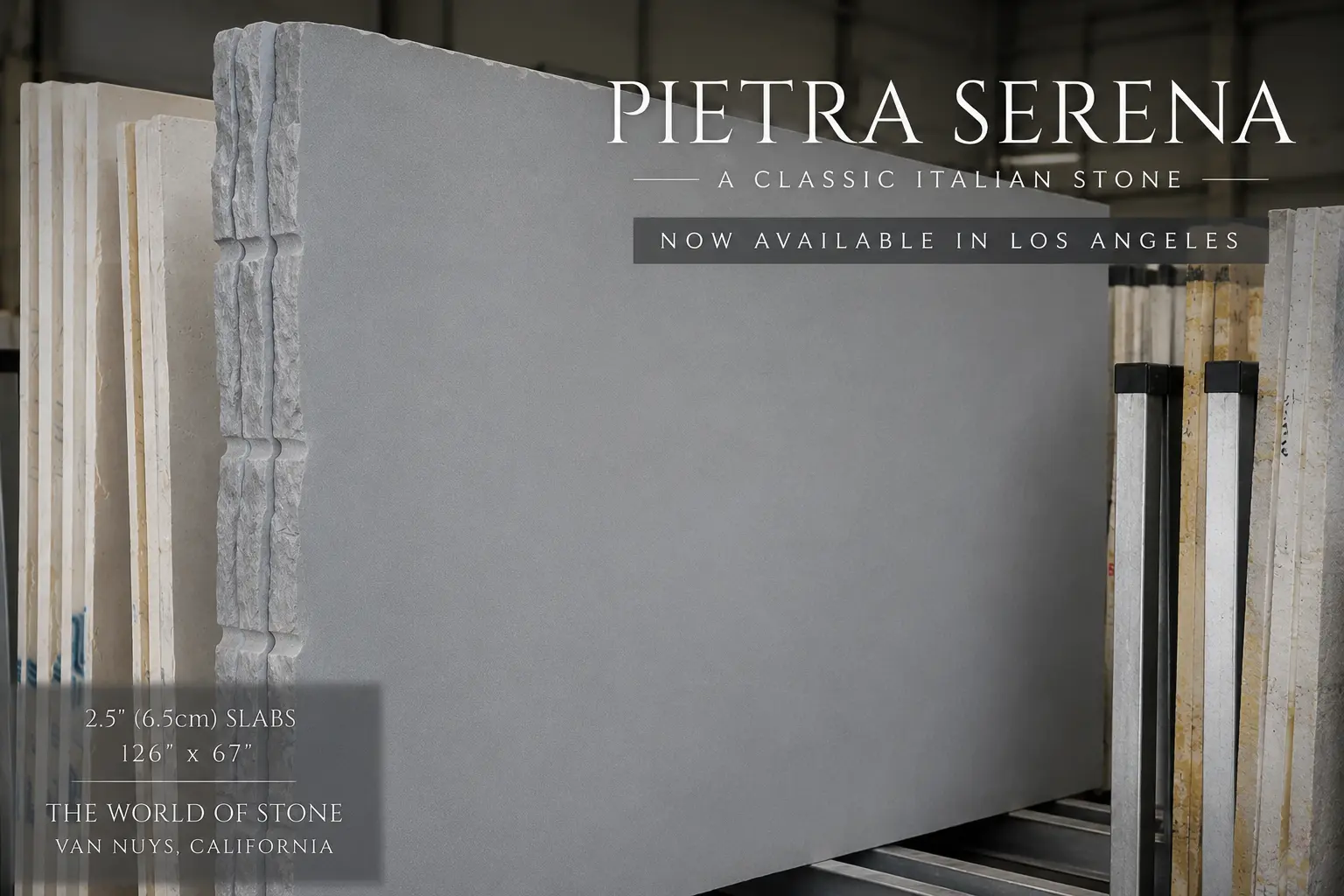
The World of Stone stocks Pietra Serena in both 2cm (¾”) and 6.5cm (2.5″) slabs, providing options for conventional surface applications as well as substantial custom architectural work.
The 2cm slabs are well suited for flooring, wall cladding, fireplace surrounds and other traditional slab applications. Our unusually thick 6.5cm slabs offer greater design flexibility for stair treads, hearths, benches, tables and dimensional elements where the visible thickness and mass of the stone become part of the architecture.
With its consistent blue-gray color and fine grain, Pietra Serena can be used across large areas while maintaining the quiet, understated appearance for which the stone has been valued for centuries.
Extra-Thick 2½” Pietra Serena Slabs
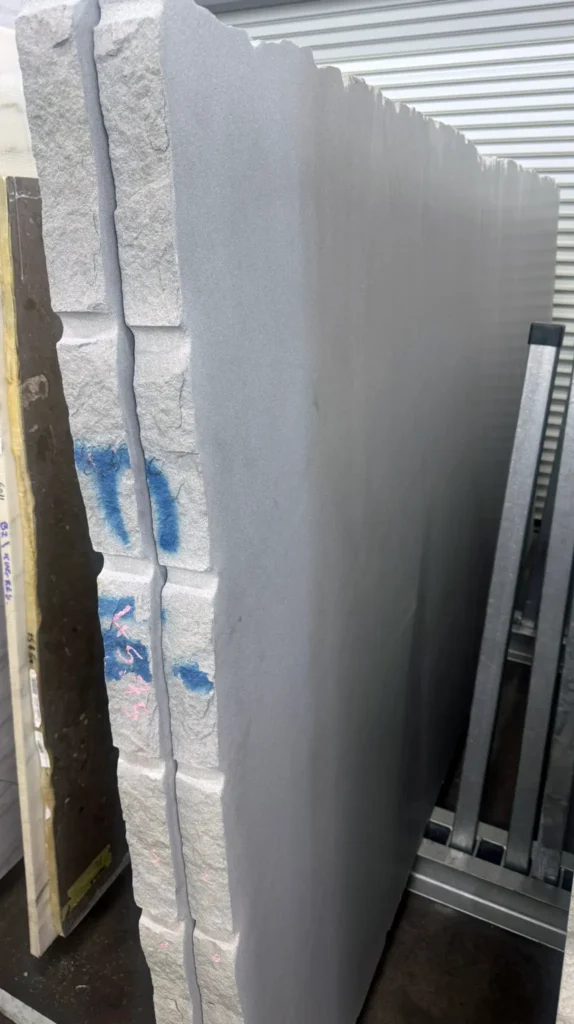
One of the most distinctive features of our Pietra Serena inventory is the availability of 6.5cm (2.5″) thick slabs, an exceptionally uncommon thickness in the Southern California slab market. The additional mass allows the stone to become an architectural element rather than simply a surface material.
These substantial slabs are particularly well suited for stair treads, fireplace hearths, benches, tables, thresholds, shelving and custom dimensional pieces where a solid, exposed stone edge is an important part of the design. The thickness also provides designers and fabricators greater flexibility for custom work without relying on laminated or built-up edges.
For projects requiring unusual dimensions or fabrication, The World of Stone can assist with material selection and sourcing to accommodate project-specific requirements.
Custom & Dimensional Fabrication
Pietra Serena has a long history as an architectural stone, making it particularly well suited for projects that extend beyond conventional slab applications. Its fine grain, consistent appearance and understated character allow it to be fabricated into substantial elements that become an integral part of the architecture.
The availability of 6.5cm (2.5″) slabs creates opportunities for custom stair treads, fireplace hearths, benches, tables, shelving, thresholds, wall caps and other dimensional components with genuine solid-stone edges rather than laminated construction.
For more complex projects, The World of Stone can work with architects, designers and fabricators to help select material and source additional stone to meet specific dimensional and aesthetic requirements.
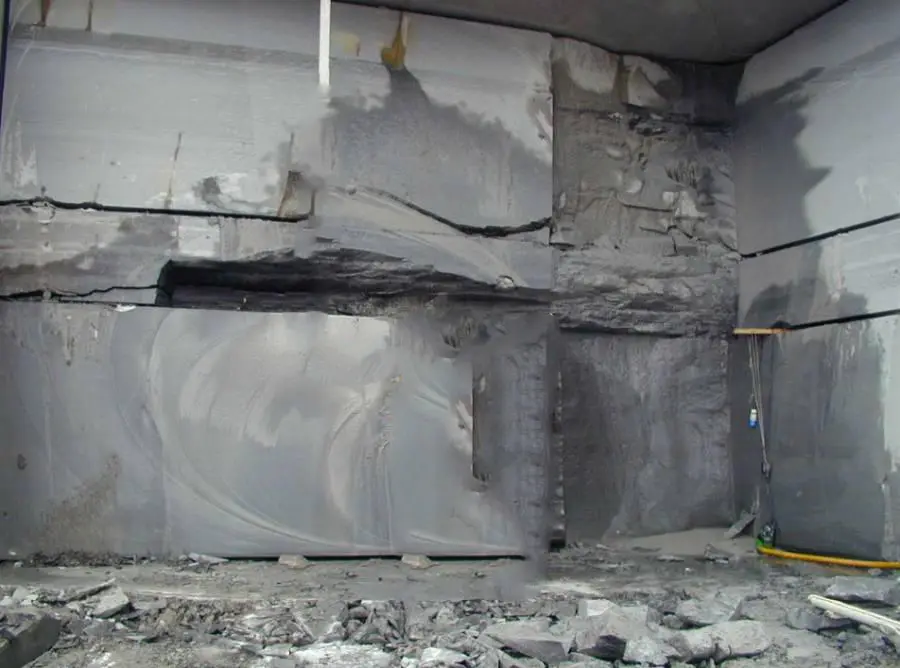
Geology of Pietra Serena
Despite its dense, fine-grained appearance, Pietra Serena is geologically a sandstone. It originates from the Macigno Formation of the Northern Apennines, a sequence of sedimentary rocks formed from sand and other mineral-rich sediments deposited in an ancient deep-marine environment.

Pietra Serena is composed primarily of sand-sized grains including quartz and feldspar, along with rock fragments and mineral cement that bind the material together. Its exceptionally fine and uniform texture gives it a compact appearance quite different from the more visibly granular sandstones commonly encountered in architectural stone.
Its characteristic blue-gray to gray coloration, subtle grain and relative visual consistency have helped make Pietra Serena an important dimensional and architectural stone in Tuscany for centuries. These geological characteristics also contribute to the restrained appearance that distinguishes it from heavily veined marbles and more visibly fossiliferous limestones.
The characteristic blue-gray color of Pietra Serena comes from its mineral composition and the extremely fine-grained material within the stone. In addition to quartz and feldspar, the sandstone contains fine clay minerals, rock fragments and other mineral components that impart a cool gray tone with a subtle blue cast. Rather than being produced by a single blue mineral, the color is the combined result of these finely dispersed constituents and the way light interacts with the stone’s dense, uniform texture. When honed, this distinctive blue-gray appearance becomes particularly evident and is one of the qualities that has made Pietra Serena so recognizable in Italian architecture.
Is Pietra Serena Sandstone or Limestone?
Pietra Serena is sometimes grouped with limestone by natural stone suppliers and within commercial stone collections, which can create confusion about its classification. Geologically, however, Pietra Serena is a sandstone, traditionally quarried from the Macigno Formation of the Northern Apennines in Tuscany.
The confusion is understandable. Pietra Serena has a dense, fine-grained and remarkably uniform appearance that bears little resemblance to the coarser, visibly granular sandstones familiar in many parts of the United States. Its long history as a cut and carved architectural stone also gives it many of the same traditional applications associated with fine European limestones.
For architectural and commercial purposes, the term Pietra Serena remains the most important identification. However, when geological classification is required, it should properly be described as an Italian sandstone.
The Macigno Formation
Pietra Serena originates from the Macigno Formation, an extensive geological formation found throughout the Northern Apennines of Tuscany. It was formed during the late Oligocene to early Miocene, when enormous quantities of sand and finer sediments were transported by underwater currents into a deep marine basin and deposited in successive layers. Over millions of years, these sediments were compacted and cemented together, creating the dense sandstone beds quarried as Pietra Serena.
The Macigno Formation contains alternating layers of sandstone, siltstone and finer sedimentary rocks, but only certain beds possess the fine grain, uniform blue-gray color and workable structure historically prized for architectural use. The quality of these selected layers helped establish Pietra Serena as one of Tuscany’s most recognizable building stones and explains why the name refers to a very particular architectural material rather than simply any gray sandstone from the region.
Architectural Applications
Pietra Serena has been used as an architectural stone for centuries, valued for its fine grain, consistent blue-gray color and ability to create clearly defined architectural forms. Its restrained appearance allows it to be used across substantial areas without overwhelming a space, while its distinctive color provides contrast against lighter surrounding materials.
Its versatility makes Pietra Serena appropriate for both traditional and contemporary architecture, including flooring, wall cladding, fireplaces, stairways, architectural surrounds, custom furniture and dimensional stonework. In modern interiors, its quiet uniformity works particularly well where designers want the character and permanence of natural stone without dramatic veining or movement.
For custom projects, Pietra Serena can also be used to create substantial architectural elements in which scale, proportion and craftsmanship become part of the design, continuing the same relationship between stone and architecture that has defined its use since the Renaissance.
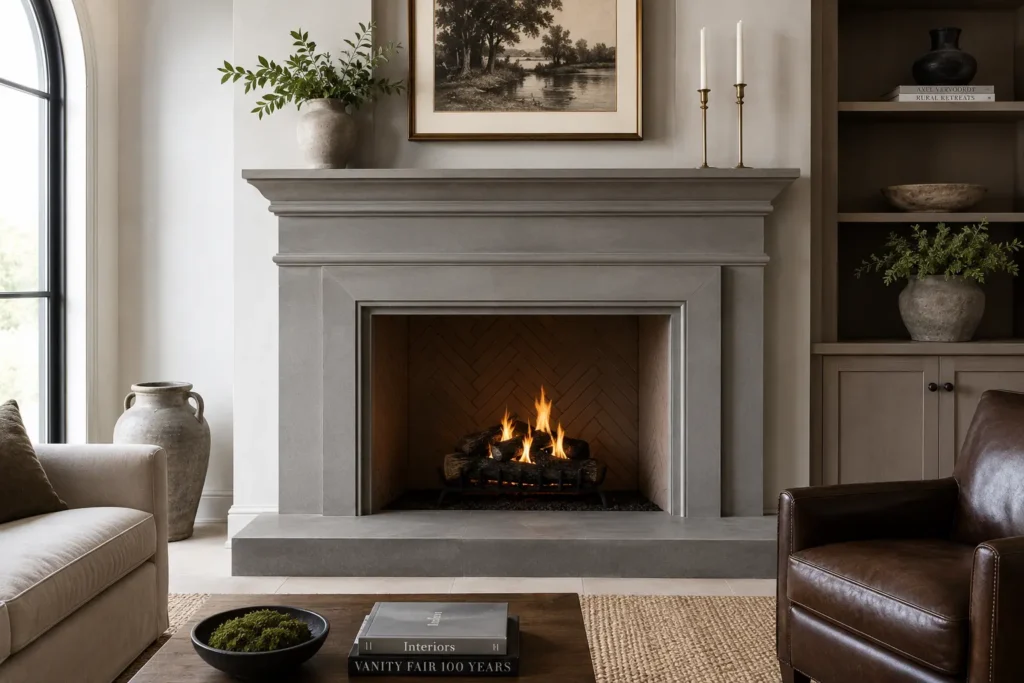
Fireplaces & Hearths
Pietra Serena is particularly well suited to fireplace surrounds and hearths, where its quiet blue-gray color creates a strong architectural presence without competing with the surrounding interior. Its fine grain and uniform appearance work beautifully in both simple contemporary designs and more traditional carved profiles, mantels and surrounds.
For substantial hearths, benches and projecting elements, Pietra Serena offers the opportunity to emphasize the natural mass and solidity of stone rather than treating it simply as a decorative surface. Paired with warm woods, plaster, metal or lighter natural stones, its cool gray tone can provide an elegant contrast while allowing the fireplace to remain a restrained architectural focal point.
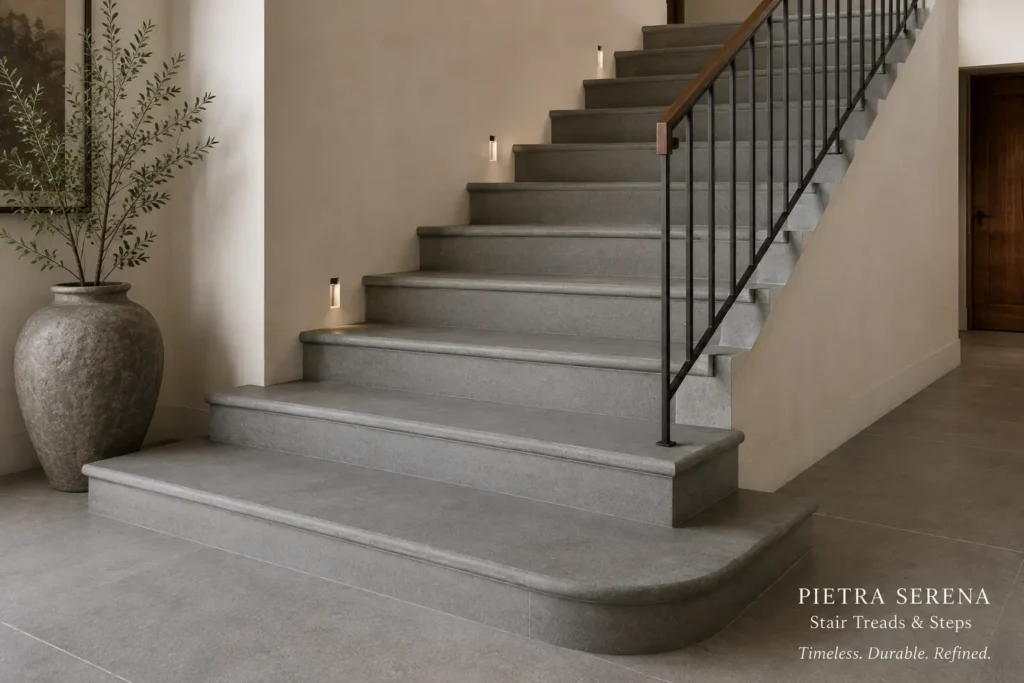
Stair Treads & Steps
Pietra Serena has a long tradition of use for stair treads, steps and landings, where its consistent color and fine grain create a clean, continuous architectural appearance. The stone works particularly well for stair designs that rely on strong geometry and simple profiles rather than decorative veining or pronounced movement.
Its understated blue-gray tone can visually define a staircase while remaining compatible with plaster, wood, metal and other natural materials. Pietra Serena can be fabricated for interior stair treads, substantial steps, landings and custom stair components, allowing the staircase to become an integral architectural feature rather than simply a transition between levels.
As with any natural stone used for walking surfaces, finish, thickness, support and installation should be selected for the specific application and anticipated traffic conditions.
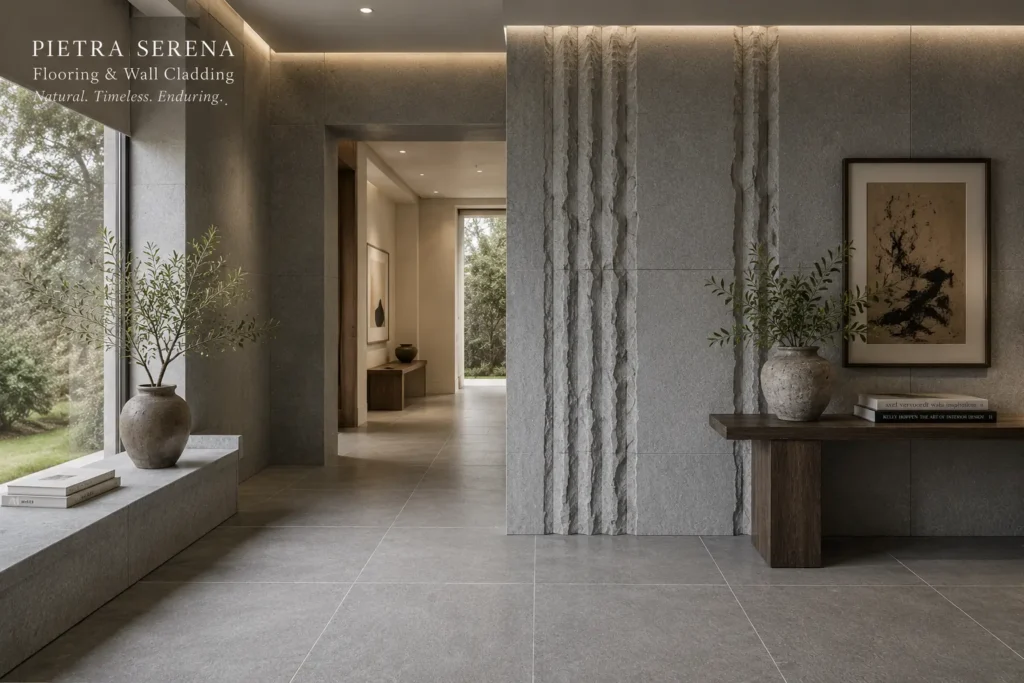
Flooring & Wall Cladding
Pietra Serena’s consistent blue-gray color and fine, understated grain make it particularly effective for flooring and wall cladding, where larger expanses of stone can create a calm and cohesive architectural surface. Rather than relying on dramatic veining or variation, the material provides visual interest through its subtle texture, natural tonal variation and quiet depth.
For flooring, Pietra Serena works especially well in entries, galleries, living spaces and other architecturally focused interiors, while wall applications can range from simple large-format cladding to fireplace walls and feature surfaces. Its neutral gray palette pairs naturally with plaster, wood, metal and other stones, allowing it to work comfortably in both contemporary and traditionally inspired interiors.
As with all natural stone flooring, the finish and installation method should be selected for the intended use, particularly where slip resistance, moisture or heavy traffic are considerations.
Custom Furniture & Architectural Elements
Pietra Serena’s restrained color and fine, uniform grain make it particularly well suited to custom furniture and architectural elements, where the shape and proportion of the finished piece can take precedence over dramatic pattern or veining. Tables, benches, shelving, consoles and other custom pieces can take on a distinctly architectural quality while retaining the subtle variation of natural stone.
The material is equally suited to thresholds, wall caps, surrounds, integrated seating and other project-specific details that connect individual elements to the larger architectural design. Its ability to move comfortably between traditional craftsmanship and clean contemporary forms is one of the qualities that has kept Pietra Serena relevant for centuries.
Pietra Serena for Custom Projects
Pietra Serena is particularly well suited to custom residential, hospitality and architectural projects where material selection extends beyond choosing a standard surface. Its consistent color, fine grain and versatility allow the same stone to be carried through flooring, fireplaces, stairways, furniture and dimensional details, creating continuity throughout a project.
The World of Stone works with architects, designers, builders and fabricators to help select material for project-specific requirements, from individual statement pieces to larger architectural stone packages. For projects requiring special dimensions, finishes or additional quantities, we can also coordinate sourcing and production directly with our suppliers in Italy.
Our goal is not simply to supply Pietra Serena, but to help determine how the material can best serve the design.
Care & Maintenance
Pietra Serena is a natural sandstone with a long history of architectural use, but its refined appearance should not be mistaken for the performance characteristics of granite, quartzite or other exceptionally hard stones. Proper specification, installation and maintenance are important, particularly in applications exposed to food, liquids, heavy traffic or weather.
For most interior applications, a high-quality penetrating sealer appropriate for natural sandstone should be considered after installation. Sealing can help reduce the absorption of water, oils and other staining agents, but it does not make the stone stain-proof or eliminate the need for routine care. Because different sealers can affect color and appearance differently, any treatment should be tested on a sample or inconspicuous area before being applied to the finished installation.
Routine cleaning should be performed with a pH-neutral cleaner formulated for natural stone and a soft cloth, mop or non-abrasive cleaning pad. Spills should be wiped up promptly, particularly oils, wine, coffee and other strongly colored liquids. Abrasive cleaners, scouring powders and harsh chemicals should be avoided.
Acidic cleaners and household products containing acids should not be used. Pietra Serena contains mineral constituents and cementing materials that can be affected by acidic substances. Vinegar, lemon-based cleaners and aggressive bathroom or masonry cleaners can alter the surface and should be kept away from the stone. For the same reason, specialty cleaning, stain removal or restoration should be performed using products and methods specifically appropriate for Pietra Serena or comparable natural sandstone.
In flooring and other high-traffic applications, Pietra Serena should also be expected to develop naturally with use. Subtle changes in surface texture, sheen and coloration can occur over time, particularly along traffic paths. This natural aging has historically been part of the character of Pietra Serena installations and can produce a beautiful patina. Where maintaining a more uniform, newly installed appearance is important, periodic professional cleaning, resealing and occasional refinishing may be appropriate.
Exterior applications require additional consideration. Climate, exposure, drainage, substrate, installation method and finish all influence long-term performance. Standing water should be avoided, and installation systems should be designed to allow appropriate drainage. Before specifying Pietra Serena for exterior paving, pool areas, freeze-thaw environments or other demanding conditions, the characteristics of the particular material and intended installation should be evaluated for the project.
For fireplaces and hearths, the stone should be installed using methods appropriate for natural stone and the particular fireplace system. Direct exposure to extreme heat, thermal cycling and combustible-clearance requirements should be evaluated by the architect, fabricator and installer rather than assuming that historical use of Pietra Serena around fireplaces makes every modern fireplace application equivalent.
The finish is also an important part of maintenance and performance. Honed, brushed or other textured surfaces can behave differently with respect to staining, wear and slip resistance. Samples should be evaluated whenever appearance or performance is critical.
Natural stone is intended to age. Pietra Serena that has been used for generations in Italian architecture demonstrates that aging does not necessarily diminish the material; subtle wear and patina can become part of its architectural character. The appropriate maintenance program therefore depends partly on the design intent—whether the goal is to preserve a more uniform appearance or allow the stone to develop naturally with use.
For significant or technically demanding installations, The World of Stone recommends that sealers, cleaners, setting materials and maintenance procedures be tested with the actual stone before installation and that the architect, fabricator, installer and appropriate product manufacturers be consulted regarding project-specific conditions.
Pietra Serena Available in Los Angeles
The World of Stone stocks Pietra Serena slabs in Los Angeles, providing architects, designers, builders and fabricators with the opportunity to view and select this classic Italian stone locally. Our current inventory includes both 2cm (¾”) slabs and unusually thick 6.5cm (2.5″) slabs, offering options for conventional surfaces as well as substantial custom and dimensional applications.
Slabs are available for viewing at our Van Nuys warehouse by appointment, where individual pieces can be selected for color, tone and natural characteristics appropriate to the project. For larger projects, special dimensions, additional quantities or specific fabrication requirements, we can also coordinate additional material directly from Italy.
The World of Stone supplies projects throughout Southern California and nationwide, working with project teams from initial material selection through coordination with fabricators and installers. Whether the requirement is a single fireplace, custom furniture element or a larger architectural stone package, we can help determine the most appropriate Pietra Serena material for the application.
Selecting Pietra Serena for Your Project
As with any natural stone, Pietra Serena should be selected with the specific application and design intent in mind. Slabs can vary subtly in tone, grain and natural markings, making individual slab selection particularly important when material will be used across multiple adjoining surfaces or fabricated into prominent architectural elements.
Consideration should also be given to finish, thickness, fabrication requirements, traffic and exposure before material is selected. A fireplace surround, floor, stair tread or custom table may each place very different demands on the stone.
The World of Stone can assist architects, designers, builders and fabricators with slab selection and project-specific material requirements. For larger projects or requirements beyond our current Los Angeles inventory, additional Pietra Serena can be sourced from Italy to coordinate with the needs of the project.