
Stoneglass: Low-Silica, Stainproof Glass Countertops

Looking for a low-silica alternative to engineered quartz that is also nonporous, stainproof and highly resistant to acids? Stoneglass is an Italian-made architectural glass surface designed for countertops, vanities, wall cladding and other demanding interior and exterior applications.
Stoneglass is not nanoglass. Although the two materials are sometimes confused because of their appearance, Stoneglass is a different, advanced glass-based material engineered to overcome many of the limitations associated with earlier generations of crystallized glass and nanoglass slabs.
What Is Stoneglass?
Stoneglass is an Italian-made architectural glass surface that combines the clean, luminous appearance of glass with many of the practical qualities associated with stone. It is produced through a controlled process of melting and crystallization, creating a dense, homogeneous material suitable for countertops, vanities, wall cladding, flooring, furniture and exterior architectural applications. The manufacturer describes the process as similar to the natural conditions involved in granite formation.
Unlike engineered quartz, Stoneglass contains no resins, solvents or glues. Its virtually nonporous surface is highly resistant to staining and abrasion, does not require sealing, and maintains its appearance under prolonged UV exposure. The material is also 100% recyclable. Independent technical testing reports water absorption of just 0.003%, along with no staining or corrosion in chemical-resistance testing.
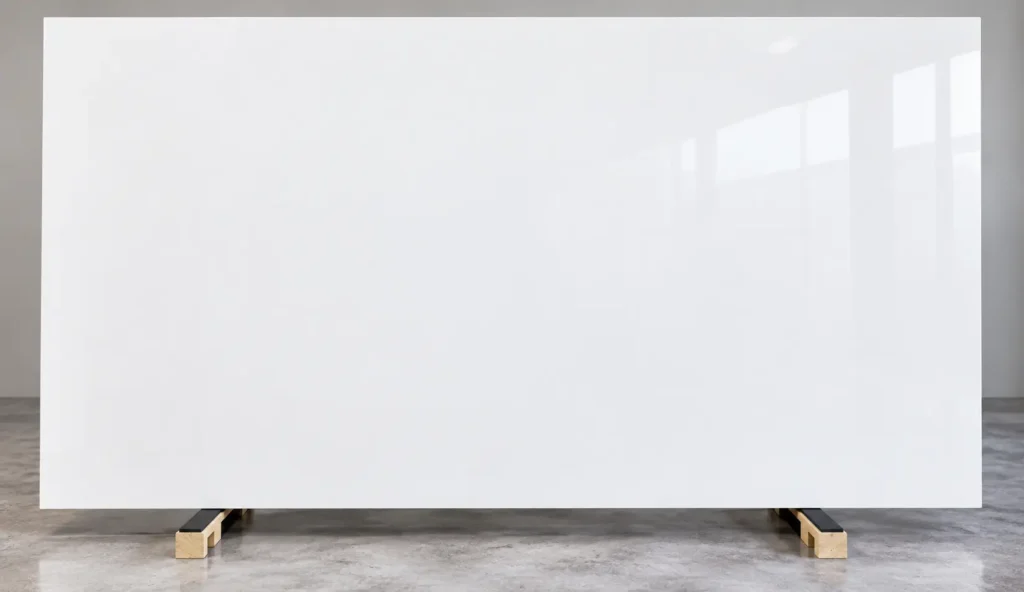
Available in polished and matte finishes, Stoneglass has a distinctive depth and interaction with light that separates it visually from conventional solid-surface materials. It can even be used in translucent and backlit applications, allowing designers to create effects that are difficult to achieve with natural stone or engineered quartz.
Most importantly, Stoneglass should not be confused with the older nanoglass or crystallized-glass products that have circulated in the countertop market. Stoneglass is a specific Italian-manufactured architectural material with its own formulation, manufacturing process, technical specifications and fabrication requirements. For designers, fabricators or homeowners who had a disappointing experience with older nanoglass products, Stoneglass should be evaluated as a different material—not assumed to perform the same way.
A Low-Silica Alternative to Engineered Quartz
As architects, designers and fabricators look for countertop materials with lower crystalline silica content, Stoneglass offers an important alternative to traditional engineered quartz. Unlike conventional quartz surfaces, Stoneglass is a glass-based architectural material manufactured in Italy without resins, solvents or glues. Its dense, virtually nonporous structure provides the clean, consistent appearance designers expect from a manufactured surface while offering a very different material composition.
Independent testing of Stoneglass has reported no detectable crystalline silica phases in the tested material. This distinction is especially relevant when slabs are cut, ground or polished during fabrication, where airborne respirable crystalline silica can be a serious occupational concern. Stoneglass therefore provides designers and project teams with another option when low-silica countertop materials are a priority.
Choosing a lower-silica surface does not mean sacrificing performance. Stoneglass has extremely low water absorption—reported at just 0.003%—and laboratory testing reports no staining or corrosion in chemical-resistance testing. It is also resistant to UV exposure and suitable for both interior and exterior applications.
For projects seeking an alternative to engineered quartz countertops, Stoneglass combines low-silica considerations with the characteristics designers still want from a premium surface: a nonporous finish, stain resistance, durability, consistent color and a refined appearance available in both polished and honed finishes.
Stoneglass Is Not Nanoglass
Stoneglass is sometimes mistaken for the nanoglass and crystallized-glass slabs that appeared in the countertop market years ago. While the materials may look superficially similar, they should not be considered the same product.
Stoneglass is manufactured in Italy using an advanced crystallization process that creates a dense, homogeneous glass-based slab with exceptional clarity and depth. It was developed as a high-performance architectural surface rather than simply another generation of inexpensive white nanoglass.
For architects, designers and fabricators who previously had disappointing experiences with nanoglass, Stoneglass deserves a fresh look.
Stoneglass vs. Traditional Nanoglass
For fabricators, one of the most important things to understand about Stoneglass is what it isn’t. Stoneglass is not traditional nanoglass. The similar clean white appearance can lead to confusion, particularly among fabricators who have worked with earlier nanoglass or crystallized-glass products and remember them as difficult, brittle or unpredictable materials to fabricate.
Stoneglass was specifically engineered to be worked using the same types of equipment commonly used to fabricate natural stone. The manufacturer’s technical manual states that Stoneglass is easily workable and can be processed using common machinery used for glass and marble fabrication. It provides detailed parameters for bridge-saw cutting, waterjet cutting, CNC machining, drilling, edge fabrication and polishing.
In practical terms, an experienced stone fabricator should approach Stoneglass much more like a granite or marble slab than the troublesome nanoglass products they may remember. It can be cut, shaped, drilled, polished and edge-finished with conventional stone-fabrication equipment. As with natural stone, proper support, tooling, feed rates and fabrication procedures matter, and inside corners require an appropriate radius rather than a sharp 90-degree cut.
That distinction is important because the reputation of traditional nanoglass can cause a fabricator to reject Stoneglass before ever working with it. Past experience with nanoglass should not be used to judge how Stoneglass will fabricate. Stoneglass has its own fabrication specifications and a comprehensive technical manual developed specifically for professional fabricators.
For a fabricator encountering Stoneglass for the first time, The World of Stone can provide the complete Stoneglass fabrication manual, recommended tooling and machining parameters before fabrication begins. We encourage fabricators to review those specifications rather than treating the material as nanoglass. Once the correct procedures are understood, Stoneglass is a straightforward material for a qualified stone fabrication shop to work with.
A Stainproof, Nonporous Countertop Surface
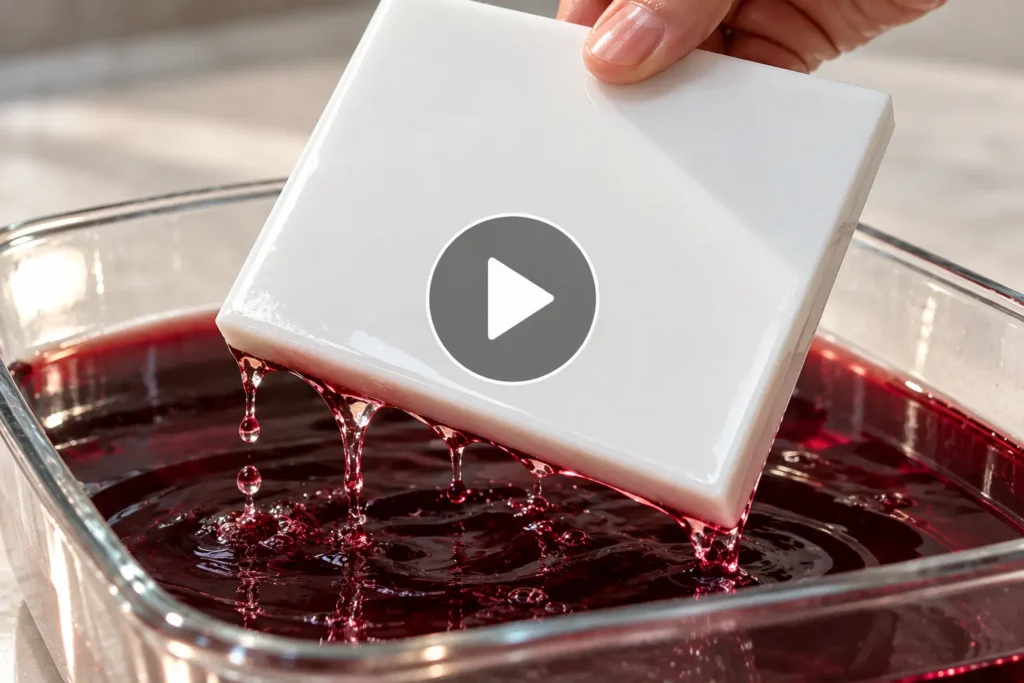
One of Stoneglass’s greatest advantages as a countertop material is its extremely low porosity. Unlike natural stone, Stoneglass does not rely on a sealer to protect its surface. The manufacturer’s technical testing reports water absorption of just 0.003%, leaving virtually no pore structure in which liquids or staining agents can penetrate.
That makes Stoneglass particularly well suited to kitchens, bathrooms, hospitality spaces and other areas where a clean white surface must stand up to everyday use. The technical manual specifically identifies Stoneglass as stain resistant because its surface has no porosity to retain solid or liquid deposits.
Stoneglass also performs exceptionally well against substances that can be problematic for other countertop materials. In standardized chemical-resistance testing, the material showed “no stain or corrosion.” It also withstood dry heat testing at 180°C (356°F) for 20 minutes with no change.
For homeowners and designers looking for a white countertop that doesn’t require sealing and is highly resistant to staining, this combination is particularly valuable. There is no periodic sealer to maintain and no porous surface waiting to absorb a spill. The result is a bright, refined countertop surface designed to retain its appearance with remarkably little maintenance.
Easy Everyday Cleaning
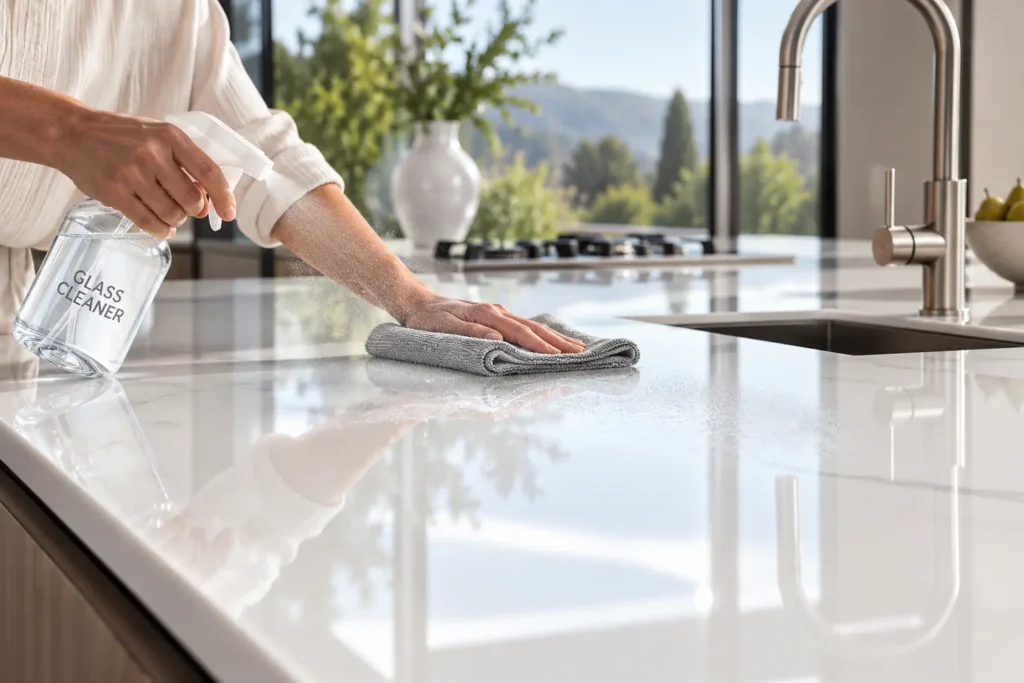
Daily maintenance is remarkably simple. Stoneglass can be cleaned with standard household glass cleaner, making it easy to remove fingerprints, grease and everyday residue without special stone cleaners or maintenance products. The manufacturer also states that Stoneglass can be cleaned and polished with household cleansers.
There is no sealer to maintain or periodically reapply, making Stoneglass an especially practical choice for busy kitchens, bathrooms and commercial environments.
Acid & Chemical Resistance
Stoneglass is particularly well suited to kitchens and other demanding environments because it offers excellent resistance to acids and common household chemicals. Unlike acid-sensitive natural stones such as marble and limestone, Stoneglass will not etch simply because an acidic substance comes into contact with the surface.
This is especially valuable on a white countertop, where everyday substances such as lemon juice, vinegar and other acidic foods can come into contact with the work surface. Stoneglass’s dense, nonporous structure prevents these liquids from being absorbed into the material, while its chemical resistance helps protect the surface itself.
Laboratory testing performed in accordance with EN 14617-10 for chemical resistance reported “no stain or corrosion.” The manufacturer’s technical documentation also states that Stoneglass is stain resistant because its surface does not have porosity capable of retaining solid or liquid deposits.
For designers and homeowners who love the crisp appearance of a white marble countertop but are concerned about etching, staining and ongoing maintenance, Stoneglass provides a very different level of practicality. Spills can be cleaned with ordinary household cleaners—including standard glass cleaner—without the specialized cleaning products typically recommended for acid-sensitive natural stone. The manufacturer’s literature specifically states that Stoneglass can be cleaned with household cleansers.
Stoneglass vs. Quartz Countertops
Engineered quartz has long been popular for its consistent appearance, low maintenance and stain resistance. Stoneglass offers many of those same practical benefits, but it is a fundamentally different type of surface. Rather than combining quartz aggregate with polymer resins, Stoneglass is an Italian-made glass-based material produced through a process of melting and crystallization and contains no resins, solvents or glues.
One of the most important differences today is crystalline silica content. For architects, designers, contractors and fabricators seeking a low-silica alternative to traditional engineered quartz, Stoneglass provides another option without giving up the qualities expected from a premium countertop surface. Independent testing of Stoneglass has reported no detectable crystalline silica phases in the tested material.
Stoneglass is also exceptionally nonporous. Technical testing reports water absorption of only 0.003%, and chemical-resistance testing resulted in no stain or corrosion. It requires no sealing and is resistant to staining, making it particularly attractive for kitchens, bathrooms and hospitality applications.
Another important distinction is the absence of resin. Stoneglass’s technical documentation reports no physical alteration or color change after prolonged UV exposure, allowing the material to be considered for exterior as well as interior applications.
Aesthetically, Stoneglass also offers something different. Its glass-based composition gives the material a distinctive depth, luminosity and interaction with light, particularly in the polished finish. Stoneglass can also be used for translucent and backlit applications—design possibilities that conventional engineered quartz generally cannot provide.
Stoneglass is therefore more than simply a substitute for quartz. For projects seeking a low-silica, nonporous, stain-resistant and resin-free countertop surface, it offers designers and fabricators a different material platform with its own architectural and aesthetic possibilities.
Stoneglass vs. Porcelain & Sintered Stone
Porcelain and sintered stone have become popular alternatives to engineered quartz, particularly for projects seeking durable, nonporous surfaces without the resin content found in traditional quartz countertops. White Stoneglass belongs in that same conversation, but it offers a distinctly different material and aesthetic.
One of the most noticeable differences is the appearance of the surface itself. Porcelain and sintered stone frequently rely on printed designs to reproduce the look of marble, stone or other materials. White Stoneglass does not attempt to imitate natural stone. Its glass-based composition creates a clean, luminous surface with genuine depth and interaction with light, particularly in the polished finish. Stoneglass can also be used in translucent and backlit applications, opening possibilities that conventional opaque surfaces cannot provide.
Performance is another reason to consider White Stoneglass. The material is extremely nonporous, with technical testing reporting water absorption of only 0.003%. Chemical-resistance testing reported no stain or corrosion, and the manufacturer’s technical documentation reports no color change after prolonged UV exposure.
Fabrication can also be an important consideration. Porcelain and sintered slabs require fabrication techniques appropriate to those materials. White Stoneglass is designed to be fabricated using common equipment used for glass and natural stone, with established procedures for waterjet cutting, blade cutting, CNC machining, drilling, edgework and polishing.
The choice ultimately comes down to what the project needs. Porcelain and sintered stone offer an enormous range of printed patterns and stone-inspired designs. White Stoneglass offers something different: a highly nonporous, resin-free architectural surface with a luminous character of its own rather than an imitation of another material.
For designers who want the performance advantages of a manufactured surface but want more visual possibilities than solid White Stoneglass, Slabology provides another option, transforming Stoneglass with custom patterns, colors and compositions.
Stoneglass Strength in Action

Stoneglass is engineered to be a strong architectural surface, but sometimes a demonstration communicates that better than specifications alone.
In this demonstration, a full-size Stoneglass slab is supported above the ground while a vehicle is driven onto the surface. The slab supports the load without breaking, providing a dramatic visual demonstration of the material’s strength.
While this demonstration is not a substitute for standardized laboratory testing or proper engineering for a specific installation, it offers an impressive look at the physical performance of Stoneglass.
Polished & Honed Stoneglass
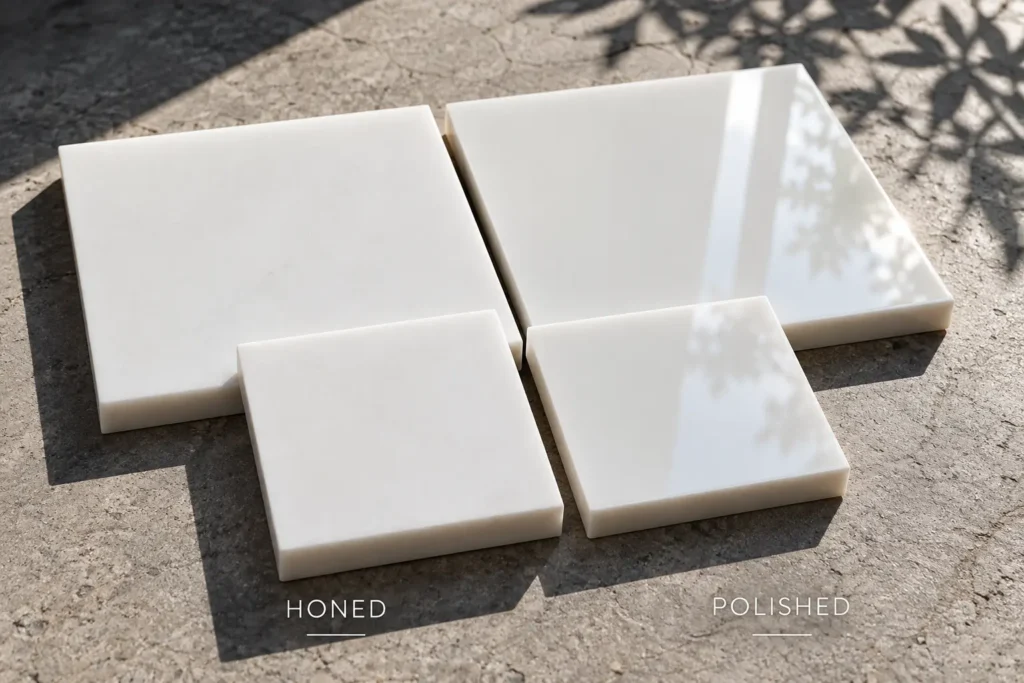
White Stoneglass is available in both polished and honed finishes, allowing the same material to take on two distinctly different appearances. The polished surface is highly reflective, emphasizing the qualities that make Stoneglass visually unique. Light interacts with the material, giving the white surface a sense of depth and luminosity. It is an excellent choice for countertops, vanities, wall panels and architectural features where a crisp, refined white surface is desired.
Honed Stoneglass offers a quieter, more understated appearance. The reduced reflection gives the surface a softer architectural character that works particularly well in contemporary and minimalist interiors. It provides an alternative for designers who want the performance of White Stoneglass but prefer a less reflective countertop surface.
Both finishes retain the fundamental characteristics of White Stoneglass: a dense, extremely low-porosity surface that requires no sealing and is highly resistant to staining. The choice between polished and honed Stoneglass is therefore primarily an aesthetic one. Polished emphasizes light, clarity and depth; honed creates a softer, more restrained appearance. Designers can select the finish that best complements surrounding cabinetry, metals, natural stone and other materials in the space.
Invisible Induction Cooking
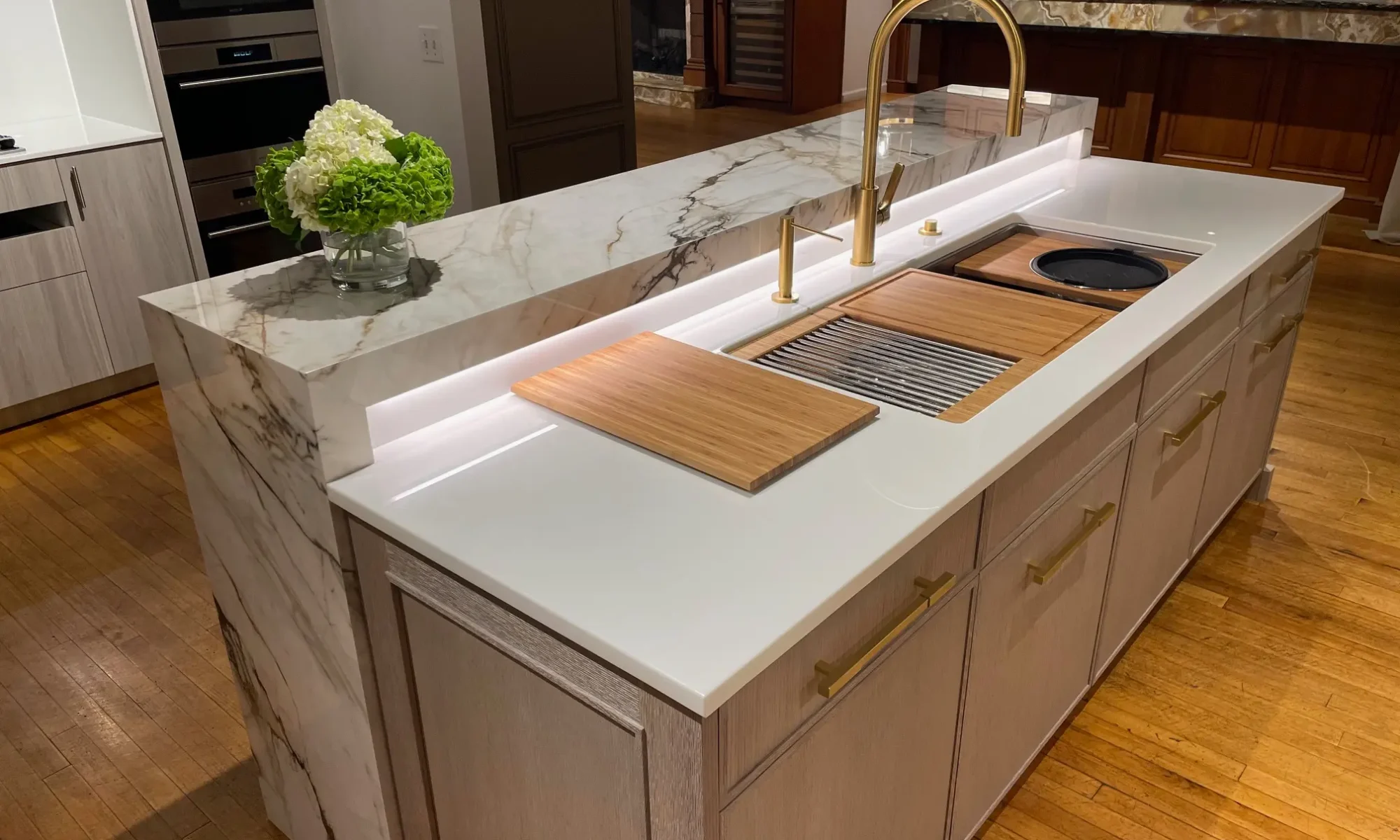
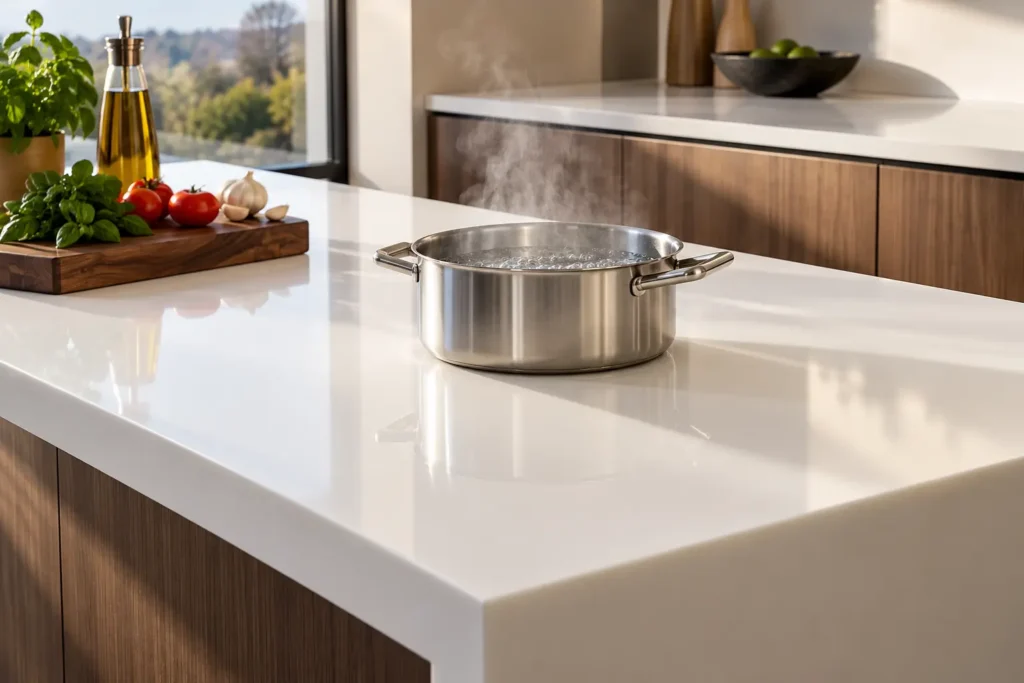
White Stoneglass can be used with invisible induction cooking systems, an increasingly popular technology that places the induction equipment beneath the countertop rather than using a conventional exposed cooktop. Companies such as InvisaCook have helped bring this approach to residential kitchen design, allowing compatible cookware to be heated directly through the countertop surface.
The result is an uninterrupted work surface that can function as a food-preparation area, serving space or gathering place, then become a cooking surface when needed. Once cooking is finished, there are no visible burners or conventional glass cooktop panels interrupting the countertop.
White Stoneglass is particularly interesting for this application because its clean, continuous appearance complements the concept of hidden technology. On a large kitchen island, the cooking system can virtually disappear into the architecture, allowing the Stoneglass surface itself to remain the visual focus.
Invisible induction requires careful coordination between the cooking system, countertop material, fabrication and installation. The World of Stone can provide Stoneglass material and technical information during the planning process so designers and fabricators can evaluate the requirements of the selected induction system.
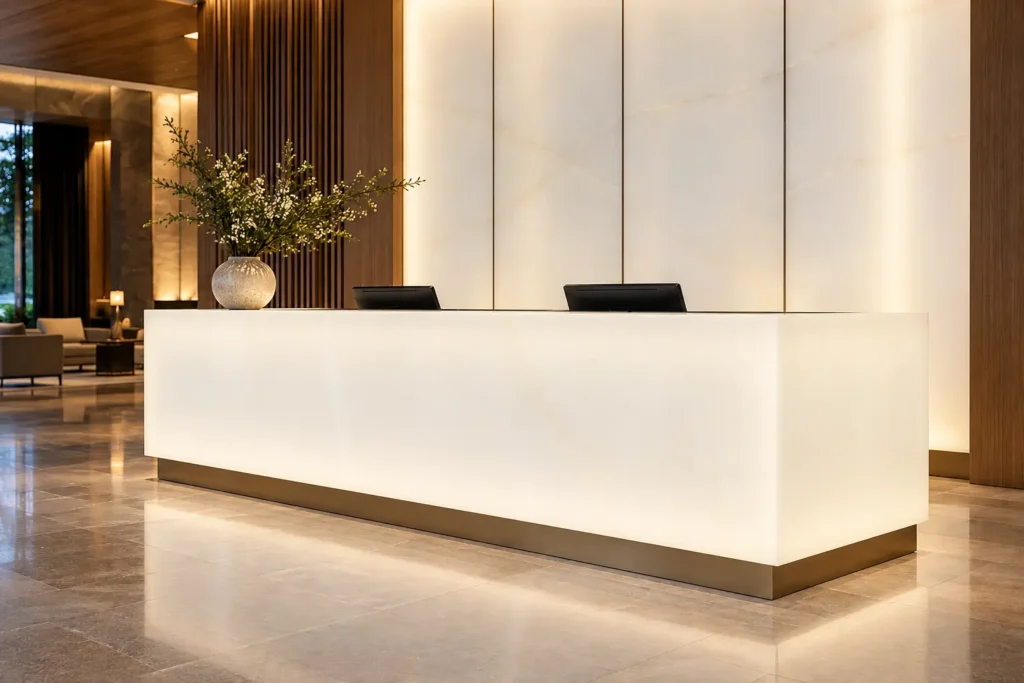
Backlit Stoneglass & Translucent Applications
One of the most distinctive characteristics of White Stoneglass is its ability to interact with light. Unlike conventional opaque countertop materials, Stoneglass can be incorporated into backlit installations, creating illuminated surfaces that become part of the architectural design.
When properly illuminated from behind, White Stoneglass takes on a luminous quality that can dramatically change the appearance of a space. Backlighting can be used for reception desks, bars, feature walls, vanities, decorative panels, furniture and other custom architectural elements. Rather than simply lighting the surface, the light becomes part of the material’s visual character.
This translucency also gives designers another way to work with Stoneglass beyond traditional countertop applications. Lighting can be concealed behind or beneath the material to create a soft glow, highlight an architectural feature or produce a more dramatic illuminated installation. The effect can range from subtle ambient lighting to a striking focal point depending on the design and lighting system.
Because the final appearance depends on the Stoneglass thickness, lighting source, distance between the lighting and the material, and supporting construction, backlit applications should be planned as a complete assembly. Mockups are recommended for significant installations so the designer can evaluate light distribution, brightness and the finished appearance before fabrication.

Interior & Exterior Applications
Stoneglass is much more than a countertop material. Its combination of extremely low porosity, UV stability and resistance to weathering allows it to be used for a wide range of interior and exterior architectural applications, from residential kitchens and bathrooms to large-scale commercial façades.
Interior applications include kitchen countertops and islands, bathroom vanities, shower walls, flooring, wall cladding, reception desks, bars, furniture, feature walls and custom architectural elements. Its clean appearance works particularly well in contemporary interiors, while its translucency creates additional opportunities for backlit surfaces and illuminated architectural features.
For exterior applications, Stoneglass can be used as building cladding, ventilated façades, exterior wall panels and other architectural surfaces exposed to sunlight and weather. Unlike resin-based materials that may be limited in exterior applications, Stoneglass is an inorganic material that remains stable when exposed to ultraviolet light.
One of the most significant examples of Stoneglass used on a large architectural scale is Tesla’s Gigafactories in Nevada and Austin, Texas. Stoneglass has been used extensively as exterior architectural cladding, including prominent entrance façade elements. The Texas installation followed its use at Tesla’s Nevada Gigafactory, providing a particularly visible example of the material being specified for demanding exterior commercial architecture.
The Tesla projects demonstrate an important distinction: Stoneglass should not be thought of simply as a white countertop surface. It is an architectural material capable of moving from a residential kitchen to the exterior façade of a major industrial building.
For architects and designers, that versatility makes it possible to carry the same material language through countertops, walls, furniture and architectural cladding while taking advantage of Stoneglass’s distinctive surface, low porosity and suitability for both interior and exterior environments.
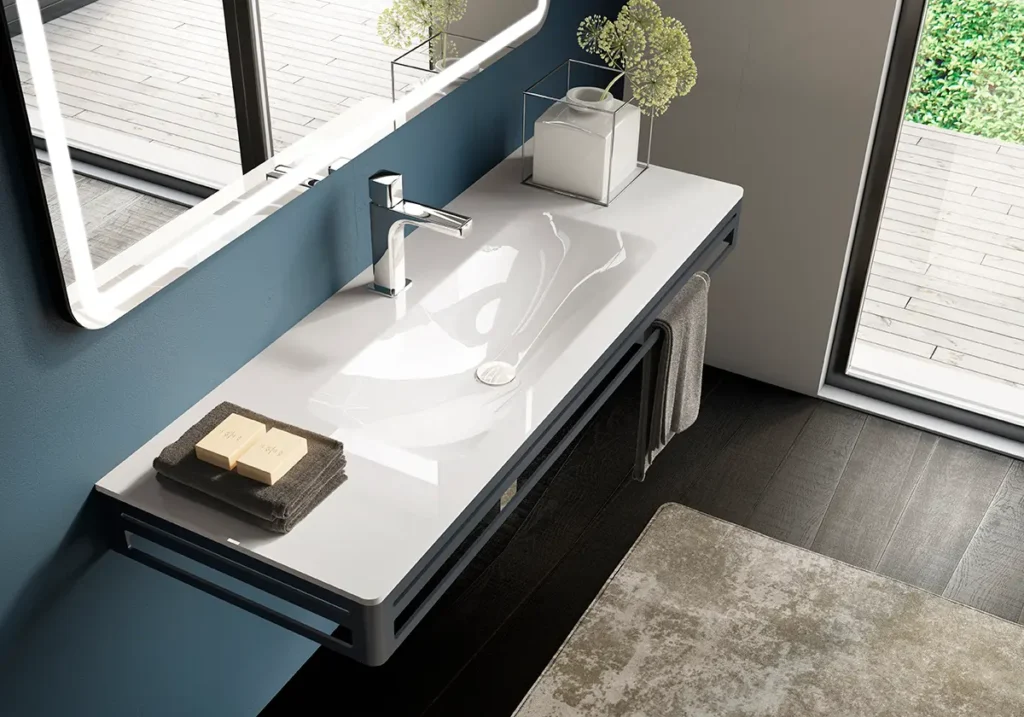
Thermoformed Stoneglass — Special Order
Stoneglass can also be produced for thermoformed architectural applications, allowing the material to be shaped into curved and three-dimensional forms that are difficult or impossible to achieve with conventional stone slabs. This opens the door to custom applications including integrated vanity basins, curved countertops, furniture components and sculptural architectural elements.
Thermoforming is accomplished by carefully heating and forming the material to create the desired shape. The result can be a remarkably clean, continuous design in which the surface itself becomes part of the architectural form rather than simply being applied to it.
This capability is associated with an earlier Stoneglass formulation and is available by special order. It should not be assumed to apply to the White Stoneglass slabs currently stocked in Los Angeles.
For projects where thermoformed Stoneglass could be appropriate, The World of Stone can work with the manufacturer to evaluate the design, dimensions, fabrication requirements and availability for the specific application.
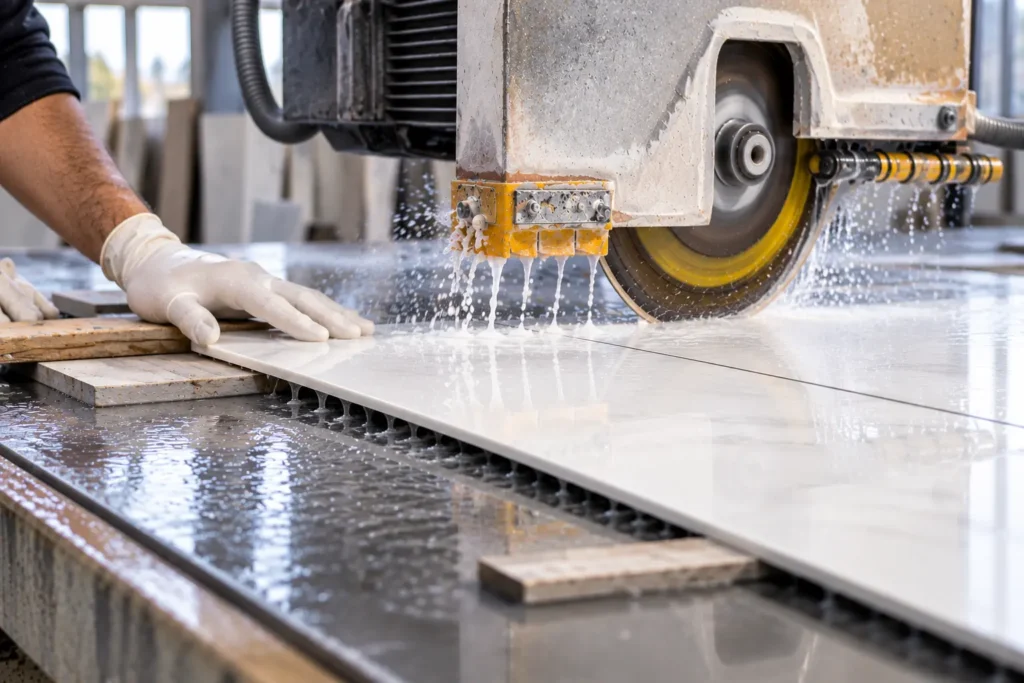
Fabricating Stoneglass
For designers specifying White Stoneglass, one of the most important conversations may happen after the material has already been selected. A fabricator may see a white crystallized-glass surface and immediately associate it with nanoglass, particularly if they have had a difficult experience fabricating older nanoglass products. Stoneglass is not traditional nanoglass, and it should not be evaluated as though it were.
White Stoneglass is designed to be fabricated using the same types of equipment routinely found in a professional stone fabrication shop. It can be cut, drilled, shaped, edge-finished and polished using conventional stoneworking equipment, including bridge saws, CNC equipment and waterjet machinery. The Stoneglass technical manual provides specific fabrication parameters for cutting, drilling, CNC machining, edgework and polishing.
For the fabricator, this means Stoneglass does not require an entirely new fabrication process simply because it is a glass-based material. As with granite, marble, quartzite or other slab materials, the fabricator needs to understand the characteristics of the material and follow the appropriate procedures. Proper tooling, feed rates, water, support and handling remain important. Details such as inside corners also need to follow Stoneglass fabrication guidelines rather than being treated exactly like every other slab material.
For designers, the distinction is equally important. If a fabricator responds to a Stoneglass specification by saying, “We don’t work with nanoglass,” that objection may be based on experience with a different material. Before changing the specification, ask whether the fabricator has actually worked with Stoneglass. The World of Stone can provide the Stoneglass fabrication manual and technical information directly to the fabricator so the shop can evaluate the material based on its actual requirements rather than assumptions associated with traditional nanoglass.
We also encourage fabricators who have not previously worked with Stoneglass to contact us before fabrication. Questions about tooling, cutting, edge details or other fabrication procedures can often be addressed before the slab reaches the saw.
A previous bad experience with nanoglass should not automatically disqualify Stoneglass from a project. Designers should feel comfortable asking their fabricator to review the Stoneglass fabrication information first, and fabricators should evaluate Stoneglass as the specific material it is. The World of Stone is available to work with both parties throughout that process.
Stoneglass Slabs Available in Los Angeles
The World of Stone maintains an extensive inventory of White Stoneglass slabs in Los Angeles, available in both polished and honed finishes. Local inventory gives designers and fabricators the opportunity to view the material in person and source Stoneglass without the lead times associated with a special-order shipment from Italy.
White Stoneglass — Honed, 10mm
Current Slab Details
Finish: Honed
Size: 119″ × 64″ × 10mm
Coverage: 52.89 sq. ft. per slab
Availability: Los Angeles / Van Nuys
White Stoneglass — Polished, 10mm
Current Slab Details
Finish: Polished
Size: 119″ × 64″ × 10mm
Coverage: 52.89 sq. ft. per slab
Availability: Los Angeles / Van Nuys
White Stoneglass — Polished, 18mm
Current Slab Details
Finish: Polished
Size: 112″ × 64″ × 18mm
Coverage: 49.78 sq. ft. per slab
Availability: Los Angeles / Van Nuys
Technical Data & Independent Silica Testing
Stoneglass is supported by detailed technical documentation covering its physical properties, chemical resistance, thermal performance, UV stability and fabrication requirements. For architects, designers and fabricators evaluating the material, these specifications provide measurable performance data rather than relying solely on appearance or marketing claims.
White Stoneglass is an extremely dense, low-porosity material. Manufacturer testing reports water absorption of just 0.003%, helping explain its resistance to staining and its ability to perform without a penetrating sealer. Testing also reports no stain or corrosion following chemical-resistance testing, as well as no visible change following prolonged UV exposure. These characteristics allow Stoneglass to be considered for both interior and exterior architectural applications.
Of particular importance today is crystalline silica content. Independent laboratory analysis of White Stoneglass found no detectable crystalline silica phases in the tested material. This distinction is increasingly relevant as architects, designers, contractors and fabricators look for alternatives to conventional engineered quartz and other high-crystalline-silica countertop materials.
It is important to describe the result accurately. “No detectable crystalline silica” does not mean that Stoneglass contains no silicon or that normal fabrication safety procedures can be ignored. Stoneglass is a glass-based material, and fabrication should always be performed using appropriate equipment, wet-processing methods, dust controls and workplace safety practices.
The combination of independently tested crystalline-silica results and documented performance makes White Stoneglass particularly relevant for projects where material composition, fabrication exposure and long-term performance are part of the specification process.
Technical data, fabrication instructions and independent silica-testing documentation are available from The World of Stone for architects, designers, contractors and fabricators evaluating Stoneglass for a project.
Frequently Asked Questions
Is Stoneglass the same as nanoglass?
No. Stoneglass should not be confused with traditional nanoglass products. It is an Italian-manufactured architectural glass surface with its own composition, manufacturing process, technical specifications and fabrication procedures. Fabricators who have had difficulties with older nanoglass products should evaluate Stoneglass based on its own fabrication guidelines rather than assuming the materials behave the same way.
Is Stoneglass easy to fabricate?
Yes. Stoneglass is designed to be fabricated using equipment commonly found in professional stone fabrication shops. It can be cut, drilled, shaped, edge-finished and polished using conventional stoneworking equipment. Detailed fabrication instructions are available for fabricators who have not previously worked with Stoneglass.
Does Stoneglass contain crystalline silica?
Independent laboratory analysis of White Stoneglass found no detectable crystalline silica phases in the material tested. This is different from saying that the material contains no silicon. Appropriate wet fabrication, dust control and normal workplace safety procedures should still be followed.
Is Stoneglass a good alternative to engineered quartz?
For many applications, yes. White Stoneglass provides a consistent manufactured surface without the resins used in conventional engineered quartz and offers extremely low porosity, stain resistance and very low detectable crystalline silica. It is particularly worth considering for projects seeking an alternative to traditional quartz countertops.
Does Stoneglass stain?
White Stoneglass is extremely nonporous, with manufacturer testing reporting water absorption of only 0.003%. Its lack of surface porosity makes it highly resistant to staining and eliminates the need for a penetrating sealer.
Will lemon juice, vinegar or other acids etch Stoneglass?
White Stoneglass offers excellent chemical resistance and is not subject to the acid etching associated with marble and other calcium-based natural stones. This makes it particularly attractive for kitchens where acidic foods and liquids are routinely used.
Does Stoneglass need to be sealed?
No. Stoneglass does not require the periodic application of a penetrating stone sealer. Its extremely low porosity is an inherent characteristic of the material.
How do you clean Stoneglass?
Routine cleaning is simple. Stoneglass can be cleaned with common household cleaners, including glass cleaner, making it particularly easy to maintain in kitchens and bathrooms.
Can Stoneglass be used outdoors?
Yes. Stoneglass can be used for both interior and exterior architectural applications. Its UV stability and weather-resistant characteristics have allowed it to be used for exterior building cladding as well as countertops, walls and other architectural surfaces.
Can Stoneglass be backlit?
Yes. White Stoneglass interacts with light and can be incorporated into backlit architectural applications. It can be used for illuminated bars, reception desks, feature walls, vanities, furniture and other custom elements. Mockups are recommended when lighting is an important part of the finished appearance.
Can Stoneglass be used with invisible induction cooking?
Stoneglass can be considered for through-surface induction cooking applications. Because these systems depend on the countertop material, thickness, induction equipment and installation details, the complete assembly should be coordinated before fabrication.
Is Stoneglass available in polished and honed finishes?
Yes. White Stoneglass is available in both polished and honed finishes. Polished Stoneglass has a brighter, more reflective appearance, while honed Stoneglass provides a softer, more understated surface.
Is Stoneglass available in Los Angeles?
Yes. The World of Stone stocks White Stoneglass in Van Nuys, Los Angeles, including polished and honed slabs in multiple thicknesses. Slabs can be viewed locally by appointment, and Stoneglass can be supplied for projects throughout the United States.
Can I see a Stoneglass sample before specifying it?
Yes. Samples are available for architects, interior designers, fabricators and qualified projects. For larger projects, viewing full slabs at The World of Stone’s Van Nuys warehouse is recommended because it provides a much better understanding of the material’s finish, depth and interaction with light.