
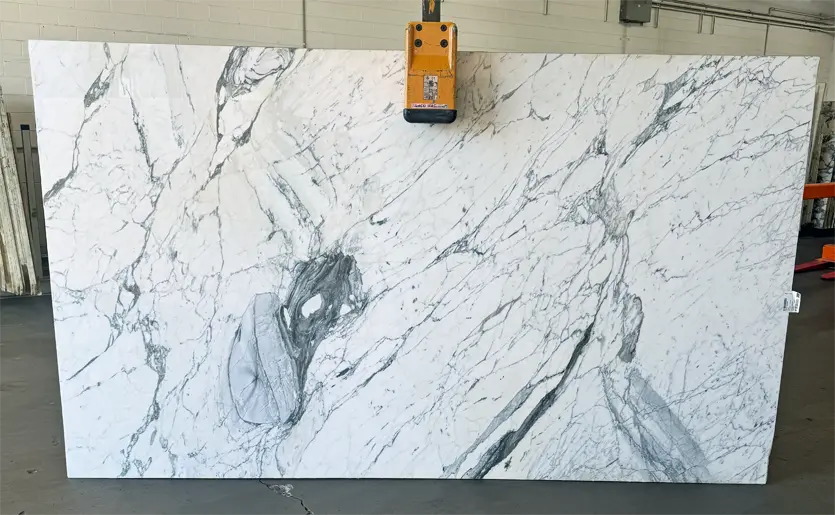
About Arabescato Corchia Marble
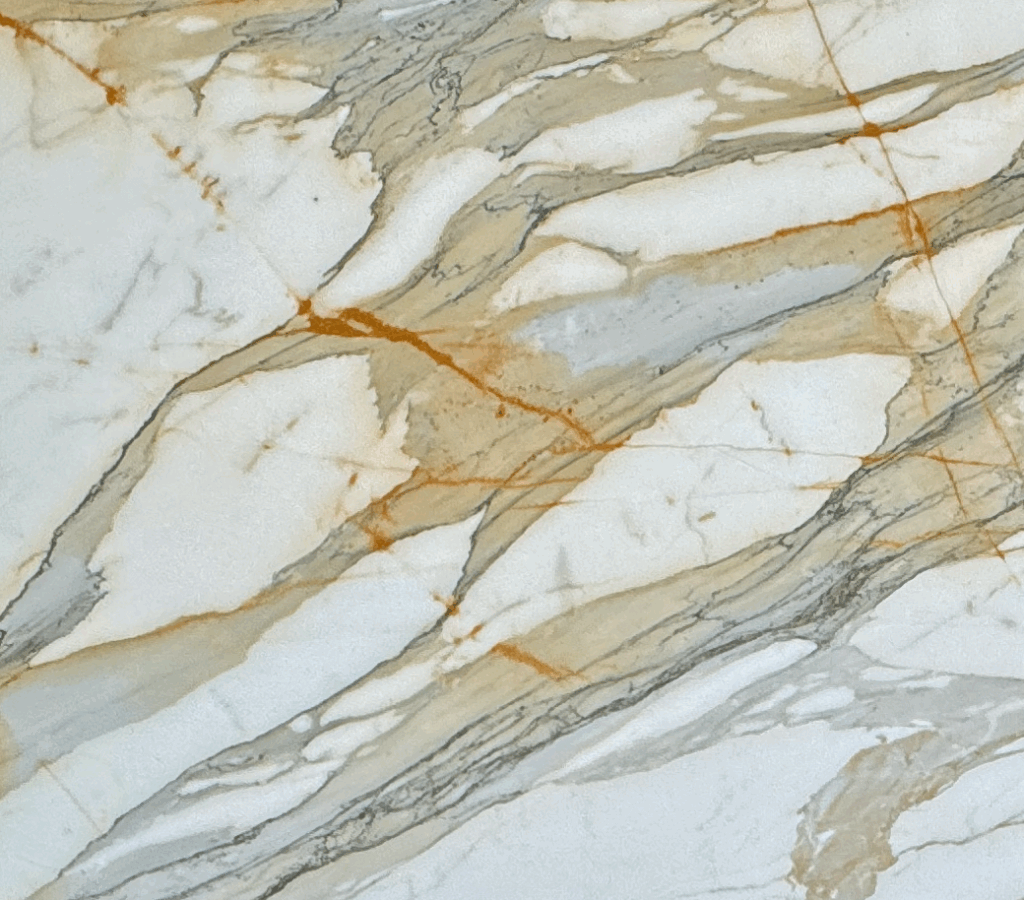
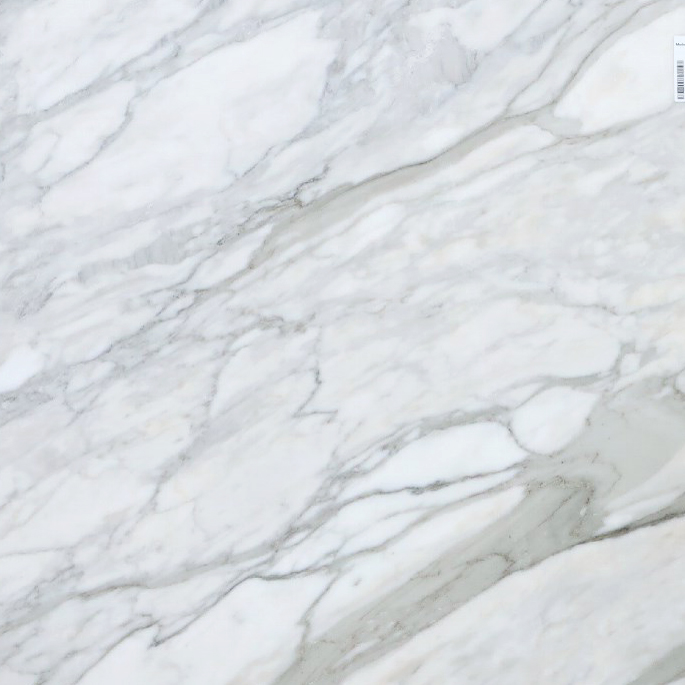
Arabescato Corchia is a distinctive Italian marble quarried in the Apuan Alps of Tuscany, within the historic Carrara marble region. Known for its dramatic movement, the stone features a distinct creamy background interwoven with areas of stark white, creating greater depth and warmth than many traditional white Italian marbles. Expressive gray veining moves throughout the surface, ranging from fine lines to broad, dramatic formations.
Each slab is naturally unique. The interplay of creamy and bright white areas, combined with gray and occasionally darker veining, gives Arabescato Corchia a layered, highly individual character. This natural variation makes slab selection especially important, particularly for projects requiring multiple slabs, bookmatching, or carefully coordinated vein movement.
Arabescato Corchia is particularly well suited to high-end residential and architectural applications where the stone is intended to become a prominent design element. Kitchen islands, countertops, bathrooms, fireplaces, feature walls and custom furnishings can all take advantage of its bold pattern, warm undertones and unmistakably Italian character.
Current Arabescato Corchia Slabs
We currently have Arabescato Corchia marble slabs available in Los Angeles in 2cm thickness, with slabs measuring approximately 120″ x 70″ and 120″ x 64″. The 120-inch length is particularly useful for large kitchen islands, long countertops, vanities and other applications where designers want to minimize seams and preserve the natural movement of the stone across a larger uninterrupted surface.
The generous slab dimensions also provide greater flexibility when planning waterfall edges, full-height backsplashes and other adjoining pieces where vein placement and continuity are important. Because Arabescato Corchia varies considerably from slab to slab, we encourage designers, architects and clients to view the material in person and select the slabs that best suit their project. Contact us for current availability and to schedule a slab viewing at our Van Nuys warehouse.
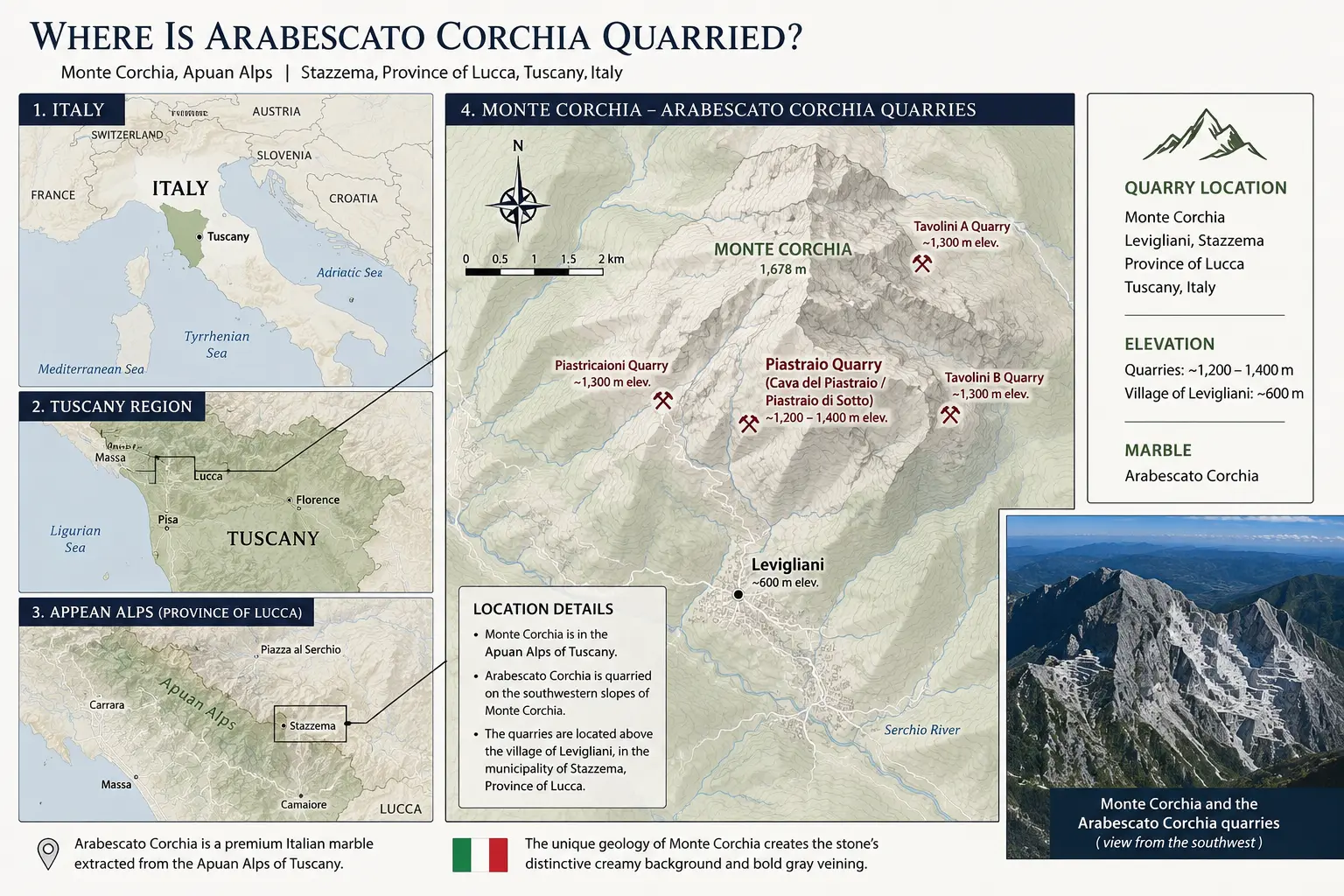
Where Is Arabescato Corchia Quarried?
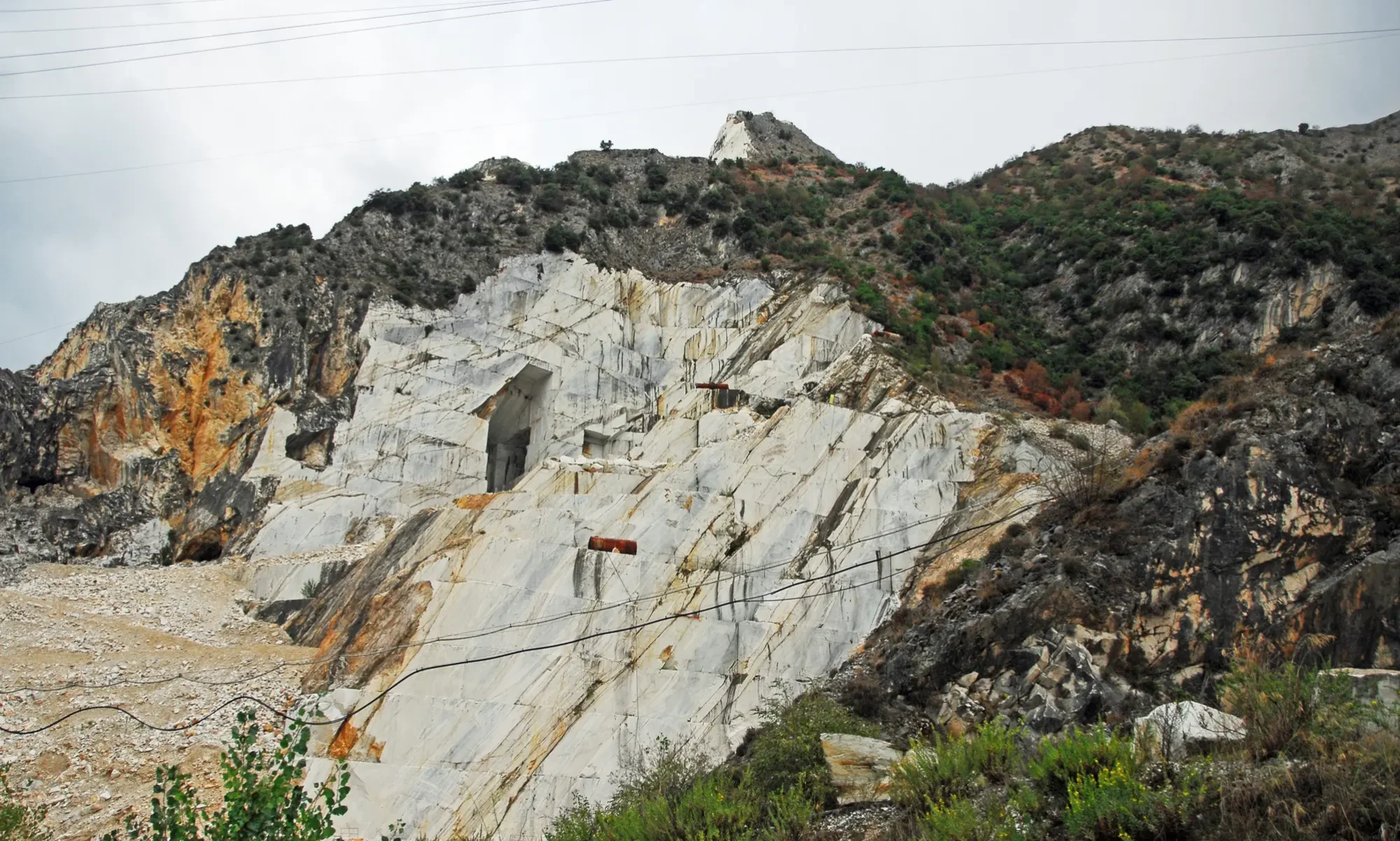
Arabescato Corchia is quarried in the Apuan Alps of northern Tuscany, Italy, Arabescato Corchia is quarried from Monte Corchia in the Apuan Alps of Tuscany, above the village of Levigliani in the municipality of Stazzema, northwest of Lucca. This mountainous area has supplied many of the world’s most recognized white marbles for centuries and remains an important source of dimensional stone today. The geology of the Apuan Alps produces considerable variation even within individual marble varieties. In Arabescato Corchia, this is expressed through the combination of creamy and stark white areas interwoven with complex gray veining and darker mineral movement. The result is a stone with considerably more visual depth and variation than a uniformly white marble.
Because the appearance can change significantly from block to block, the quarry block and resulting slab selection are especially important with Arabescato Corchia. For larger or highly coordinated projects, selecting material from the same block or production lot can help maintain continuity of color and movement throughout the installation.
Geological Characteristics of Arabescato Corchia
Arabescato Corchia is a metamorphic stone composed primarily of calcite, formed from ancient calcium-carbonate-rich marine sediments that were subjected to intense heat and pressure during the geological development of the Apuan Alps. This metamorphic process recrystallized the original limestone, producing the dense crystalline structure characteristic of marble.
What distinguishes Arabescato Corchia visually is the complexity created by mineral variation and geological movement within the stone. Its creamy background is interwoven with areas of stark white, while gray to charcoal veining moves through the surface in irregular, often sweeping formations. Rather than displaying a simple linear vein pattern, Arabescato Corchia can exhibit fractured and brecciated-looking areas that give individual slabs considerable depth and movement.
Because these characteristics are the result of natural geological processes, considerable variation should be expected from slab to slab and block to block. Changes in the balance of cream and white, the concentration of gray veining and the scale of the movement are part of the material’s natural character and make individual slab selection particularly important for architectural projects.
Why Choose Arabescato Corchia Marble?
Arabescato Corchia is chosen for projects where the natural stone is intended to be a prominent part of the design rather than a neutral background. Its combination of creamy tones, areas of stark white and expressive gray veining gives the marble exceptional depth and character while retaining the elegance associated with the classic white marbles of Tuscany.
One of its most distinctive qualities is its variation and movement. Broad sweeping veins, finer gray lines and areas of concentrated mineral activity can all occur within a single slab. This makes Arabescato Corchia particularly effective on large surfaces such as kitchen islands, feature walls, fireplaces and shower walls, where the full composition of the stone can be appreciated.
Arabescato Corchia also offers tremendous possibilities for bookmatching and vein matching. Carefully selected sequential slabs can create dramatic mirrored patterns or allow veining to flow continuously across adjoining surfaces, turning the natural pattern of the marble into an architectural element of the project.
For designers looking for an Italian white marble with more warmth and complexity than a uniformly white stone, Arabescato Corchia offers a distinctive balance. The creamy background interwoven with stark white softens the overall appearance, while its bold gray movement provides contrast and visual impact.
As with any highly figured natural stone, slab selection is important. Color, vein concentration and movement vary from slab to slab, making Arabescato Corchia especially well suited to projects where the material can be selected and laid out specifically for the finished installation.
Arabescato Corchia Slabs Available in Los Angeles
The World of Stone offers Arabescato Corchia marble slabs in Los Angeles for high-end residential, hospitality and architectural projects. Our material is available to view by appointment at our Van Nuys warehouse, allowing designers, architects, fabricators and homeowners to see the actual slabs and evaluate their color, veining and movement before making a selection.
Because Arabescato Corchia is a highly variable natural stone, individual slabs can differ considerably in the balance of creamy and stark white areas, gray veining and overall movement. Whenever possible, we recommend viewing and selecting slabs in person, particularly for projects requiring multiple pieces, bookmatching or coordinated vein movement.
Inventory changes as slabs are selected for projects, and additional material can be sourced from Italy when larger quantities or specific characteristics are required. Please contact The World of Stone for current Arabescato Corchia availability, slab dimensions and to schedule an appointment to view the material in Los Angeles.
Selecting Slabs for Your Project
Slab selection is especially important with Arabescato Corchia because its color, veining and movement can vary considerably from one slab to another. Rather than selecting this marble from a small sample, we recommend viewing the full slabs whenever possible. A sample can accurately represent the stone’s color and finish, but it cannot show the scale or composition of the veining across an entire slab.
For projects requiring multiple slabs, the material should be considered as a group. Look at how the creamy and stark white areas relate from slab to slab, as well as the direction and concentration of the gray veining. Sequential slabs from the same block are particularly valuable when the design calls for bookmatching, vein matching or continuous movement across adjoining surfaces.
The finished fabrication should also be considered during selection. A dramatic vein that works beautifully across a large kitchen island may need to be positioned differently for a fireplace, vanity or wall installation. Waterfall edges, backsplashes and other adjoining pieces can often be planned so that the natural movement continues from one surface to the next.
Whenever possible, involve the fabricator early in the selection process. Reviewing slab dimensions, finished sizes, seams and vein direction before fabrication helps ensure that the most interesting areas of the stone are used where they will have the greatest visual impact.
Architectural Applications
Arabescato Corchia is particularly well suited to architectural applications where the natural stone is intended to become an important part of the overall design. Its combination of creamy and stark white areas, dramatic gray veining and large-scale movement allows it to function as both a finish material and a strong visual element within a space.
Because every slab has its own composition, Arabescato Corchia offers designers considerable flexibility in how the material is used. Large uninterrupted surfaces can showcase the full movement of a slab, while carefully planned cuts can carry individual veins through adjoining pieces. Sequential slabs can also be bookmatched or vein matched to create larger compositions.
The marble works especially well for kitchen countertops and islands, bathrooms and shower walls, fireplace surrounds, feature walls, and custom furniture and architectural elements. For projects using several slabs, careful selection and layout before fabrication can help maintain continuity of color and movement throughout the installation.
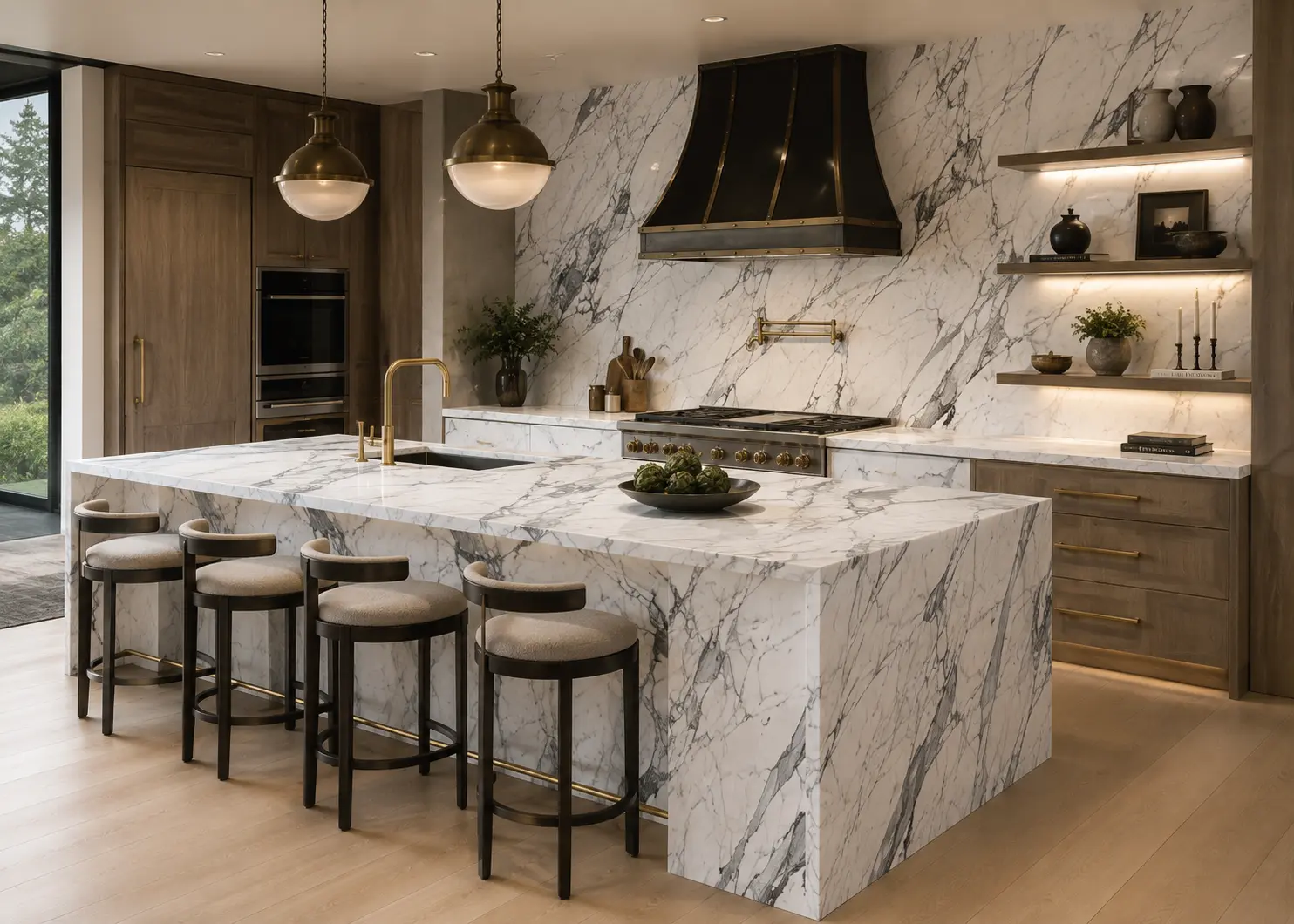
Kitchen Countertops & Islands
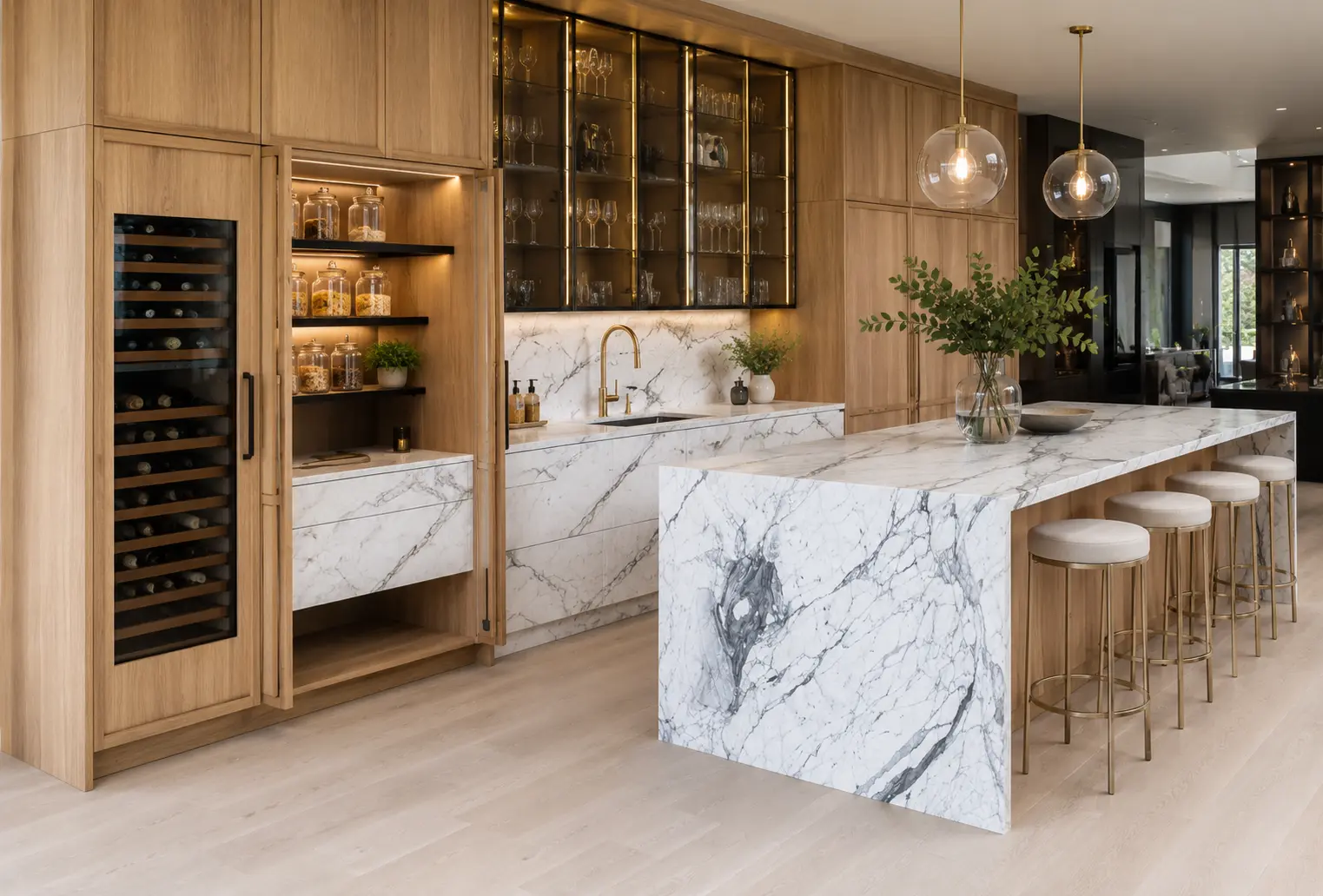
Arabescato Corchia can create a dramatic focal point in a kitchen, particularly when used for large islands, countertops and waterfall edges. The scale of the slabs allows the marble’s creamy and stark white background, sweeping gray veining and natural movement to become an important part of the overall kitchen design. Careful slab selection and layout can also allow prominent veins to continue across adjoining surfaces and waterfall panels.
It is important to remember that Arabescato Corchia is a natural marble. Like all calcite-based marbles, it requires more care in a kitchen than harder, less acid-sensitive materials. Lemon juice, vinegar, wine and other acidic foods can etch the surface, while heavy food preparation can eventually contribute to scratching and changes in the finish. Sealing can help reduce staining, but it does not prevent etching.
For kitchens where Arabescato Corchia is selected for its beauty, we recommend using cutting boards, trivets and appropriate stone-care products and cleaning spills promptly. In particularly heavy food-preparation areas, the homeowner should understand and be comfortable with the additional care marble requires and the natural patina that may develop with use.
When properly selected and maintained, Arabescato Corchia can provide a kitchen with something manufactured surfaces cannot duplicate: the depth, variation and individual character of natural Italian marble.
Bathrooms & Shower Walls
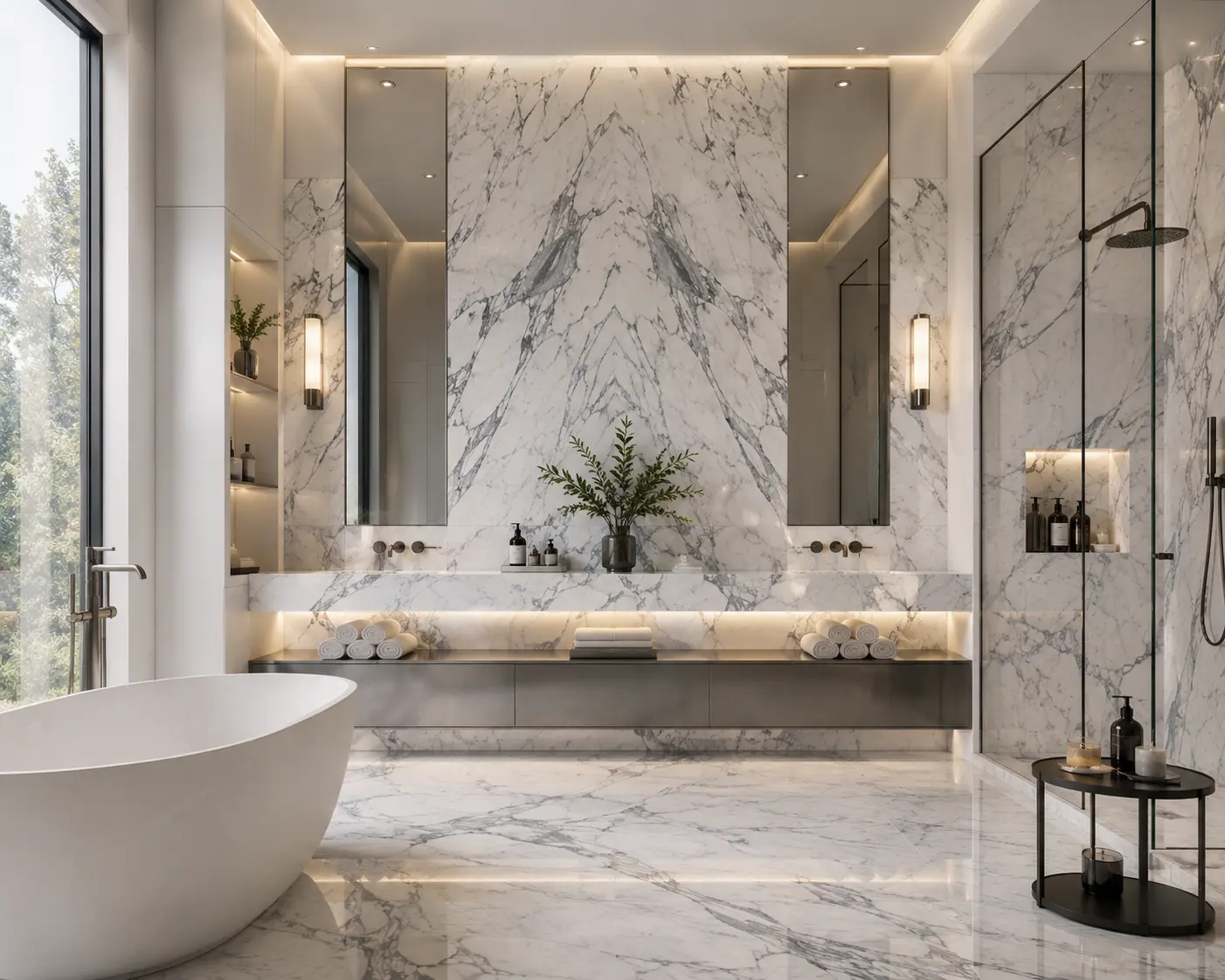
Arabescato Corchia is particularly well suited to bathrooms, where its creamy and stark white background and expressive gray veining can create a sophisticated, architectural appearance. Large-format pieces can be used for vanity tops, tub surrounds and shower walls, while carefully selected sequential slabs can be vein matched or bookmatched to create dramatic feature surfaces.
As a natural marble, Arabescato Corchia does require additional care in areas where water is constantly present. Proper installation, waterproofing and sealing are important, but routine maintenance after installation can also make a significant difference. In showers, using a squeegee after each use helps remove standing water, soap residue and minerals before they have an opportunity to build up on the stone.
Good ventilation is equally important. An appropriately sized exhaust fan helps remove moisture from the bathroom, and a fan equipped with a timer allows it to continue operating after the shower is finished. This helps the shower and surrounding surfaces dry more quickly rather than remaining damp for extended periods.
With proper installation and sensible routine care, Arabescato Corchia can be an excellent choice for bathrooms and shower walls, allowing the natural movement of Italian marble to become a prominent part of the space.
Fireplace Surrounds
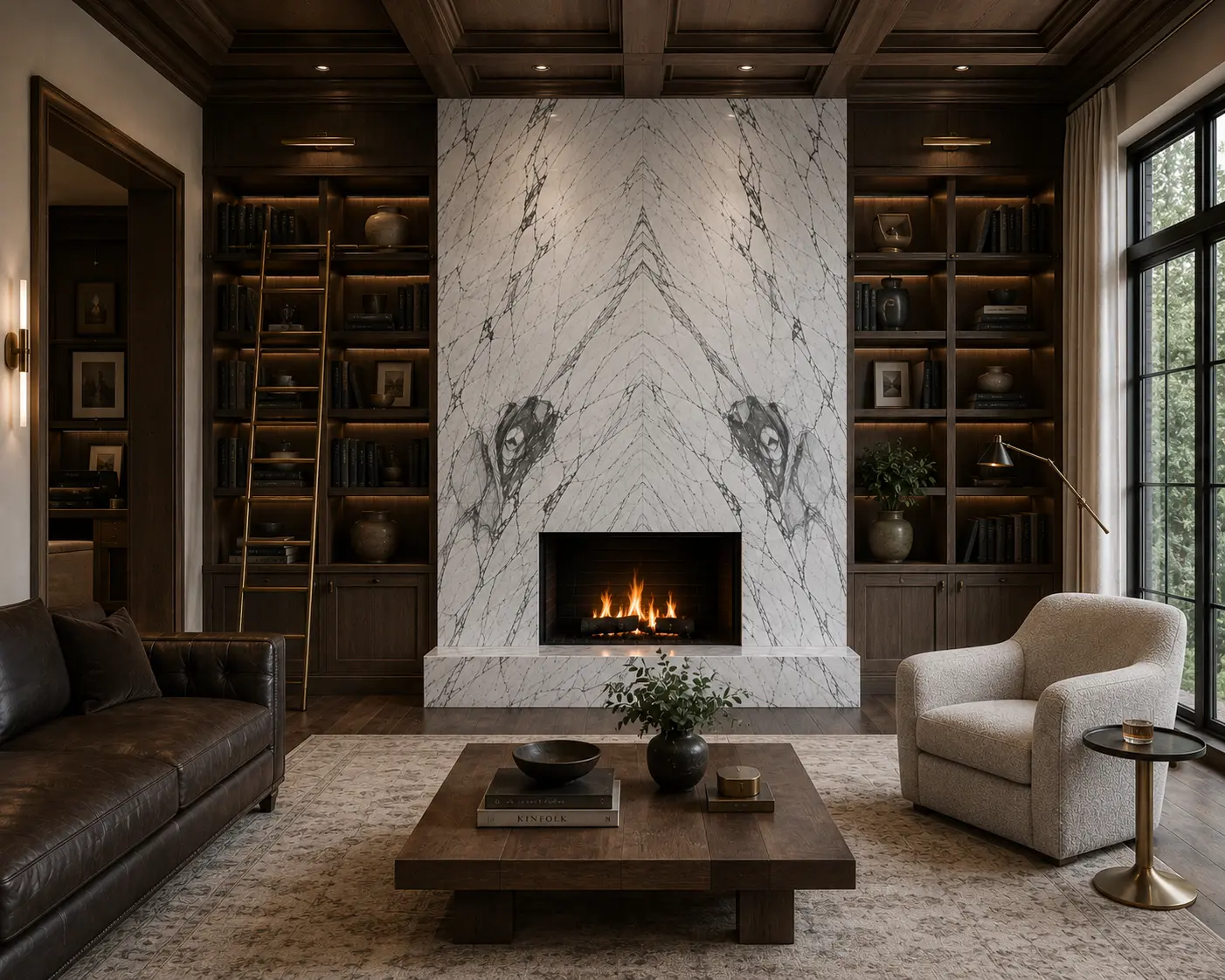
Arabescato Corchia is an excellent choice for fireplace surrounds and facades, where its dramatic veining and combination of creamy and stark white areas can create a strong architectural focal point. Large pieces allow the natural movement of the marble to remain uninterrupted, while sequential slabs can be vein matched or bookmatched across the fireplace for a more dramatic composition.
Arabescato Corchia should be used on the fireplace facade and surrounding architectural elements, not inside the firebox or anywhere the stone will be in direct contact with flame. For natural-stone firebox applications, soapstone is the appropriate choice because of its exceptional ability to withstand and retain heat. Other natural stones, including marble, should be kept outside the firebox and away from direct flame exposure.
When designing a fireplace with Arabescato Corchia, slab layout should be planned before fabrication. The location and direction of prominent veins can be coordinated around the opening, across the hearth and onto adjoining panels, allowing the natural pattern of the marble to become part of the fireplace design.
Feature Walls & Bookmatched Installations
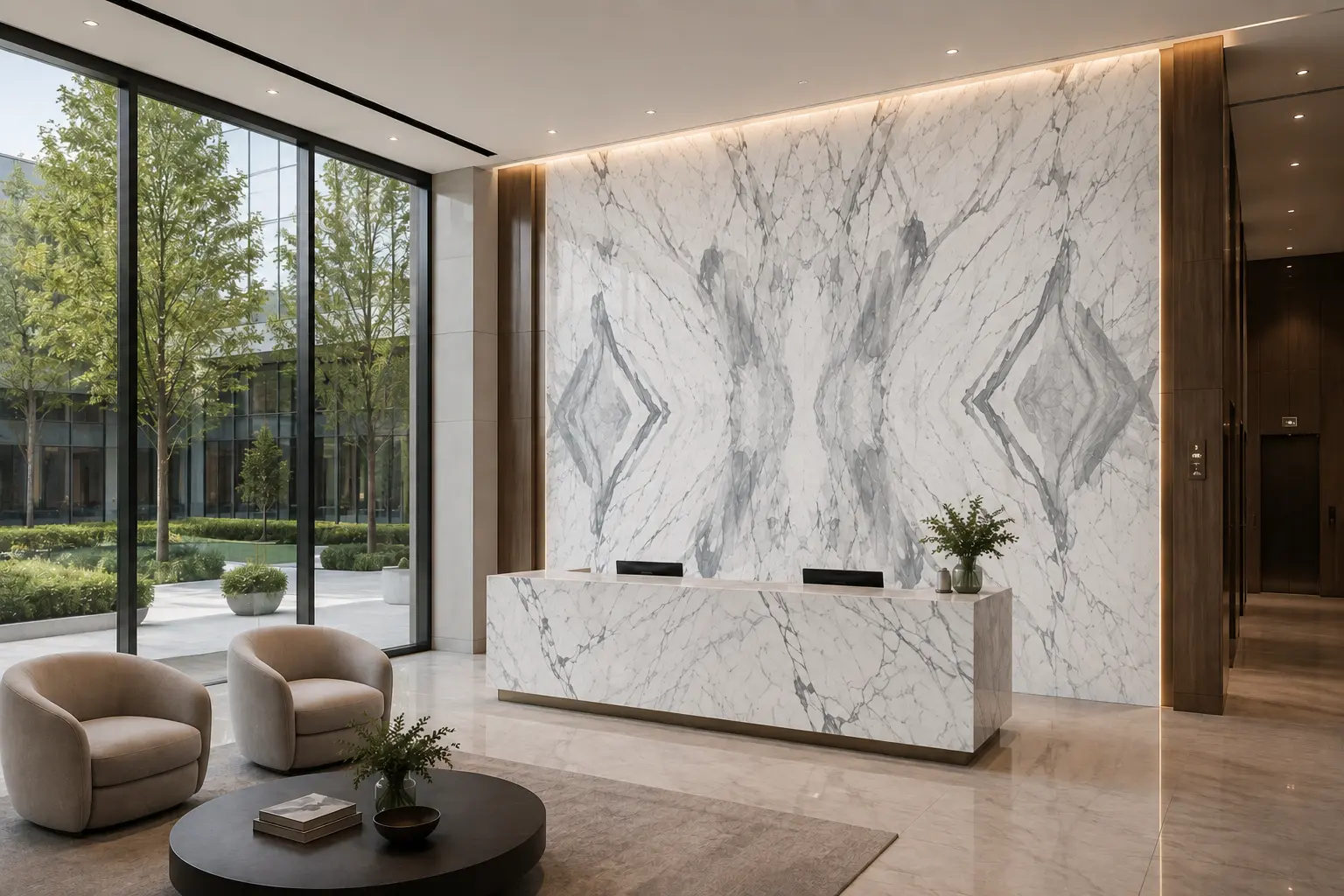
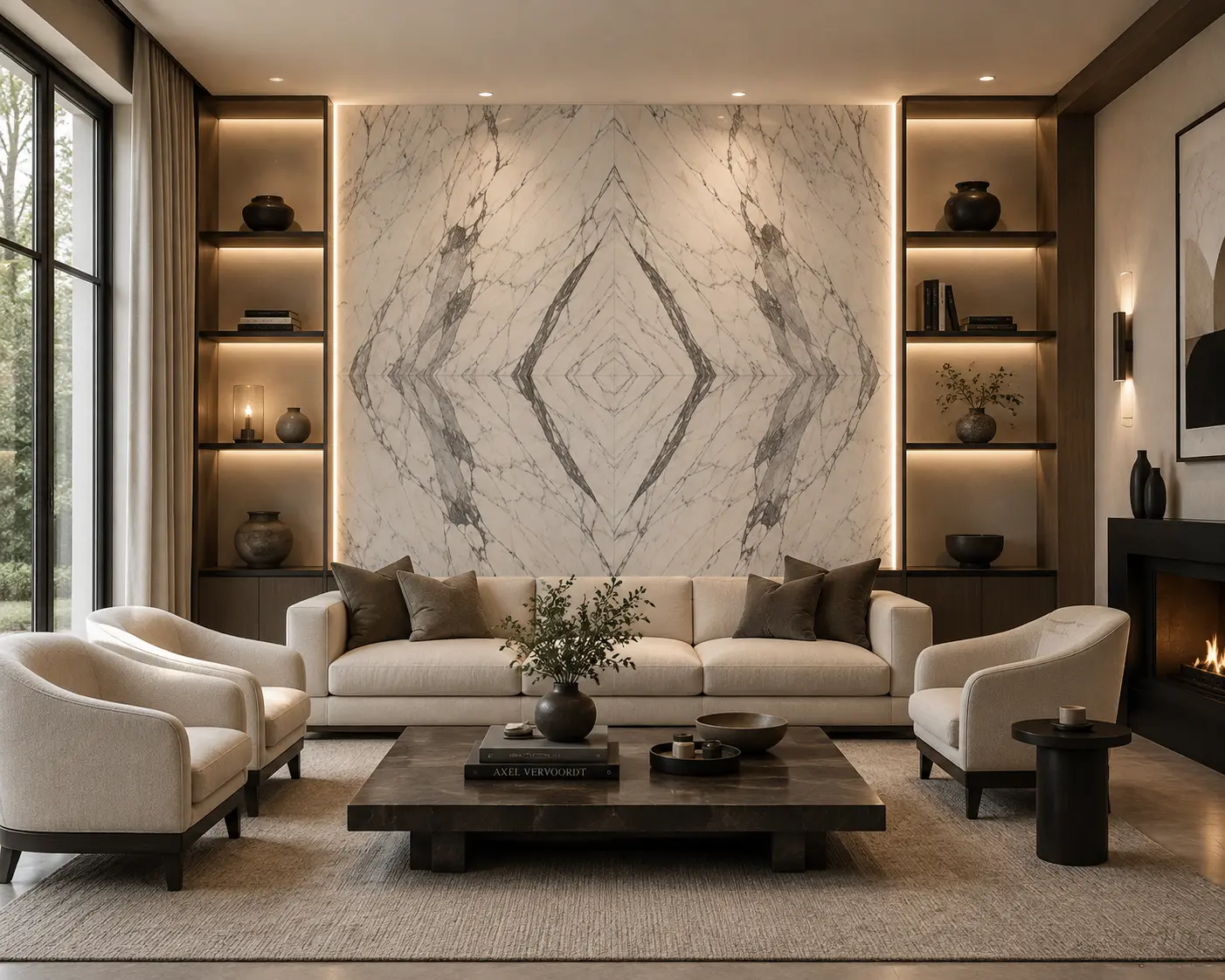
Arabescato Corchia is particularly effective on feature walls, where the scale and movement of the marble can be appreciated across a large uninterrupted surface. Its combination of creamy and stark white areas with sweeping gray veining creates natural depth and visual interest, making the stone well suited to entry walls, living areas, bathroom features, fireplace walls and other prominent architectural surfaces.
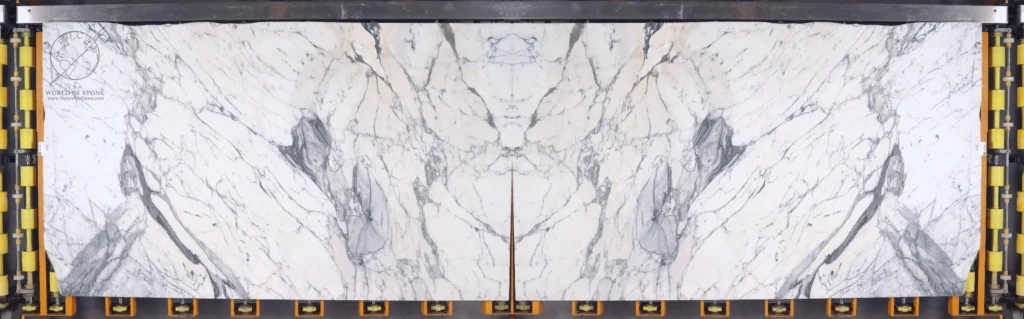
Bookmatching can take this effect even further. Sequential slabs are opened and positioned as mirror images, allowing veins and other natural formations to continue from one slab into the next. With a highly expressive marble such as Arabescato Corchia, the resulting pattern can become a dramatic centerpiece of the interior.
Not every installation needs to be bookmatched. In some projects, placing slabs sequentially in the same orientation creates a more natural flow and allows the veining to move continuously across the wall. The best approach depends on the individual slabs and the desired character of the space.
For either method, the complete slab layout should be planned before fabrication. Photographing and digitally arranging the selected slabs can help determine their orientation, seam locations and vein relationships before any material is cut.
Custom Furniture & Architectural Elements
Arabescato Corchia can also be fabricated into custom furniture and architectural elements when a project calls for something beyond conventional slab applications. Its distinctive veining and natural variation make it particularly well suited to pieces intended to become individual design features within an interior.
Custom applications can include tables, consoles, benches, shelving, vanities, reception desks, fireplace components and other dimensional architectural elements. Depending on the design, pieces can incorporate carefully selected vein placement, matched adjoining surfaces and custom edge details.
These pieces are produced by special order to the precise specifications provided by the customer rather than offered as standard finished products. Dimensions, thicknesses, finishes, edge profiles, cutouts and other fabrication requirements are established for each individual project. Material can then be selected and fabricated specifically for the intended design.
Because every custom project is different, detailed drawings and specifications should be provided before production. Early coordination also allows the stone selection, vein orientation and fabrication requirements to be considered together, helping ensure the finished Arabescato Corchia elements reflect the original design intent.
Designing with Arabescato Corchia
Designing with Arabescato Corchia begins with recognizing that the stone itself will become an important part of the finished composition. Its creamy and stark white areas, dramatic gray veining and large-scale movement give each slab an individual character that should be considered alongside the other materials, finishes and architectural elements within the space.
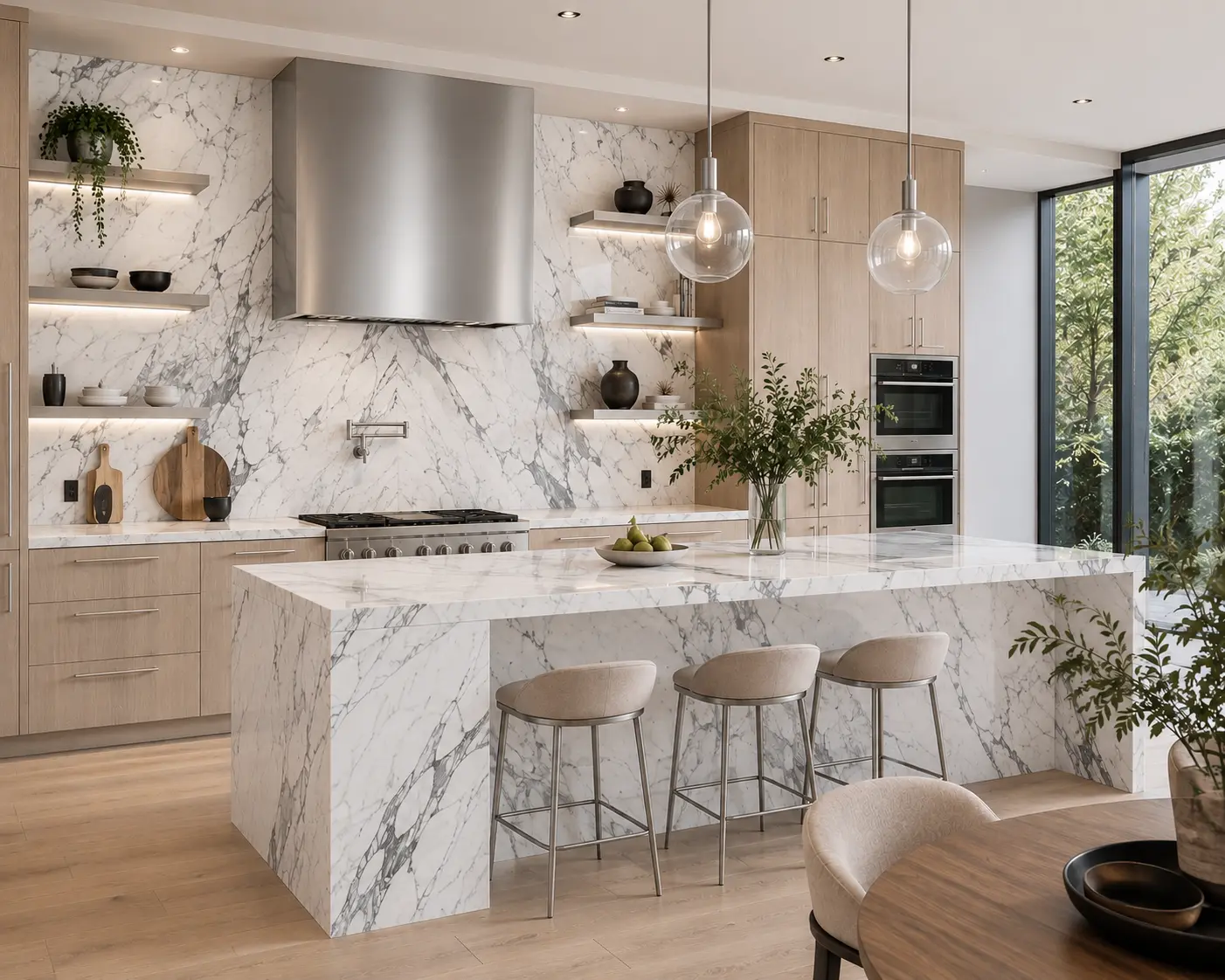
Because the marble can be visually expressive, it often works best when given room to become a focal point. Large kitchen islands, feature walls, fireplaces and shower walls allow the natural movement of the slabs to be appreciated without competing with too many other patterns. More restrained cabinetry, flooring and surrounding finishes can provide a backdrop that allows the stone to take prominence.
The warmer creamy areas within Arabescato Corchia also make it particularly versatile. The marble can coordinate with warm woods, brushed brass and bronze as well as cooler materials such as stainless steel, nickel, blackened metal and contemporary painted cabinetry. The balance of warm and cool tones within the individual slabs should be considered when selecting the surrounding finishes.
Most importantly, the design should respond to the actual slabs rather than relying solely on a small sample. Vein direction, areas of concentrated movement and transitions between cream and white can all influence where cuts and seams should occur. Planning these relationships before fabrication allows the natural characteristics of Arabescato Corchia to become an intentional part of the architecture rather than simply a surface applied to it.
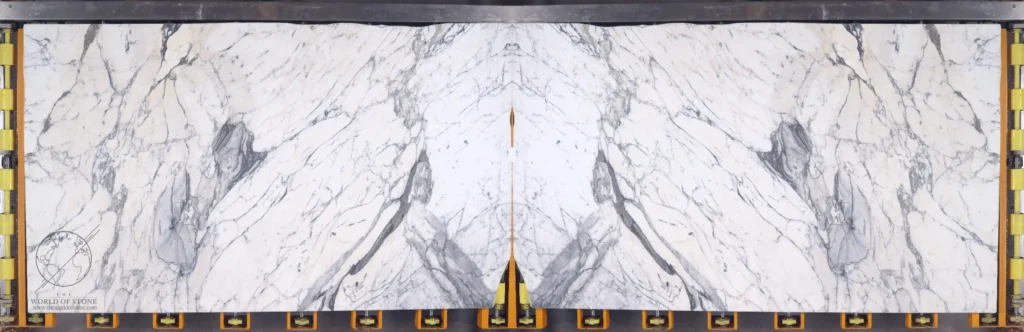
Bookmatching & Vein Matching
The dramatic movement of Arabescato Corchia makes slab layout an important part of the design process. When multiple slabs are available from the same block, their natural relationship can be used to create bookmatched, vein-matched or even diamond-matched installations.
Bookmatching uses two sequential slabs that are opened like the pages of a book. Because adjoining faces were originally next to one another within the block, the veining appears as a mirrored image across the seam. This technique is particularly effective on feature walls, shower walls, fireplaces and other large surfaces where the entire composition can be viewed at once.
Vein matching takes a different approach. Rather than creating a mirror image, individual pieces are positioned and fabricated so prominent veins appear to continue naturally from one piece into the next. This technique is often used across countertops, backsplashes, waterfall edges, wall panels and other adjoining surfaces to create visual continuity.
Diamond matching typically uses four sequential slabs arranged so their mirrored veining converges toward or radiates from a central point, creating a large symmetrical pattern resembling a diamond or kaleidoscope. It is essentially an expanded form of bookmatching and can create a dramatic architectural feature on large walls and other installations where sufficient space is available to appreciate the complete pattern.
All three techniques require careful planning before fabrication. The actual slabs should be photographed and laid out in advance so the designer, fabricator and client can evaluate seam locations, orientation and vein relationships before the material is cut. With a highly figured marble such as Arabescato Corchia, thoughtful slab layout can be every bit as important as the stone selection itself.
Pairing Arabescato Corchia with Other Materials
Arabescato Corchia is unusually versatile because its coloration contains both warm and cool elements. The creamy portions of the background introduce warmth, while the stark white areas and gray veining provide cooler contrast. This allows the marble to work with a broad range of woods, metals, cabinetry colors and other natural materials.
Natural woods are particularly effective companions. White oak, walnut and other warm-toned woods complement the creamy areas of the marble while providing contrast to its white and gray movement. Darker woods can create a richer, more dramatic composition, while lighter woods produce a softer and more contemporary appearance.
Metals can significantly influence how the stone is perceived. Brushed brass and bronze emphasize the warmer cream tones within Arabescato Corchia, while satin nickel, stainless steel and chrome bring attention to its cooler whites and grays. Blackened metal can provide strong contrast and works especially well in contemporary interiors.
For cabinetry and painted surfaces, warm whites, ivory, greige and natural wood tones can reinforce the softer side of the marble. Crisp white cabinetry can emphasize its bright white areas, while charcoal, deep gray, navy and other darker colors allow the marble to become a stronger focal point.
Arabescato Corchia can also be combined with other natural stones, but competing patterns should be considered carefully. A quieter limestone, basalt or relatively uniform marble can complement Arabescato Corchia without competing with its dramatic movement. When multiple highly figured stones are used together, viewing the actual materials side by side is particularly important.
There is no single correct combination. Because Arabescato Corchia varies considerably from slab to slab, the surrounding materials should ideally be selected against the actual slabs being used for the project. The balance of cream, white and gray within a particular selection can help determine whether warmer or cooler companion materials will produce the desired result.
Arabescato Corchia vs. Other Italian White Marbles
Arabescato Corchia vs. Carrara
Arabescato Corchia and White Carrara are both Italian marbles from the Apuan Alps of Tuscany, but visually they can be very different. Arabescato Corchia is generally much more expressive, with a combination of creamy and stark white areas crossed by bold gray veining and larger-scale movement. White Carrara typically has a more uniform white-to-light-gray background with finer, softer gray veining and a quieter overall appearance.
The name “Carrara” has also become something of a catch-all term in the stone and design industries. It is sometimes used loosely to describe a wide range of white and gray Italian marbles from the greater Carrara marble-producing region, even when the material is not technically White Carrara. This can create confusion when comparing stones or specifying material for a project.
True White Carrara is a specific family of marble traditionally graded according to background color, clarity, vein character and overall quality. Arabescato Corchia is a distinctly different material with its own recognizable character and quarry source at Monte Corchia. Calling Arabescato Corchia simply “Carrara marble” may describe its broader regional heritage, but it does not accurately communicate what the stone actually looks like.
For designers and clients, the distinction matters. If the goal is a relatively quiet and consistent white-gray marble, White Carrara may be the more appropriate choice. When the design calls for greater movement, stronger contrast and a warmer interplay of cream, white and gray, Arabescato Corchia offers a very different visual statement.
Arabescato Corchia vs. Calacatta
Arabescato Corchia and Calacatta are both prestigious Italian marbles from the Apuan Alps, but they have distinctly different visual characteristics. Arabescato Corchia typically displays greater overall movement, with creamy areas interwoven with stark white and complex gray veining. Traditional Calacatta marbles are generally recognized for a cleaner white background with more defined, widely spaced veining, although the appearance varies considerably among the legitimate Calacatta varieties.
It is also important to understand that Calacatta is not simply a generic term for any white marble with dramatic veining. Historically, the name has been associated with specific Italian marbles and quarrying areas, with recognized varieties such as Calacatta Gold, Calacatta Borghini and others having their own identifiable characteristics.
In recent years, however, the name Calacatta has been applied increasingly loosely throughout the stone and surface industries. Marbles from unrelated quarrying regions—and even manufactured quartz and porcelain products—are routinely marketed using Calacatta-inspired names. While this may communicate a general design aesthetic to the consumer, it has also diluted the meaning and significance of the name. A designation that once communicated something meaningful about a stone’s origin and character is now frequently used as a marketing description for almost any predominantly white surface with bold gray or gold veining.
For that reason, The World of Stone believes materials should be identified as accurately as possible by their recognized stone name and origin. Arabescato Corchia does not need to be presented as another type of Calacatta. It has its own history, quarry source and distinctive appearance, and those characteristics are precisely what make the material worth specifying.
Arabescato Corchia vs. Statuario
Arabescato Corchia and Statuario are both highly regarded white Italian marbles from the Apuan Alps, but their appearance is distinctly different. Arabescato Corchia typically has considerably more movement, with creamy areas interwoven with stark white and complex gray veining. Statuario is generally associated with a cleaner white field and more defined gray veining, but color alone does not define a true Statuario.
One of the most important characteristics of Statuario is its depth and clarity. A high-quality Statuario has a crystalline quality that gives the white background visual depth rather than appearing flat or opaque. Its veining can appear embedded within the stone rather than simply sitting on its surface. This combination of whiteness, depth, clarity and distinctive veining is what separates exceptional Statuario from other white Carrara-area marbles.
The terminology can become confusing because Statuario, Statuarietto and Gioia are not the same material. Although they share a general white-and-gray aesthetic, their appearance changes noticeably as you move through the group.
Statuario sits at the top, with the greatest depth and clarity, typically accompanied by a cleaner white background and distinctive gray veining.
Statuarietto retains some of the visual character associated with Statuario but generally has less depth and clarity. Its gray veining is typically finer and more frequent, producing a somewhat busier overall appearance.
Gioia moves another step away from the classic Statuario appearance. The background generally has less depth and clarity again, with more closely distributed gray movement and a busier, more uniform pattern.
These distinctions are important because the names are sometimes used too loosely in the marketplace. Statuarietto and Gioia should not simply be marketed as Statuario because they resemble it. Each has its own character, appearance and appropriate place within a project.
Arabescato Corchia is different from all three. Its appeal is not based on achieving the depth and clarity associated with Statuario. Instead, it is defined by its dramatic movement, complex gray veining and distinctive interplay of creamy and stark white areas. For a designer, the choice is therefore not simply between different grades of white marble, but between stones with fundamentally different visual personalities.
Care & Maintenance
Arabescato Corchia is a natural marble and should be maintained with products and cleaning methods specifically intended for natural stone. Routine care is relatively simple, but understanding the characteristics of marble will help preserve the appearance of the material over time.
For everyday cleaning, use a soft cloth or sponge with warm water and a pH-neutral cleaner formulated for natural stone. Avoid acidic cleaners, vinegar, lemon-based products and abrasive cleaning compounds. Because marble is primarily composed of calcite, acids can react with the surface and cause etching, leaving dull areas that cannot simply be cleaned away.
A quality penetrating sealer can help reduce the absorption of liquids and make staining less likely, particularly on countertops and other frequently used surfaces. However, sealing does not prevent etching or scratching. The appropriate sealer and frequency of application depend on the finish, location, use and specific sealing product, so the manufacturer’s recommendations should be followed rather than relying on a fixed resealing schedule.
In kitchens, spills—particularly wine, citrus, vinegar, oils and other foods—should be cleaned promptly. Cutting boards and trivets are recommended for food-preparation areas. Over time, frequently used marble countertops may develop a natural patina, particularly with a honed finish.
In showers and other continuously wet environments, keeping the stone as dry as practical between uses can significantly reduce mineral deposits and soap buildup. Using a squeegee after showering is one of the simplest and most effective maintenance practices. Good ventilation is also important. An appropriately sized exhaust fan, preferably equipped with a timer so it continues running after the shower is finished, helps moisture dissipate more quickly.
With proper installation, appropriate cleaning products and reasonable routine care, Arabescato Corchia can provide decades of service. Like other natural marbles, it should be selected with an understanding that the material will age naturally and may develop a patina that becomes part of its character.