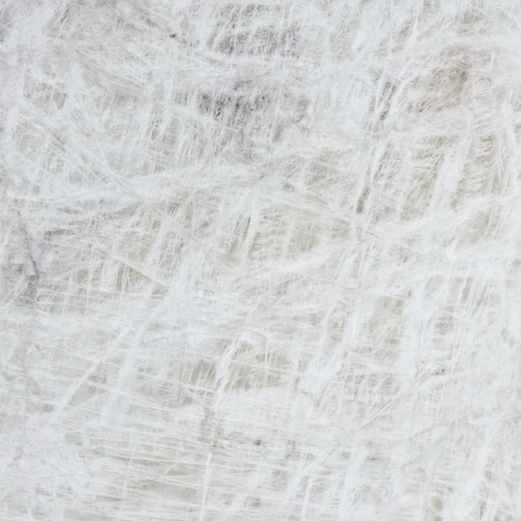
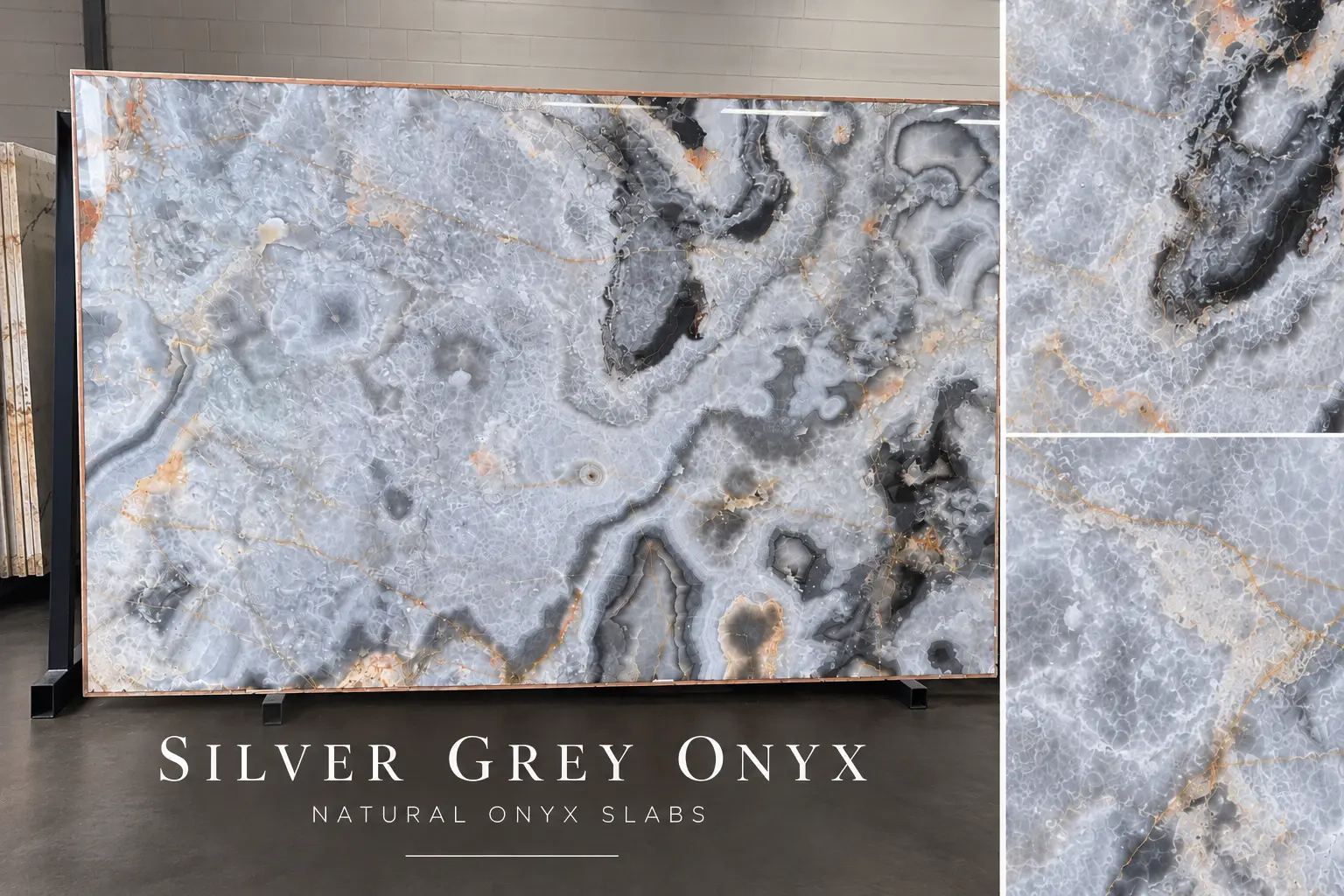
Silver Grey Onyx is a dramatic natural stone featuring swirling layers of silver, smoky gray, charcoal, and black, accented by occasional warm gold and amber mineral formations. Its intricate patterns range from delicate, cloudlike movement to bold, contrasting areas of dark and light stone.
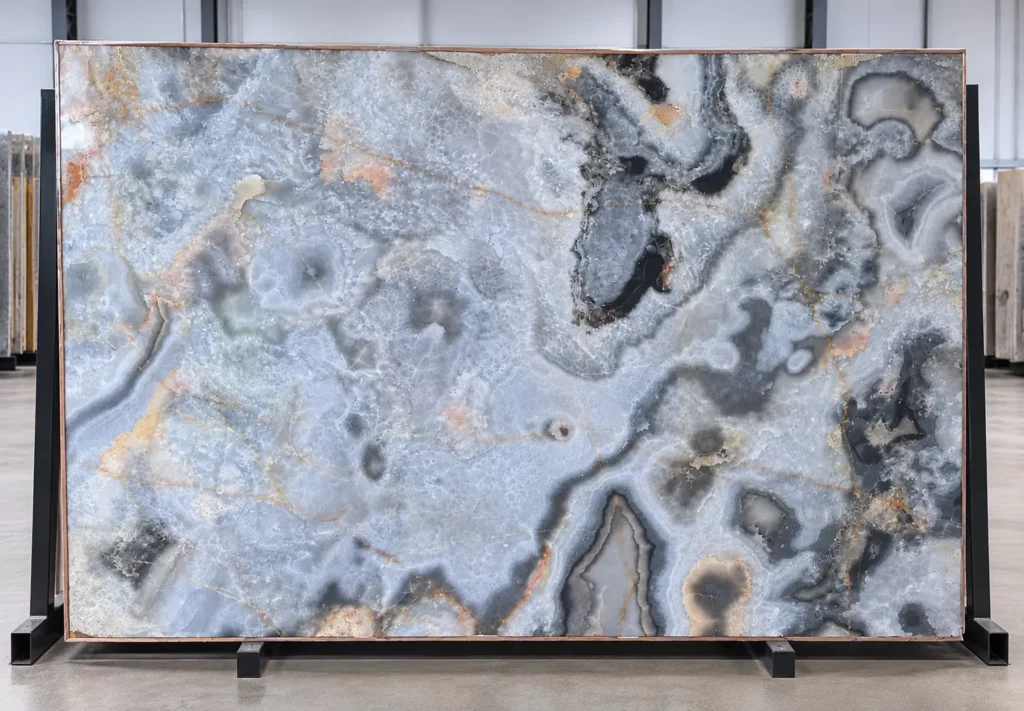
A Distinctive Natural Onyx with Silver and Charcoal Formations
Silver Grey Onyx is closely related to our Black Onyx inventory, with both selections originating from the same block of natural stone. While the darker slabs are predominantly black, these lighter selections reveal the extraordinary variation that can occur within a single block of onyx.
Individual slabs exhibit significant differences in color distribution and pattern. Some feature large areas of translucent silver-gray stone, while others contain dramatic black formations and concentrated gold accents. This variation makes individual slab selection especially important.
Available in limited quantities at The World of Stone in Los Angeles, Silver Grey Onyx offers distinctive possibilities for feature walls, decorative installations, and backlit applications where the stone’s translucency can be appreciated.
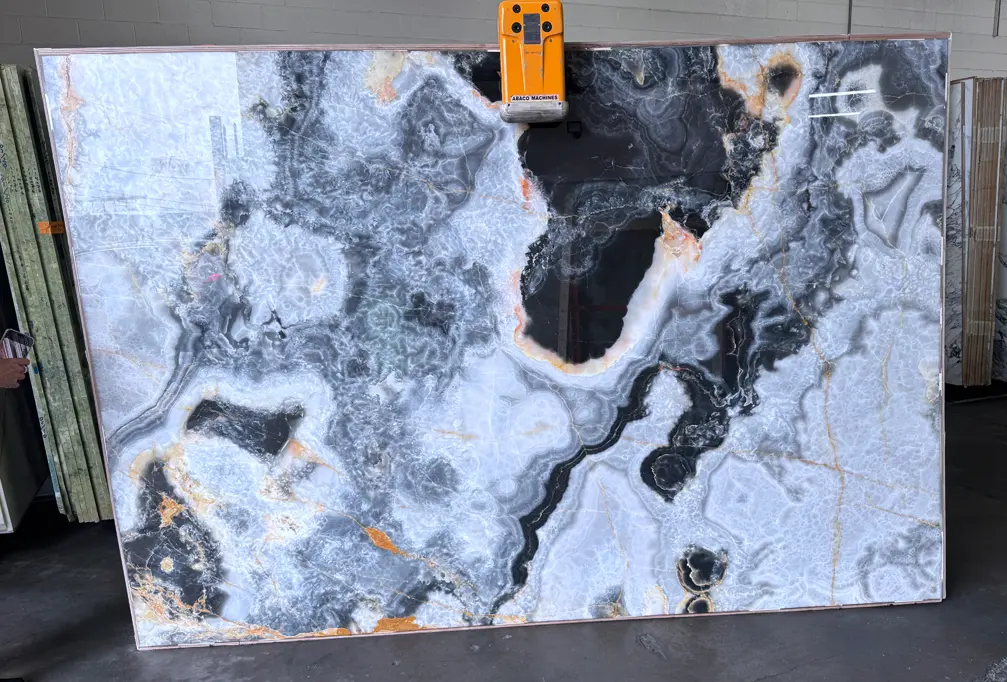
Silver-Gray, Black, and Subtle Gold Coloration
Silver Grey Onyx features a complex combination of silvery gray, soft white, charcoal, and deep black, accented by delicate veins and occasional deposits of warm gold and amber. These contrasting colors create remarkable visual depth, with lighter crystalline formations surrounding darker mineral concentrations.
The silver-gray areas range from pale, translucent white to smoky gray, often displaying intricate, cloudlike patterns and delicate concentric banding. Black and charcoal formations provide dramatic contrast, appearing as irregular shapes, flowing bands, and sharply defined pockets within the lighter stone.
Fine gold and amber-colored veins travel through the material, occasionally collecting along fractures and mineral boundaries. These warmer tones provide subtle accents without overwhelming the predominantly cool coloration.
The distribution of these colors varies considerably between individual slabs. Some are dominated by expansive silver-gray formations, while others contain substantial areas of black and charcoal. This natural variation gives each slab its own character and makes Silver Grey Onyx particularly appealing for architectural installations where the stone itself becomes a focal point.
Intricate Crystalline Patterns and Natural Movement
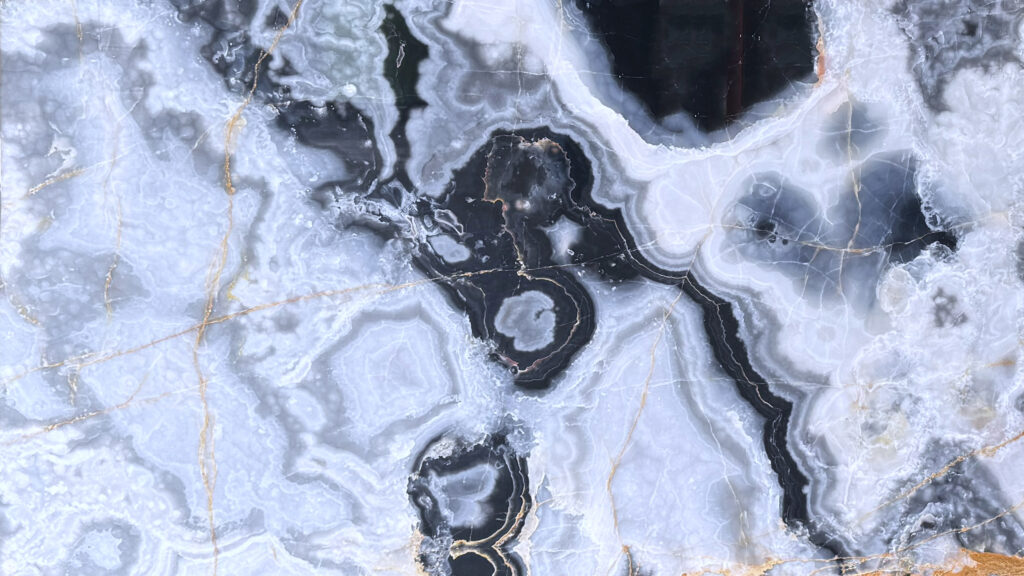
One of the most distinctive characteristics of Silver Grey Onyx is the complexity of its crystalline patterns and natural movement. Unlike stones with relatively consistent directional veining, this material displays an intricate arrangement of swirling formations, concentric bands, and irregular mineral deposits that create an almost three-dimensional appearance.
Delicate, lace-like crystalline structures spread across the lighter silver-gray areas, forming interconnected patterns that resemble clouds, frost, or fine mineral networks. These formations transition into darker charcoal and black regions, where the patterns become more concentrated and sharply defined.
Rounded and occasionally eye-shaped formations appear throughout the slabs, surrounded by successive layers of contrasting minerals. These structures reflect changes in mineral deposition during the stone’s formation, creating the distinctive banding and complex internal patterns associated with natural onyx.
The movement is neither strictly linear nor uniformly distributed. Broad areas of relatively quiet coloration may transition abruptly into highly detailed crystalline formations or dramatic dark mineral concentrations. This irregularity gives the stone a sense of movement and depth that changes as the viewer examines different areas of the slab.
For designers, these characteristics offer considerable creative possibilities. Individual slabs can be positioned to emphasize a particular formation, while carefully selected adjacent pieces can create larger compositions. Because the patterns vary substantially throughout the material, reviewing the actual slabs is essential when planning installations that depend on visual continuity.
The Natural Formation of Silver Grey Onyx
Silver Grey Onyx is a form of natural calcite onyx, a decorative stone composed primarily of calcium carbonate. Unlike traditional siliceous onyx, which belongs to the chalcedony family, the material commonly sold as onyx in the natural stone industry develops through the gradual precipitation of carbonate minerals from mineral-rich water.
This process typically occurs in environments where groundwater circulates through limestone formations, fractures, cavities, or other underground openings. As water containing dissolved calcium carbonate encounters changes in temperature, pressure, or carbon dioxide concentration, calcite and sometimes aragonite begin to precipitate, gradually building successive layers of mineral deposits.
Over extended periods, variations in water chemistry, mineral concentration, and deposition conditions produce the intricate banding and crystalline structures characteristic of decorative onyx. Changes in these conditions can create sharply contrasting layers, irregular formations, and complex patterns within relatively small areas of stone.
The predominantly silver-gray coloration of this material is interrupted by concentrated charcoal and black formations, along with occasional gold and amber-colored mineral deposits. These darker and warmer colors may reflect trace impurities, mineral inclusions, or changes in the chemistry of the water during formation. Their precise composition cannot be established from appearance alone.
Unlike many sedimentary stones that develop relatively consistent bedding, natural onyx frequently forms around irregular cavities and openings. Mineral deposits may accumulate in different directions, creating concentric patterns, curved bands, and abrupt transitions between colors and textures.
These complex growth conditions also help explain why onyx blocks may contain internal voids, fractures, and structurally inconsistent areas. The same geological processes responsible for the stone’s extraordinary appearance can make it challenging to extract and process into finished slabs.
Silver Grey Onyx is a particularly striking example of this natural variability, with intricate crystalline formations and dramatic contrasts that reveal the complex history of its mineral deposition.
How Mineral Deposition Creates Layered Patterns
The intricate layers and crystalline formations found in Silver Grey Onyx develop through successive episodes of mineral deposition. Unlike many sedimentary stones formed through the accumulation and compaction of sediments, calcite onyx develops as mineral-rich water deposits calcium carbonate within underground cavities, fractures, and other natural openings.
As groundwater travels through limestone and other calcium-rich formations, it gradually dissolves small quantities of calcium carbonate. When this water enters an open cavity or encounters changes in pressure, temperature, or dissolved carbon dioxide, some of the calcium carbonate precipitates from solution, forming new mineral deposits.
Over time, repeated episodes of precipitation create successive layers of calcite and, in some cases, aragonite. Changes in water flow, mineral concentration, and chemical composition influence the thickness, color, and crystalline structure of each layer. Some deposits form relatively uniform bands, while others develop irregular, curved, or concentric patterns around existing mineral formations.
The distinctive silver-gray, charcoal, and black patterns in Silver Grey Onyx reflect variations in the material deposited during these successive growth periods. Trace impurities and mineral inclusions can influence coloration, while differences in crystal size and structure affect the way light passes through or reflects from the stone.
When mineral deposition occurs within irregular cavities, growth may proceed inward from several surfaces simultaneously. This can produce rounded formations, overlapping bands, and complex crystalline boundaries rather than the relatively straight veining associated with many marbles.
Periods of interrupted deposition may also leave openings or weak boundaries between mineral layers. Subsequent mineral-rich water can partially fill these spaces, creating additional crystalline structures and contrasting patterns. Other cavities may remain unfilled, contributing to the internal voids and structural inconsistencies frequently encountered during onyx processing.
The result is a stone whose appearance records numerous stages of mineral growth. Each change in coloration, crystalline texture, or banding represents a variation in the conditions under which the material developed, giving Silver Grey Onyx its distinctive depth, complexity, and natural movement.
Translucency and Light Transmission in Natural Onyx
Silver Grey Onyx and Black Onyx – Two Expressions of the Same Stone
Although marketed separately because of their distinctly different appearances, Silver Grey Onyx and Black Onyx originate from the same block of natural stone. Their contrasting coloration provides an exceptional example of the variation that can occur within a single onyx deposit.
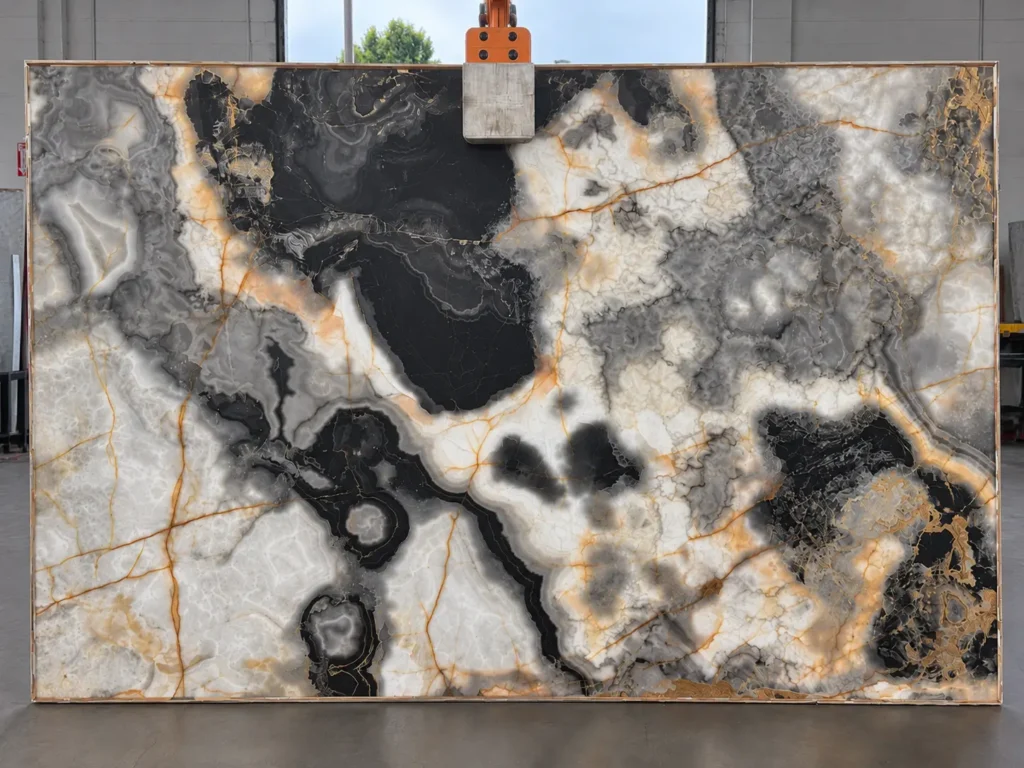
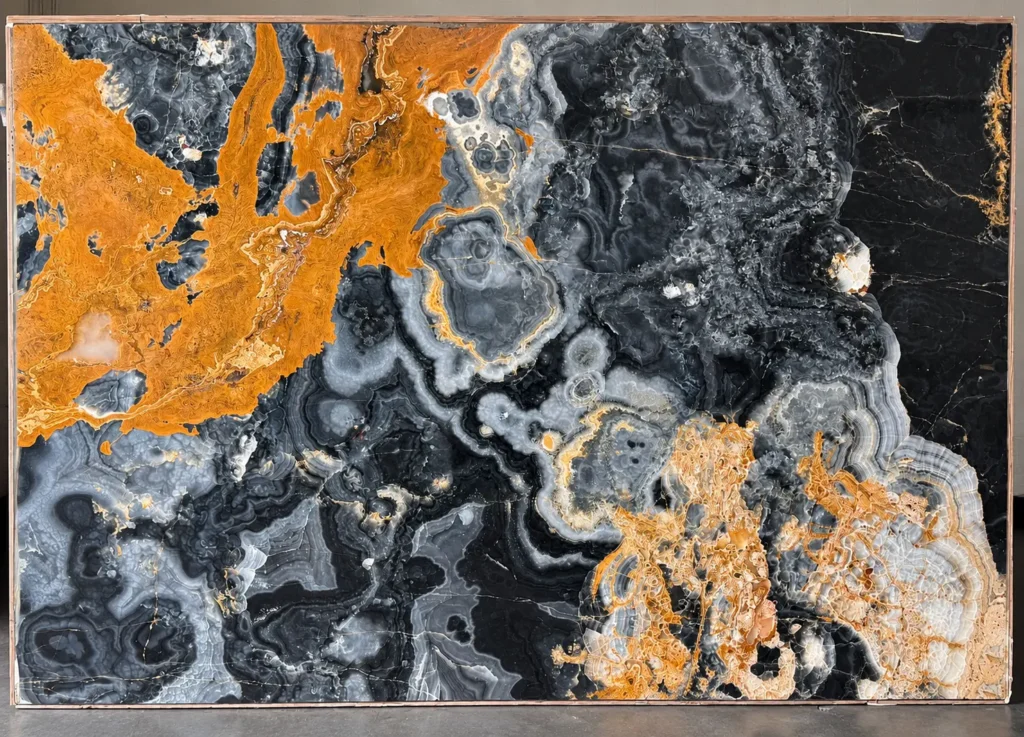
Our Black Onyx slabs are characterized by extensive areas of deep black and charcoal, dramatic amber-gold mineral deposits, and intricate gray crystalline formations. Silver Grey Onyx, by comparison, displays a predominantly silver-gray and pale crystalline background, interrupted by darker mineral concentrations and delicate gold veining.
Despite these differences, both selections share distinctive concentric banding, irregular crystalline structures, and complex mineral patterns that reveal their common origin.
The transition between these two appearances is particularly evident when comparing slabs 24 and 25. Slab 24 contains substantial black formations and concentrated gold deposits, while slab 25 exhibits a significantly lighter composition, with expansive silver-gray areas surrounding bold charcoal and black patterns.
What makes this comparison especially interesting is that the dramatic visual difference does not necessarily represent a change occurring over the thickness of a single slab.
Natural onyx blocks frequently contain internal cavities, fractures, and structurally unstable sections that cannot be processed into finished slabs. During production, these areas may be discarded, leaving gaps in the usable material recovered from the block.
In this particular block, material between the surviving slabs was unsuitable for production and discarded. The retained slab numbers therefore do not represent an uninterrupted sequence of usable stone.
This explains how slabs originating from the same block can exhibit dramatically different appearances, even when their surviving identification numbers are close together.
Rather than treating these differences as inconsistencies, they demonstrate the extraordinary geological character of natural onyx. Each usable slab represents a surviving portion of a complex mineral formation, with its own distinctive balance of color, crystalline structure, and natural movement.
For designers and architects, this variation makes individual slab selection especially important. It also creates opportunities to choose between two very different visual expressions of the same natural material.
Dramatic Color Variations Within a Single Block
One of the most fascinating characteristics of natural onyx is the dramatic variation in color and pattern that can occur within a single block. Unlike many relatively consistent marbles and limestones, onyx can exhibit substantial changes in mineral concentration, crystalline structure, and coloration over relatively short distances.
Our Silver Grey Onyx and Black Onyx slabs provide an excellent example of this natural phenomenon. Although both selections originated from the same block, their appearances are remarkably different.
The darker portions feature extensive black and charcoal formations, concentrated amber-gold mineral deposits, and sharply defined crystalline patterns. The lighter portions display expansive areas of silver-gray and translucent white, interrupted by irregular dark formations and delicate gold veining.
These differences develop during the stone’s formation as mineral-rich water deposits successive layers of calcium carbonate. Changes in water chemistry, trace mineral content, and deposition conditions influence the color, thickness, and crystalline structure of the developing layers.
Because onyx frequently forms within irregular cavities and underground openings, mineral deposition does not always proceed uniformly. Different areas of the same deposit may develop contrasting patterns, creating abrupt transitions between light and dark formations.
However, the visual differences between finished slabs do not always indicate how rapidly the material changed within the original block.
During processing, structurally unstable sections containing large cavities, fractures, or other imperfections may be discarded. Consequently, two surviving slabs may represent portions of the block that were originally separated by a substantial amount of unusable material.
This distinction is particularly important when evaluating our Silver Grey Onyx inventory. The dramatic differences between individual slabs reflect both the stone’s natural geological variation and the selective recovery of usable material during production.
The result is a collection of slabs that share a common geological origin but offer distinctly different visual characteristics. For architectural and interior design applications, this makes selecting the actual slabs essential, particularly when color consistency, pattern continuity, or bookmatching is important.
Why Consecutive Slab Numbers May Look Completely Different
When natural stone slabs are numbered during production, the numbers generally identify the sequence of finished, usable slabs recovered from a block. However, consecutive slab numbers do not necessarily mean the pieces were cut from immediately adjacent sections of stone.
This distinction is particularly important with natural onyx.
Unlike relatively sound blocks of marble or limestone, onyx frequently contains large internal cavities, fractures, and structurally unstable areas. During cutting, portions of the block may prove unsuitable for producing finished slabs. These sections are discarded, and production continues with the remaining usable material.
Consecutive slab numbers therefore identify the next usable slabs in the production sequence, not necessarily the next physical slices through the block.
For example, slabs numbered 23 and 24 may appear consecutive, but several inches of fractured or otherwise unusable stone could have been removed between them. The surviving slabs retain their production numbers even though the material originally separating them is no longer present.
Our Silver Grey Onyx and Black Onyx inventory illustrates this situation particularly well.
Slab 24 features extensive black and charcoal formations with prominent amber-gold mineral deposits. Slab 25, although next in the surviving sequence, displays a substantially lighter appearance, with expansive silver-gray crystalline areas and contrasting dark formations.
Without understanding the production process, someone might reasonably assume that the stone underwent this dramatic transformation within the thickness of a single slab.
In reality, unusable material was discarded during processing. The visual transition between the surviving slabs therefore represents more than the small distance their consecutive numbers might suggest.
This is also why consecutive slab numbers should never be taken as a guarantee of visual continuity or suitability for bookmatching. Even slabs recovered from the same block must be evaluated individually for color, pattern, dimensions, and compatibility.
The numbering tells us the order in which usable slabs were recovered. It does not tell us how much of the original block was lost along the way.
Understanding that difference provides valuable insight into both the extraordinary variation of natural onyx and the challenges involved in producing it.
Why Natural Onyx Is More Difficult to Produce
Natural onyx is among the more challenging decorative stones to quarry, cut, and process into finished slabs. While its translucency, intricate crystalline formations, and dramatic coloration make it highly desirable, the internal structure of the material can create significant difficulties throughout production.
Unlike many relatively sound blocks of marble or limestone, natural onyx frequently contains extensive fractures, internal cavities, irregular mineral boundaries, and areas of structural weakness. These conditions are often concealed within the block and may not become apparent until cutting begins.
A block that appears suitable from the outside can reveal substantial areas of unusable material once it reaches the saw. Individual slabs may fracture during cutting, contain large voids, or lack sufficient structural integrity to withstand subsequent handling and polishing.
In some cases, reinforcing the stone with resin or fiberglass backing can help stabilize otherwise usable material. However, reinforcement cannot overcome every structural defect. Sections containing extensive cavities or severe fractures may have to be discarded entirely.
These challenges continue beyond the initial cutting process. Onyx requires careful handling during transportation, polishing, storage, and fabrication. Its crystalline structure and natural discontinuities can make it more vulnerable to breakage, particularly when slabs contain large openings or concentrated areas of weakness.
One of the most significant consequences is the relatively low yield of finished material from an individual block.
A sound block of limestone might produce approximately 50 usable slabs, while a comparable block of onyx may yield only 20. These figures are illustrative rather than fixed production standards, but they demonstrate the substantial difference in material recovery that can occur.
The costs associated with quarrying, transporting, cutting, reinforcing, and finishing the original block remain, even when a significant portion of the stone cannot be sold.
As a result, fewer finished slabs must absorb the expense of processing the entire block. This reduced yield is one of the important reasons natural onyx often commands a higher price than more structurally consistent stones.
Our Silver Grey Onyx and Black Onyx slabs provide a particularly useful example. Although both selections originated from the same block, unusable sections were discarded during production, leaving surviving slabs with dramatically different appearances.
The finished slabs represent only the portions of the original block that could successfully be recovered and processed.
Understanding these production challenges provides a greater appreciation for natural onyx. Its value reflects not only its extraordinary appearance, but also the difficulty, expense, and material losses involved in bringing a finished slab from the quarry to the showroom.
Internal Voids, Fractures, and Structural Instability
One of the greatest challenges in producing natural onyx slabs is the presence of internal voids, fractures, and structurally unstable areas within the original block. These conditions are common in decorative calcite onyx and are closely related to the geological environments in which the material forms.
Natural onyx develops through the gradual deposition of calcium carbonate from mineral-rich water. As these deposits accumulate within underground cavities, fractures, and irregular openings, they can create complex crystalline formations with varying degrees of structural continuity.
Unlike a relatively homogeneous block of limestone, an onyx block may contain numerous internal boundaries where mineral growth was interrupted, changed direction, or developed around existing cavities. Some of these openings become filled by subsequent mineral deposition, while others remain partially or completely empty.
The result can be a block that appears reasonably sound from the outside but contains significant structural weaknesses beneath its surface.
These hidden conditions often become apparent only when the block is cut into slabs.
As the saw progresses through the stone, it may encounter large cavities, open fractures, or sections where the mineral structure lacks sufficient continuity to remain intact. Some slabs can be successfully reinforced and processed, while others may break during cutting or prove unsuitable for further production.
Resin treatments, fiberglass backing, and other reinforcement methods can improve the handling characteristics of certain onyx slabs. However, these techniques have limitations. Extensive voids, severe fractures, or large areas of unstable material may make a section of the block economically or structurally impractical to recover.
When this occurs, the unusable material is discarded, and cutting continues until another suitable section is reached.
This process helps explain why the surviving slabs from a single onyx block may exhibit dramatic differences in appearance, even when their identification numbers are consecutive.
Our Silver Grey Onyx and Black Onyx slabs provide an example. Material between certain surviving slabs was unsuitable for production and discarded, leaving visually different sections of the original block represented in the finished inventory.
The amount of material lost during processing can be substantial. Unlike the relatively predictable yield of a sound limestone block, the number of finished onyx slabs may not be known until cutting and processing are completed.
These structural characteristics also require special consideration during fabrication and installation. Natural onyx should be carefully evaluated for existing fractures, resin-filled areas, backing materials, and other conditions that may influence its suitability for a particular application.
For designers and architects, understanding these limitations is just as important as appreciating the stone’s appearance. The extraordinary crystalline formations that make natural onyx desirable are part of a complex geological structure that demands careful selection, experienced fabrication, and appropriate installation methods.
Lower Slab Yields and the Cost of Natural Onyx
One of the less obvious reasons natural onyx commands a premium price is the relatively low yield of usable slabs recovered from an individual block. While its extraordinary colors, translucency, and crystalline formations contribute to its desirability, the cost of producing finished onyx is also influenced by the substantial amount of material that may be lost during processing.
Consider a relatively sound block of limestone that might produce approximately 50 finished slabs. A comparable block of natural onyx may yield only 20 usable slabs because of internal cavities, fractures, and structurally unstable sections. These figures are illustrative, and actual yields vary considerably depending on the material and condition of the block.
The difference becomes particularly significant when considering the expenses involved in production.
Quarrying equipment, labor, block transportation, cutting, reinforcement, polishing, and handling all contribute to the cost of finished stone. Many of these expenses are incurred regardless of how much usable material is ultimately recovered.
When a substantial portion of an onyx block must be discarded, the production costs are distributed across fewer saleable slabs.
A lower yield does not necessarily mean the original block was less expensive to extract or process. It means fewer finished slabs are available to recover those costs.
The challenges extend beyond the initial cutting process. Onyx slabs may require additional reinforcement, resin treatment, careful polishing, and specialized handling. Even after successful processing, their natural fractures and crystalline structure can make transportation and fabrication more demanding than with many conventional stones.
Our Silver Grey Onyx and Black Onyx inventory illustrates this reality. Both materials originated from the same block, but portions of the stone were unsuitable for production and discarded. The surviving slabs represent only the usable sections recovered from that block.
This loss of material helps explain both the gaps in visual continuity between surviving slabs and the economics of producing natural onyx.
For designers and homeowners, the price of natural onyx reflects more than the appearance of a polished slab. It also reflects the difficulty of recovering that slab from a geologically complex block, the additional processing required, and the substantial amount of stone that may never reach the showroom.
Understanding these factors provides a more complete picture of why natural onyx is often more expensive than marble or limestone. Its value is influenced not only by what survives the production process, but also by everything that does not.
Architectural and Interior Design Applications
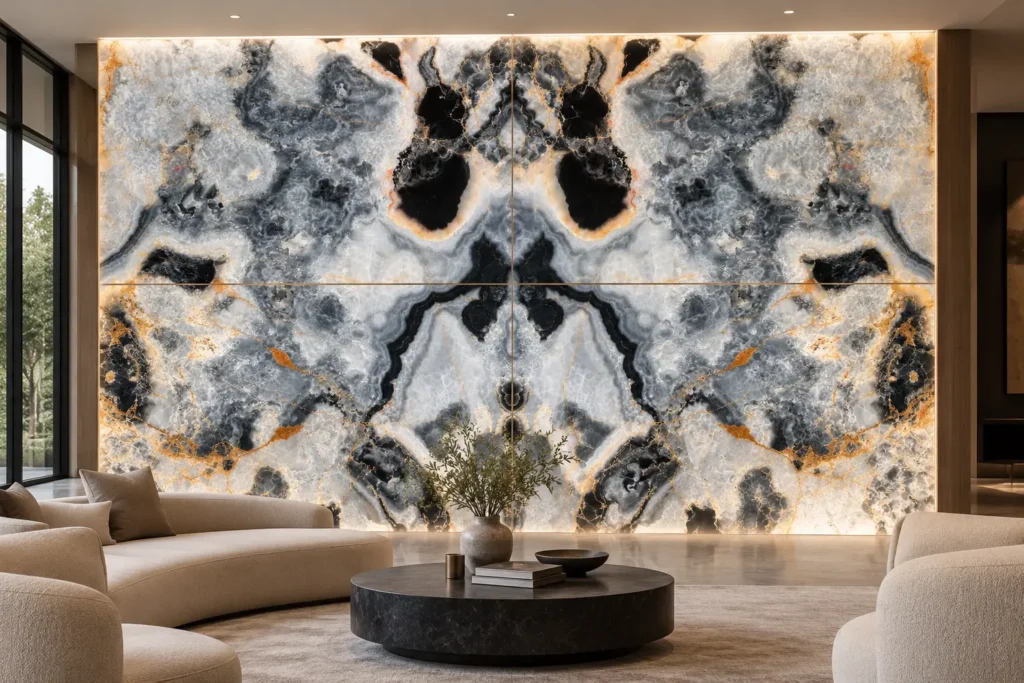
Silver Grey Onyx offers distinctive possibilities for architectural and interior design applications where natural stone serves as a prominent visual feature. Its intricate crystalline formations, contrasting silver-gray and charcoal coloration, and subtle gold accents create a dramatic appearance that can complement both contemporary and traditional interiors.
Unlike stones with consistent directional veining, Silver Grey Onyx features irregular mineral formations, concentric patterns, and areas of contrasting color. This natural movement makes it particularly suitable for installations where the material can be appreciated as an individual composition rather than simply a decorative surface.
Feature walls and decorative wall panels are among the most effective applications. Large slabs allow the stone’s complex patterns to remain visible, creating a focal point without requiring elaborate architectural detailing. In contemporary interiors, the contrast between the lighter crystalline areas and darker mineral formations can be especially effective alongside restrained materials such as wood, metal, and neutral plaster finishes.
The natural translucency of Silver Grey Onyx also makes it a candidate for backlit installations. When properly illuminated, lighter crystalline areas can transmit light, revealing internal mineral structures and layered formations that may be less apparent under conventional lighting. The darker portions remain more subdued, creating additional contrast and visual depth.
Other potential applications include decorative fireplace surrounds, reception desks, bar fronts, vanity features, and custom furniture elements. In each case, the suitability of the material depends on the intended use, structural support, fabrication requirements, and exposure to moisture, heat, or physical wear.
Because calcite onyx is relatively soft and sensitive to acidic substances, it is generally better suited to carefully considered decorative applications than to heavily used work surfaces. Applications involving frequent contact, abrasion, or chemical exposure require particular attention to maintenance and long-term performance.
Individual slab selection is especially important with Silver Grey Onyx. The available slabs vary considerably in the distribution of silver-gray, black, and gold formations. Designers should evaluate the actual pieces to determine how their patterns will relate to the dimensions and composition of the intended installation.
For projects requiring multiple slabs, seam placement, pattern alignment, and the availability of compatible pieces should be established before fabrication begins.
With thoughtful planning and appropriate fabrication, Silver Grey Onyx can transform a relatively simple architectural surface into a distinctive natural stone feature, allowing the material’s extraordinary geological character to become the central element of the design.
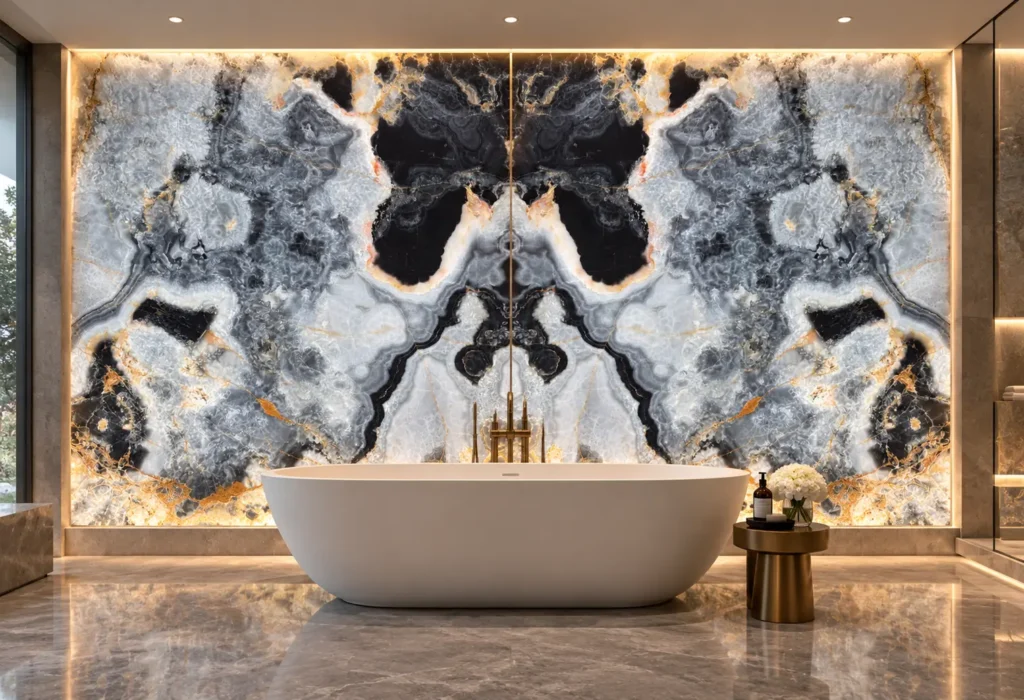
Backlit Feature Walls and Decorative Installations
The natural translucency of Silver Grey Onyx makes it an intriguing material for backlit feature walls and decorative architectural installations. When illuminated from behind, the stone’s lighter crystalline formations can transmit light, revealing intricate mineral patterns and internal structures that are less apparent under conventional surface lighting.
Unlike uniformly translucent materials, Silver Grey Onyx contains substantial variations in light transmission. Pale silver-gray and white crystalline areas may appear luminous, while concentrated charcoal and black formations absorb or obstruct more light. The resulting contrast creates a dramatic interplay of illuminated mineral patterns, darker silhouettes, and subtle variations in depth.
This characteristic can be particularly effective in large decorative wall installations, where the stone becomes both an architectural surface and a source of ambient illumination.
Backlit onyx can also be incorporated into reception desks, bar fronts, decorative partitions, and custom architectural panels. In hospitality and high-end residential interiors, these applications can create distinctive focal points without relying on elaborate surrounding finishes.
However, successful backlighting requires more than simply placing lights behind a slab.
The thickness, mineral composition, internal fractures, and varying translucency of the stone all influence how light travels through the material. A lighting system that works well behind a predominantly pale onyx may produce a very different result behind a slab containing extensive black formations.
For this reason, the actual slabs should be tested with backlighting before the final installation is designed. Lighting intensity, color temperature, diffusion, and the distance between the light source and the stone must be considered to achieve reasonably even illumination without distracting hot spots.
Structural support is equally important. Natural onyx can contain internal fractures, resin-filled areas, and reinforcing materials that affect fabrication and installation. Backlit panels may require engineered support systems, suitable backing materials, and carefully planned access for future lighting maintenance.
Silver Grey Onyx is particularly interesting because its darker formations remain visually prominent even when the lighter areas are illuminated. Rather than producing a uniformly glowing surface, the material can reveal a complex composition of light and shadow that emphasizes its natural crystalline structure.
With careful slab selection, appropriate reinforcement, and a properly designed lighting system, Silver Grey Onyx can create striking illuminated architectural features that showcase the extraordinary character of natural stone.
Bookmatching and Individual Slab Selection
Bookmatching is one of the most dramatic ways to showcase natural stone, but achieving a successful bookmatch with onyx can be considerably more difficult than with many marbles and other decorative stones.
In a traditional bookmatch, consecutive slabs are arranged as mirror images, creating a symmetrical composition across the adjoining surfaces. This technique relies on sufficient continuity in the stone’s color, veining, and mineral formations to produce a visually balanced pattern.
With natural onyx, that continuity can be particularly difficult to achieve.
Onyx blocks frequently contain internal voids, fractures, and structurally unstable sections that must be discarded during production. Although the surviving slabs may retain consecutive identification numbers, they are not necessarily adjacent sections of the original block. Several inches of unusable material may have been removed between two finished slabs, interrupting the continuity required for a successful bookmatch.
Some onyx blocks may produce only two or three slabs suitable for bookmatching, even when the total number of usable slabs is considerably greater.
The problem is not simply the number of slabs recovered. Onyx often exhibits dramatic changes in coloration, crystalline structure, and mineral distribution throughout a single block. Two slabs that are close in the production sequence may have substantially different patterns, making it difficult or impossible to create a convincing mirrored composition.
Our Silver Grey Onyx and Black Onyx inventory illustrates this challenge. Although both selections originated from the same block, their appearances vary from predominantly black formations with concentrated gold deposits to lighter silver-gray crystalline patterns. Material discarded during processing further interrupted the continuity between surviving slabs.
For this reason, slab numbers alone should never be used to determine whether onyx can be successfully bookmatched.
Even when two slabs appear compatible, their actual patterns must be evaluated together. The direction of the cut, orientation of the polished faces, location of natural fractures, and available usable dimensions all influence the final composition.
In some cases, a complementary arrangement may be more successful than attempting a strict mirror image. Carefully positioned slabs can create an attractive installation through coordinated color and movement without requiring perfect symmetry.
Individual slab selection is therefore essential when working with natural onyx. Designers and fabricators should review the actual material, establish the intended layout, and confirm that sufficient compatible stone is available before committing to a design.
At The World of Stone, we encourage clients to evaluate onyx as a collection of individual natural compositions rather than assuming that slabs from the same block will provide continuous patterns.
When a successful bookmatch is possible, the result can be extraordinary. However, the limited number of compatible slabs and the substantial material losses encountered during production make these opportunities less predictable than with many other natural stones.
Silver Grey Onyx Slabs Available in Los Angeles
The World of Stone offers a limited selection of Silver Grey Onyx slabs at our Los Angeles showroom. This distinctive natural stone features intricate silver-gray crystalline formations, dramatic charcoal and black patterns, and subtle amber-gold mineral accents.
Our Silver Grey Onyx originated from the same block as our Black Onyx inventory. Although the two selections share a common geological origin, their dramatically different appearances provide designers with distinct aesthetic possibilities.
The available Silver Grey Onyx slabs vary considerably in color distribution, crystalline patterns, and natural movement. Some feature expansive areas of pale silver-gray, while others contain substantial black formations and contrasting mineral deposits. Each slab should be evaluated individually to determine its suitability for a particular design.
Because natural onyx can be difficult to quarry and process, matching material may not be available once the existing inventory has been sold. Replacing a slab with another piece of the same commercial variety does not guarantee comparable coloration, pattern, or translucency.
Our Silver Grey Onyx is particularly well suited for decorative feature walls, carefully designed backlit installations, fireplace surrounds, and custom architectural applications where its unusual crystalline formations can be fully appreciated.
The World of Stone is an importer and distributor of natural stone and specialty surfaces, serving architects, interior designers, fabricators, and homeowners throughout Southern California and nationwide. We work with clients to evaluate individual slabs, discuss fabrication considerations, and coordinate shipping throughout the contiguous United States.
Our Los Angeles showroom is available by appointment, allowing clients to review the actual slabs and appreciate the variations in color, pattern, and translucency that photographs cannot always fully capture.
For current availability, slab dimensions, pricing, or assistance selecting Silver Grey Onyx for an upcoming project, contact The World of Stone.
Limited Inventory at The World of Stone
The World of Stone currently offers four Silver Grey Onyx slabs, each measuring approximately 110″ × 75″ × 3/4″ (57.29 square feet). These are exceptionally generous dimensions for natural onyx, a material that frequently yields smaller finished slabs because of internal fractures, cavities, and structural instability during production.
The substantial size of these slabs provides opportunities for large decorative installations, including feature walls, backlit panels, fireplace surrounds, and custom architectural elements. Their dimensions allow designers to showcase broad areas of the stone’s intricate crystalline formations while potentially reducing the number of seams required.
Although all four slabs originate from the same block, their appearances vary considerably. Some display expansive silver-gray and pale crystalline formations, while others feature more prominent charcoal and black mineral concentrations. Delicate amber-gold veining appears throughout, providing subtle warmth against the predominantly cool coloration.
The available selection consists of four slabs. Because usable material was discarded during processing, these slabs do not represent an uninterrupted sequence through the original block. Their patterns and coloration should be evaluated individually, particularly for installations requiring multiple pieces.
Finding natural onyx in these dimensions is noteworthy. Finding four usable slabs with related coloration from the same block offers additional design possibilities, although their varying patterns do not guarantee suitability for bookmatching.
Once these particular slabs are sold, obtaining matching material may be difficult or impossible. Even another block sold under the same commercial name could exhibit substantially different colors, crystalline structures, and natural movement.
The slabs are available for viewing by appointment at The World of Stone in Los Angeles. We welcome architects, interior designers, fabricators, and homeowners to review the actual material and discuss project requirements.
Nationwide shipping is available throughout the contiguous United States.