A Refined Natural Onyx with Horizontal Banding
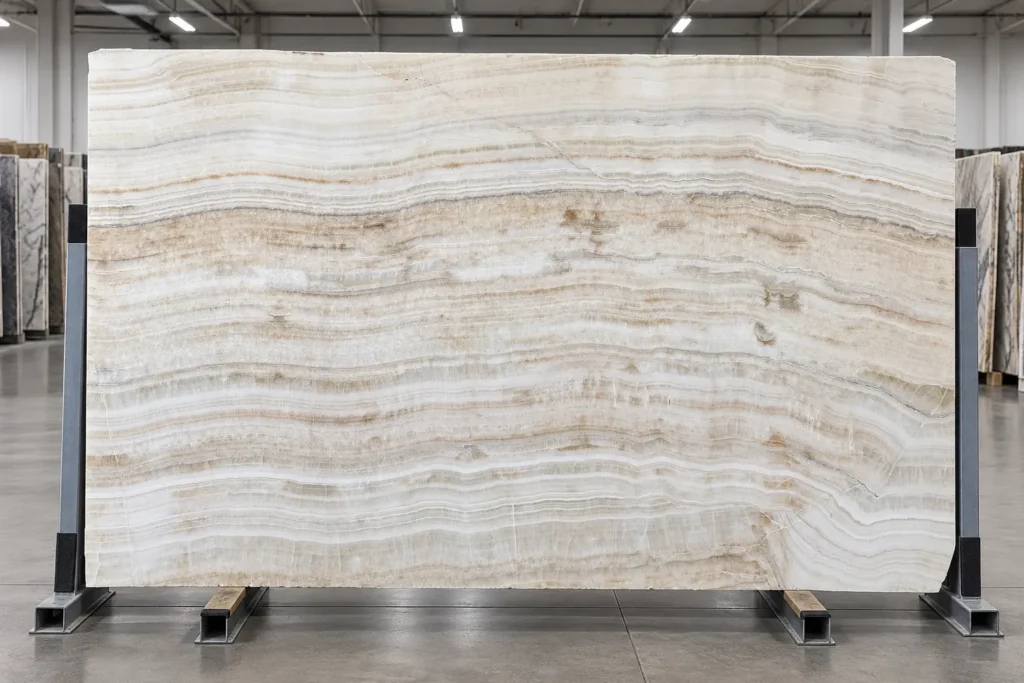
Ivory Onyx Extra is distinguished by its delicate horizontal banding and soft, neutral coloration. Layers of ivory, cream, warm beige, and subtle taupe flow across the stone, creating a continuous pattern that is both visually interesting and remarkably understated.
Unlike more dramatically patterned varieties of onyx, Ivory Onyx Extra offers a quieter, more architectural appearance. Its closely spaced mineral layers create depth and movement without overwhelming the surrounding design, making it particularly appealing for contemporary and transitional interiors.
The horizontal orientation of the veining is one of the material’s defining characteristics. When incorporated into large wall panels, fireplace surrounds, or other architectural features, these flowing bands can emphasize width and create a sense of visual continuity.
As with all natural stone, variations in color, banding, and mineral deposits are inherent characteristics of the material. These differences contribute to the individuality of each slab and should be considered during selection and fabrication.
Ivory, Cream, and Warm Beige Coloration
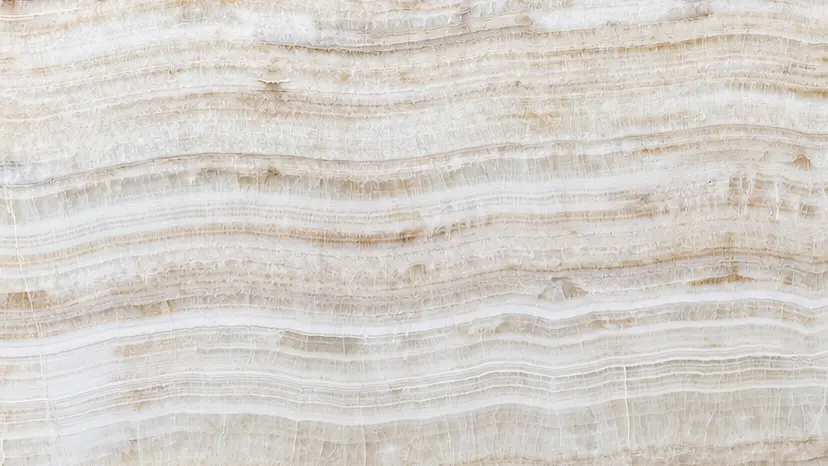
The subtle coloration of Ivory Onyx Extra is largely associated with its mineral composition and the conditions under which the stone formed. Like most decorative calcite onyx, the material is composed primarily of calcium carbonate (CaCO₃), deposited in successive layers as mineral-rich water circulated through natural openings and cavities.
The predominantly ivory and cream-colored layers are characteristic of relatively pure calcite, while the warmer beige, tan, and honey-colored bands likely reflect small concentrations of additional minerals and trace elements introduced during formation.
Iron-bearing compounds, particularly iron oxides and hydroxides such as hematite and goethite, are common contributors to yellow, golden, and brown coloration in natural stone. Even small quantities can influence the appearance of otherwise pale calcium carbonate deposits. Fine clay particles and other mineral impurities may also contribute to the muted taupe and grayish tones visible within the slab.
The variation between lighter and darker bands reflects changes in mineral deposition over time. Differences in water chemistry, mineral concentration, and precipitation conditions produced the closely spaced layers that give Ivory Onyx Extra its distinctive horizontal movement.
These natural variations create a sophisticated palette of warm neutrals, allowing Ivory Onyx Extra to complement wood, bronze, brushed metals, and other architectural finishes without competing with the surrounding materials.
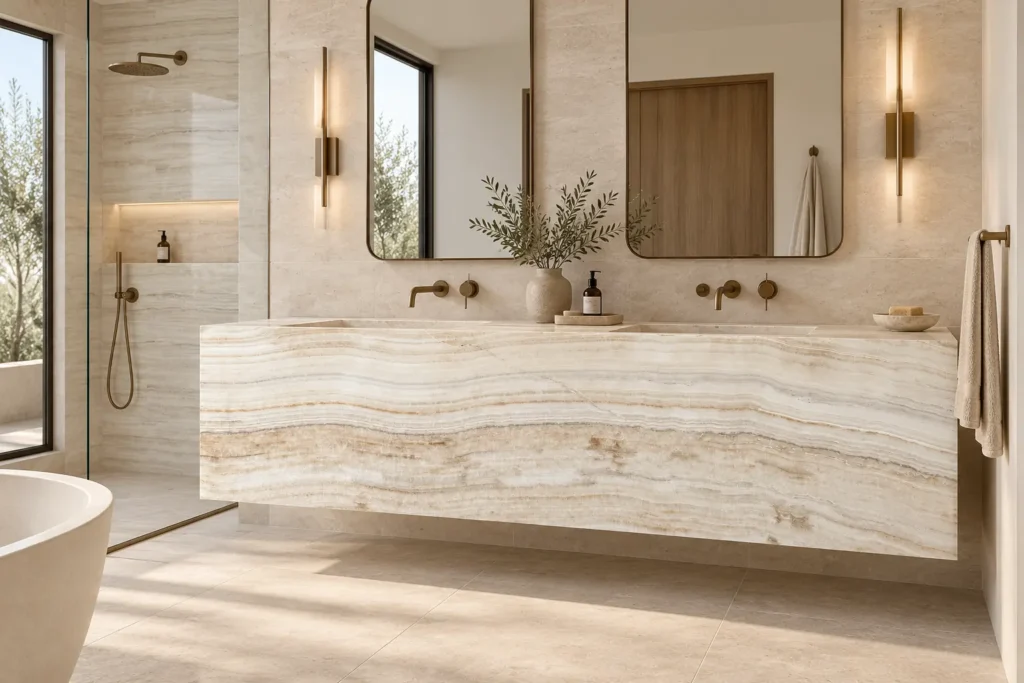
Natural Movement and Layered Patterns
One of the most distinctive characteristics of Ivory Onyx Extra is the remarkable continuity of its horizontal banding. Fine, closely spaced layers move across the stone in gentle waves, occasionally rising, dipping, or folding into more pronounced formations. This natural movement gives the material depth and visual interest while maintaining an overall sense of balance.
The layered patterns developed through successive deposits of calcium carbonate, with subtle changes in mineral concentration and deposition conditions creating variations in color, thickness, and transparency. Some bands appear almost linear, while others form delicate undulations that reflect changes in the stone’s growth over time.
Unlike the bold, irregular veining commonly associated with marble, Ivory Onyx Extra displays a more rhythmic pattern. Its flowing layers can create a sense of continuity across large architectural surfaces, particularly when the stone is installed with the banding running horizontally.
For projects incorporating multiple slabs, careful selection and layout are essential. Although individual slabs may share similar coloration and movement, their patterns will not necessarily align. Where available, sequential slabs can offer opportunities for greater visual continuity, while bookmatching or other mirrored arrangements depend on the cutting sequence and available inventory.
The result is a natural stone whose character comes not from dramatic contrasts, but from the intricate layering and subtle variations developed during its formation.
Natural Formation and Characteristics of Ivory Onyx
Ivory Onyx Extra is believed to have formed through the gradual deposition of calcium carbonate from mineral-rich water, a geological process that can produce the distinctive layering and translucency associated with decorative onyx.
Unlike marble, which develops when limestone undergoes intense heat and pressure during metamorphism, most natural onyx used in architectural applications is a form of banded calcite, sometimes referred to geologically as calcareous onyx or onyx marble. Despite these commercial names, it is not a true metamorphic marble.
The formation process typically begins when groundwater absorbs carbon dioxide as it moves through soil and rock. This mildly acidic water can dissolve calcium carbonate from surrounding limestone formations, carrying dissolved calcium and bicarbonate through underground fractures, cavities, and natural channels.
When conditions change, particularly through the release of dissolved carbon dioxide, calcium carbonate can precipitate from the water and accumulate on existing mineral surfaces. Over extended periods, successive deposits build the layers that eventually form substantial masses of banded calcite.
Changes in water chemistry, mineral concentration, flow conditions, and the presence of trace impurities can produce differences in color and layer thickness. These variations are responsible for the delicate horizontal bands, occasional undulations, and subtle transitions between ivory, cream, beige, and warmer earth tones visible in Ivory Onyx Extra.
The stone’s characteristic translucency is associated with its crystalline calcium carbonate structure, which can allow light to penetrate the surface to varying depths. Crystal size, impurities, natural fractures, and differences between individual layers all influence how light travels through the material.
Although Ivory Onyx Extra displays characteristics consistent with this type of geological formation, its precise depositional environment cannot be established from appearance alone. The material may have developed in a cave, along a mineral-rich spring system, or within another environment favorable to calcium carbonate precipitation.
The result is a natural stone that preserves a visible record of changing mineral deposition conditions, expressed through its finely layered patterns, warm neutral coloration, and distinctive interaction with light.
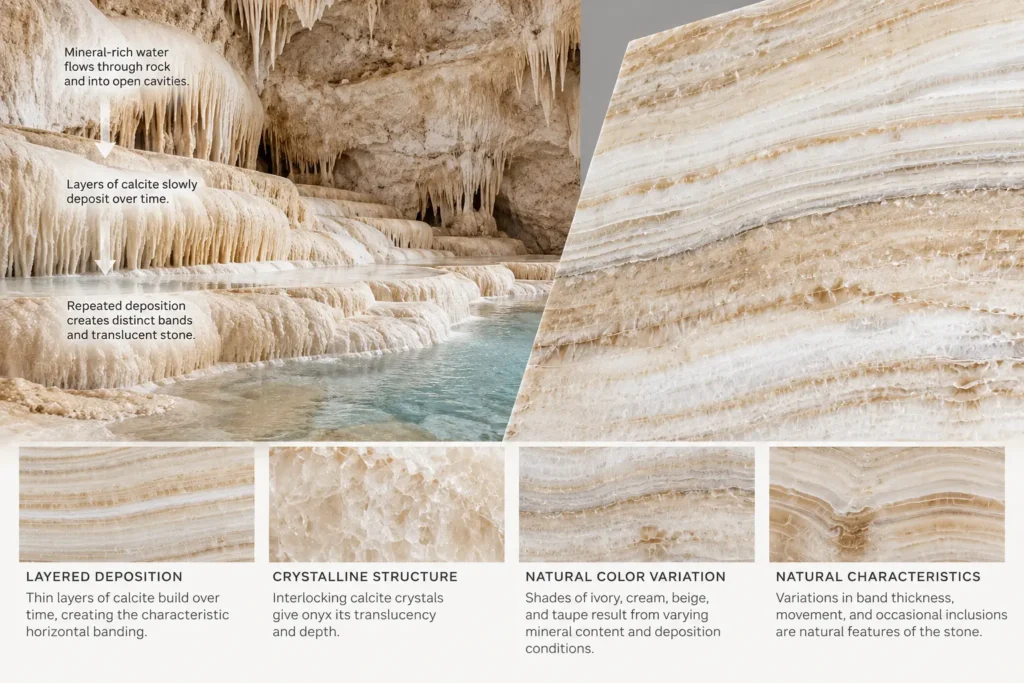
How Natural Onyx Develops Its Distinctive Layers
The distinctive banding found in natural onyx develops through repeated episodes of calcium carbonate deposition. As mineral-rich water moves through underground cavities, fractures, or spring systems, changes in temperature, pressure, and dissolved carbon dioxide can cause calcium carbonate to precipitate and accumulate in successive layers.
Each new deposit forms over an existing mineral surface. Over time, variations in water chemistry, mineral concentration, and deposition rates create subtle differences in color, thickness, and crystalline structure. These changes produce the alternating bands that distinguish decorative onyx from many other natural stones.
In Ivory Onyx Extra, the closely spaced ivory, cream, and beige layers suggest relatively consistent deposition conditions interrupted by periodic changes in mineral content. The warmer bands may contain trace amounts of iron-bearing compounds or other impurities, while the lighter layers are likely composed of comparatively pure calcium carbonate.
The gently undulating patterns visible throughout the slab may reflect irregularities in the original depositional surface, changes in water movement, or variations in crystal growth. As successive layers accumulated, these subtle contours were preserved and repeated, creating the flowing horizontal movement seen in the finished stone.
Unlike the veining found in many metamorphic marbles, which may result from deformation, recrystallization, or mineral-filled fractures, the banding in calcite onyx generally represents successive episodes of mineral precipitation.
When a block is cut into slabs, these accumulated deposits become visible as continuous bands across the stone’s surface. The orientation of the cut relative to the original layers determines how prominently the patterns appear.
In Ivory Onyx Extra, the resulting horizontal movement is particularly well suited to architectural applications where designers want to emphasize the natural continuity and geological character of the material.
Translucency and Light Transmission
One of the most remarkable characteristics of natural onyx is its ability to transmit light through the stone. This translucency is closely related to the crystalline structure of calcium carbonate, the primary mineral component of decorative onyx.
Many varieties of calcite onyx exhibit a fine-grained crystalline structure, sometimes described as microcrystalline or cryptocrystalline. The term cryptocrystalline refers to mineral crystals so small that they cannot be individually distinguished without significant magnification. Rather than forming large, easily recognizable crystals, the calcium carbonate develops as a dense accumulation of extremely fine crystalline particles.
This fine crystalline structure can contribute to the distinctive way light interacts with natural onyx. When light enters the stone, it passes through the calcium carbonate while encountering numerous microscopic crystal boundaries, mineral inclusions, and variations in density. These features scatter and diffuse the light, producing the soft, luminous appearance associated with translucent onyx.
However, fine crystal size alone does not guarantee translucency. The degree of light transmission also depends on the stone’s thickness, crystal orientation, internal fractures, porosity, and mineral impurities. Closely packed crystals with relatively few voids may permit greater light penetration, while darker mineral deposits and internal discontinuities can absorb or scatter additional light.
In Ivory Onyx Extra, the alternating layers of ivory, cream, and warm beige may respond differently to illumination. Lighter bands may transmit more light, while darker layers containing additional mineral impurities may appear more subdued. When illuminated from behind, these differences can emphasize the stone’s natural horizontal patterns and reveal details that are less apparent under conventional surface lighting.
The resulting effect can make natural onyx particularly appealing for illuminated feature walls, decorative panels, reception areas, and other architectural installations where the stone becomes part of the lighting design.
Because translucency varies from one slab to another, actual light transmission should always be evaluated before specifying a backlit installation. Testing the selected material with an appropriate lighting system helps establish the desired brightness, color temperature, and uniformity while accounting for variations within the stone.
Backlit Ivory Onyx and Architectural Lighting
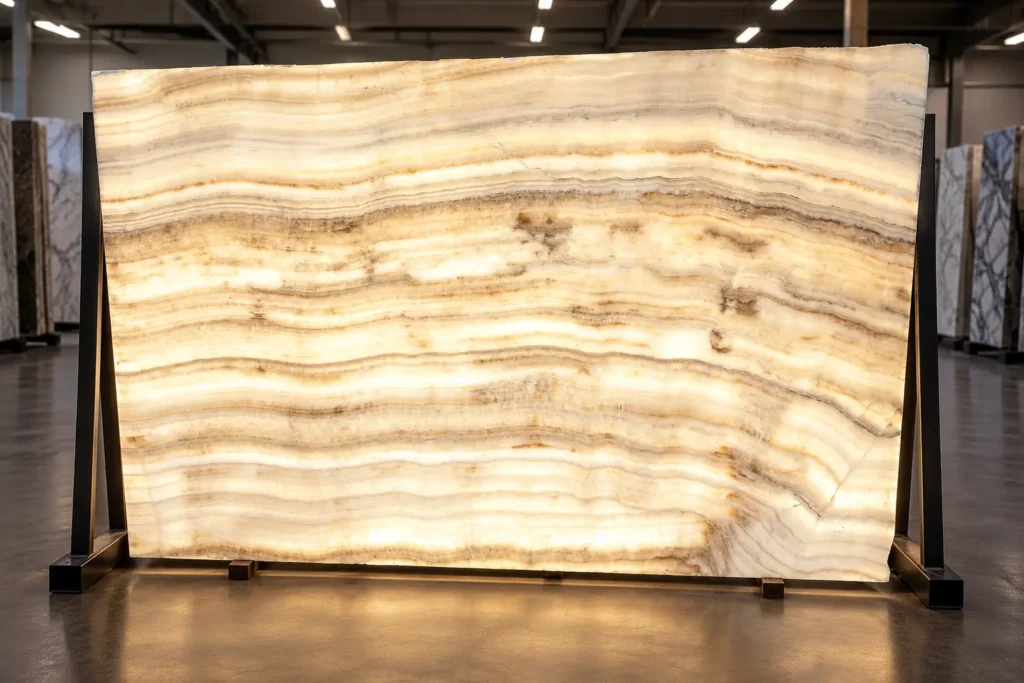
Creating Illuminated Onyx Feature Walls
Natural onyx offers a distinctive architectural opportunity: the ability to introduce light through the stone itself rather than relying exclusively on conventional surface illumination. When properly selected and installed, translucent onyx panels can transform an ordinary wall into an illuminated architectural feature.
Ivory Onyx Extra is particularly appealing for this type of application because of its delicate horizontal banding and warm neutral coloration. Backlighting may emphasize the differences between its ivory, cream, and beige layers, revealing subtle variations in mineral density and crystalline structure that are less apparent under ordinary lighting.
An illuminated onyx feature wall can serve as a focal point in a luxury residence, hotel lobby, reception area, or hospitality interior. Depending on the design, the stone may be installed as a single panel, a series of adjoining slabs, or a carefully arranged composition intended to emphasize the natural movement of the material.
The lighting system is as important as the stone selection. Modern LED panels and purpose-designed backlighting systems can provide relatively uniform illumination across large surfaces. Appropriate light diffusion, spacing, and color temperature help minimize visible hotspots and unwanted shadows while maintaining the stone’s natural coloration.
For Ivory Onyx Extra, warm white lighting may complement the material’s cream and beige tones, while a more neutral color temperature can produce a different visual effect. The final appearance should be evaluated using actual samples or selected slabs with the proposed lighting system rather than relying solely on photographs or digital renderings.
Backlit installations also require careful coordination between the stone fabricator, lighting supplier, and installation contractor. Panel thickness, structural support, access for future lighting maintenance, and the visibility of seams or reinforcement materials all influence the finished result.
Because natural onyx varies in translucency, not every slab or portion of a slab will transmit light uniformly. Testing the selected material before fabrication is essential to establishing realistic expectations.
When these considerations are addressed early in the design process, illuminated Ivory Onyx Extra can become more than a decorative wall covering. The stone and lighting work together to create an architectural feature that highlights the material’s natural layering, depth, and geological character.
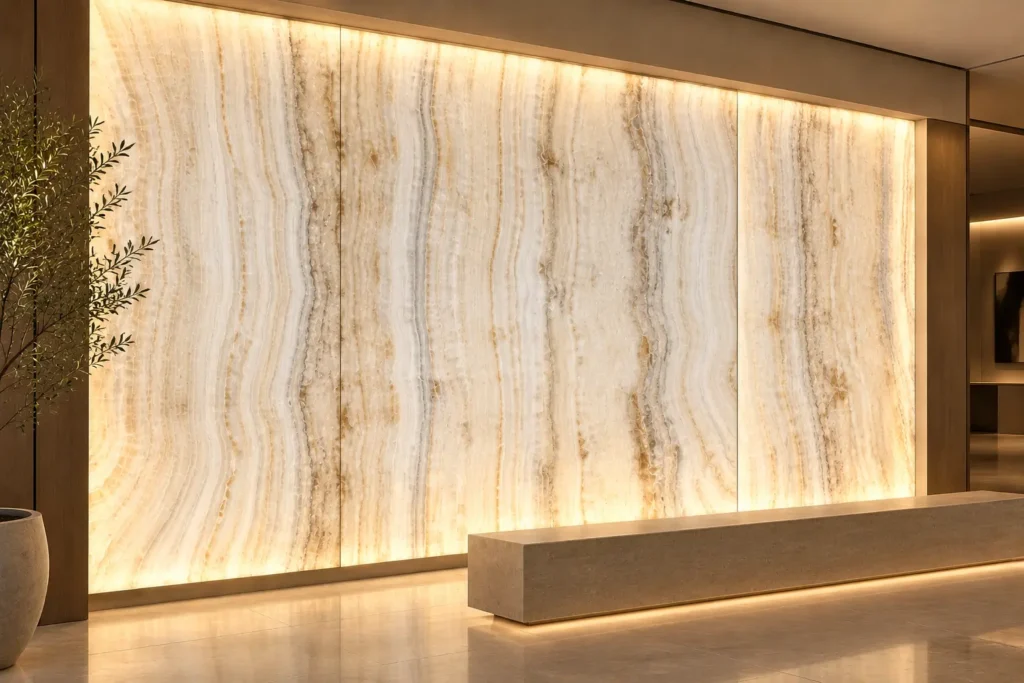
Considerations for Backlighting Natural Onyx
Backlighting natural onyx requires more planning than simply placing a light source behind a stone panel. The translucency that makes onyx so visually appealing also introduces technical considerations involving slab selection, thickness, lighting distribution, structural support, and installation.
Not all natural onyx transmits light uniformly. Differences in crystalline structure, mineral concentration, banding, and internal fractures can affect the amount of light passing through individual areas. In Ivory Onyx Extra, the lighter ivory and cream layers may transmit light differently from the darker beige and taupe bands. These variations are part of the material’s natural character, but they should be evaluated before fabrication.
Slab thickness is another important consideration. Thinner sections generally allow more light transmission, although the relationship is not always consistent because of variations within the stone. Reducing thickness may improve illumination but can also affect structural integrity, particularly in material containing natural fissures or other discontinuities. Any thinning, reinforcement, or lamination should be evaluated by an experienced stone fabricator.
The choice of lighting system significantly influences the finished appearance. LED panels and purpose-designed backlighting assemblies can provide more consistent illumination than widely spaced individual light sources. Proper diffusion and spacing help reduce hotspots, visible shadows, and uneven brightness. The depth of the lighting cavity must also accommodate the selected system and its installation requirements.
Color temperature deserves particular attention. Warm white illumination can emphasize the golden and beige tones of Ivory Onyx Extra, while neutral white lighting may provide a different interpretation of its natural coloration. The appropriate choice depends on the surrounding materials, architectural lighting, and intended atmosphere.
For larger installations, slab layout and seam placement should be coordinated with the lighting design. Adjacent slabs may vary in translucency even when their surface coloration appears similar. Reinforcement materials, adhesives, mounting components, and panel joints can also become more visible when illuminated from behind.
Accessibility is another consideration that is sometimes overlooked. LED components, drivers, and electrical connections should be installed in accordance with applicable requirements, with provisions for maintenance or replacement. Adequate ventilation and thermal management should follow the lighting manufacturer’s specifications.
Before committing to a backlit installation, we recommend testing the actual Ivory Onyx Extra material with the proposed lighting system. Ideally, this evaluation should include representative areas of the selected slabs and the intended stone thickness. A physical mockup can reveal variations in light transmission, color, and visible support details that photographs and computer renderings cannot reliably predict.
With appropriate planning and coordination among the designer, fabricator, lighting specialist, and installer, backlit natural onyx can produce an exceptional architectural feature. The objective is not to eliminate the stone’s natural variation, but to understand how it will interact with light and incorporate those characteristics into the finished design.
Fabrication, Installation, and Maintenance
Ivory Onyx Extra is a decorative natural stone that requires thoughtful fabrication, appropriate installation methods, and realistic expectations regarding maintenance. Like other calcite-based onyx materials, it is considerably more sensitive to acids, abrasion, and certain cleaning products than many granites and quartzites.
The intended application is particularly important. Vertical wall installations and horizontal surfaces exposed to daily use present very different maintenance requirements.
Vertical Wall Applications
Decorative wall panels, fireplace surrounds, illuminated features, and other vertical installations are generally among the more suitable applications for natural onyx. These surfaces are less likely to experience abrasion, standing liquids, food spills, or repeated contact with household chemicals.
In residential and hospitality interiors, vertical installations can preserve the stone’s appearance for many years with relatively modest maintenance. Routine cleaning generally involves a soft cloth and a suitable pH-neutral stone cleaner. Abrasive pads, acidic cleaners, and harsh chemicals should be avoided.
Backlit wall installations require additional fabrication and installation planning. Panel thickness, reinforcement, mounting systems, lighting access, and the potential visibility of adhesives or support components must all be considered. Large panels may require engineered support systems appropriate to their dimensions and weight.
Horizontal Surfaces and Daily Use
Horizontal applications, including bathroom vanities, bar tops, tabletops, and countertops, require considerably more attention because they are exposed to spills, abrasion, and regular cleaning.
Natural onyx is composed primarily of calcium carbonate, which reacts with acidic substances. Lemon juice, vinegar, wine, certain cosmetics, and many household cleaning products can chemically etch the surface, leaving dull marks or changes in sheen. These marks are not necessarily stains; they result from a reaction with the stone itself.
Kitchen countertops and food preparation surfaces present the greatest maintenance challenges. In addition to acidic foods and beverages, these areas are exposed to oils, moisture, utensils, cookware, and frequent cleaning. Even careful use cannot eliminate the possibility of etching, scratching, or staining.
For this reason, we generally recommend Ivory Onyx Extra for decorative applications rather than heavily used kitchen countertops or primary food preparation surfaces. While it can be fabricated for horizontal use, the owner should understand that maintaining a pristine appearance may require considerable care and occasional professional restoration.
Bathroom vanities and decorative tabletops may be more practical, particularly where use is limited and the owner is comfortable with the material’s maintenance requirements. However, toothpaste, cosmetics, personal care products, and standing water can still affect the surface or finish.
Sealing and Surface Protection
A suitable penetrating sealer may help reduce the absorption of certain liquids, potentially providing additional time to clean spills before staining occurs. However, sealing does not make natural onyx stainproof, scratchproof, or resistant to acid etching.
This distinction is important. No conventional penetrating sealer can prevent the chemical reaction between acidic substances and calcium carbonate. Claims suggesting otherwise should be evaluated carefully.
Protective coatings or specialty surface treatments may offer additional protection in certain applications, but their suitability, appearance, maintenance requirements, and long-term performance should be reviewed with the product manufacturer and an experienced stone professional.
Fabrication and Long-Term Care
Natural onyx can contain fissures, mineral-filled veins, and variations in crystalline structure that require special attention during cutting, handling, and installation. Depending on the slab and intended application, reinforcement or resin treatments may be necessary. Cutouts, narrow sections, unsupported spans, and edge details should be evaluated carefully.
Fabrication should be entrusted to a shop experienced with natural onyx rather than one treating it as interchangeable with marble or granite.
For routine maintenance, use nonabrasive materials and cleaning products specifically suitable for calcite-based natural stone. Spills should be removed promptly, particularly on horizontal surfaces. Acid etching and scratches may require professional refinishing rather than ordinary cleaning.
Ultimately, Ivory Onyx Extra is best specified with an understanding of how the finished surface will be used. On a decorative wall, its natural banding and potential translucency can be enjoyed with relatively little maintenance. On a frequently used countertop, the same material demands a substantially greater commitment to care.
Selecting the appropriate application from the beginning is the most effective way to ensure that the stone performs in line with the owner’s expectations.
Ivory Onyx Extra Slabs in Los Angeles
Ivory Onyx Extra is in stock at The World of Stone in Los Angeles. Our inventory includes a full block of bookmatched slabs measuring 112″ × 71″ × 3/4″, available for viewing by appointment.
These generous dimensions make Ivory Onyx Extra suitable for large decorative wall panels, illuminated features, bathroom vanities, fireplace surrounds, and custom architectural installations.
The availability of a full block provides designers and architects with considerable flexibility when planning larger projects. Sequential slabs offer opportunities for bookmatched compositions, creating mirrored patterns that emphasize the stone’s delicate ivory, cream, and beige banding. Multiple pairs may also be incorporated into larger architectural features, depending on the project requirements and available slab sequence.
Although the slabs share a consistent overall character, natural variations in color, pattern, and translucency should be expected. Reviewing the actual slabs and their sequence is particularly important when planning bookmatched installations or projects involving backlighting.
The World of Stone is a specialty importer and distributor of natural stone and architectural surfaces. We work with architects, interior designers, fabricators, and project teams to assist with material selection, slab layout considerations, and project coordination.
Our Los Angeles showroom operates by appointment, allowing clients to examine the available Ivory Onyx Extra slabs and discuss their specific project requirements.
We also arrange nationwide shipping throughout the contiguous United States using third-party freight carriers, making Ivory Onyx Extra available for luxury residential and hospitality projects beyond Southern California.
View Available Slabs at The World of Stone
Ivory Onyx Extra is in stock at The World of Stone in Los Angeles, with a full block of bookmatched slabs available for selection. Each slab measures approximately 112″ × 71″ × 3/4″, offering opportunities for coordinated installations requiring multiple slabs.
We encourage architects, interior designers, fabricators, and homeowners to view the actual material before making their selections. Natural onyx can vary in coloration, banding, crystalline structure, and translucency, even among slabs cut from the same block.
For projects involving bookmatching, our inventory can be reviewed to identify suitable slab pairs and evaluate pattern continuity. Where backlighting is being considered, we recommend examining the selected material under appropriate lighting conditions before finalizing the design.
The World of Stone operates an appointment-only showroom in the Van Nuys area of Los Angeles. This allows us to dedicate time to reviewing the available slabs, discussing project requirements, and helping clients make informed material selections.
Contact The World of Stone to schedule an appointment to view Ivory Onyx Extra or request additional slab photographs and availability information.
Nationwide Shipping and Project Support
Although Ivory Onyx Extra is stocked at our Los Angeles showroom, The World of Stone supplies natural stone to residential and commercial projects throughout the contiguous United States.
We arrange nationwide shipping through experienced third-party freight carriers familiar with the handling and transportation of natural stone slabs. Appropriate crating, loading, and transportation arrangements are coordinated according to the material, shipment size, and delivery destination.
For projects requiring multiple slabs, particularly bookmatched installations, careful planning is essential. We work with architects, interior designers, contractors, and fabricators to help identify suitable slab sequences, review material requirements, and coordinate selections before shipping.
Ivory Onyx Extra requires particular attention when specified for large wall installations, illuminated features, or custom architectural elements. We can provide available slab photographs, dimensions, and material information to assist project teams with preliminary planning and fabrication considerations.
The World of Stone specializes in sourcing and distributing natural stone rather than fabrication or installation. We encourage coordination with experienced local fabricators and installers who understand the handling requirements and characteristics of calcite-based onyx.
Whether the project is located in Southern California or elsewhere in the country, our objective is to help clients obtain the appropriate material, understand its characteristics, and make informed decisions before fabrication begins.
Contact The World of Stone to discuss Ivory Onyx Extra availability, project requirements, and nationwide shipping arrangements.