
The World of Stone’s Nero Marquina is selected for the classic character associated with this iconic black stone: a deep, dense black background crossed by expressive white calcite veining. While traditional Nero Marquina originates in Spain, our material is sourced as blocks and processed into finished slabs in Italy, where Italian stone-production expertise brings out its depth, contrast and distinctive veining.
In the international stone trade, the name Nero Marquina is also widely used to describe black natural stones with this recognizable look and character. We use the name because it accurately communicates the aesthetic designers and architects know as Nero Marquina, while identifying the production of our slabs separately.

Nero Marquina Slabs Available in Los Angeles
Current Slab Details
Finish: Polished
Usable Size: 115″ × 67″ × 3/4″
Coverage: 53.50 sq. ft. per slab
Availability: Los Angeles / Van Nuys — call for current availability
About Nero Marquina Marble
Nero Marquina is one of the most recognizable black natural stones in architectural and interior design. Its deep black background is crossed by distinctive white calcite veining, creating a dramatic contrast that works equally well as a statement material or as a sophisticated complement to lighter stones, wood, metal and glass.
The name Nero Marquina originates with the celebrated black stone quarried in northern Spain, but it has also become widely associated in the stone and design industries with dense black natural stones that share its characteristic appearance. The material offered by The World of Stone is carefully selected for this classic Nero Marquina look and character.
Our Nero Marquina is processed in Italy by an experienced, high-quality natural stone producer. Italian slab production and finishing bring out the richness of the black background, clarity of the white veining and natural variation that make each slab unique.
Although commonly referred to as Nero Marquina marble within the stone industry, materials of this type are geologically dense limestones. The familiar marble designation reflects longstanding commercial and design terminology rather than a strict geological classification.
The Classic Nero Marquina Look
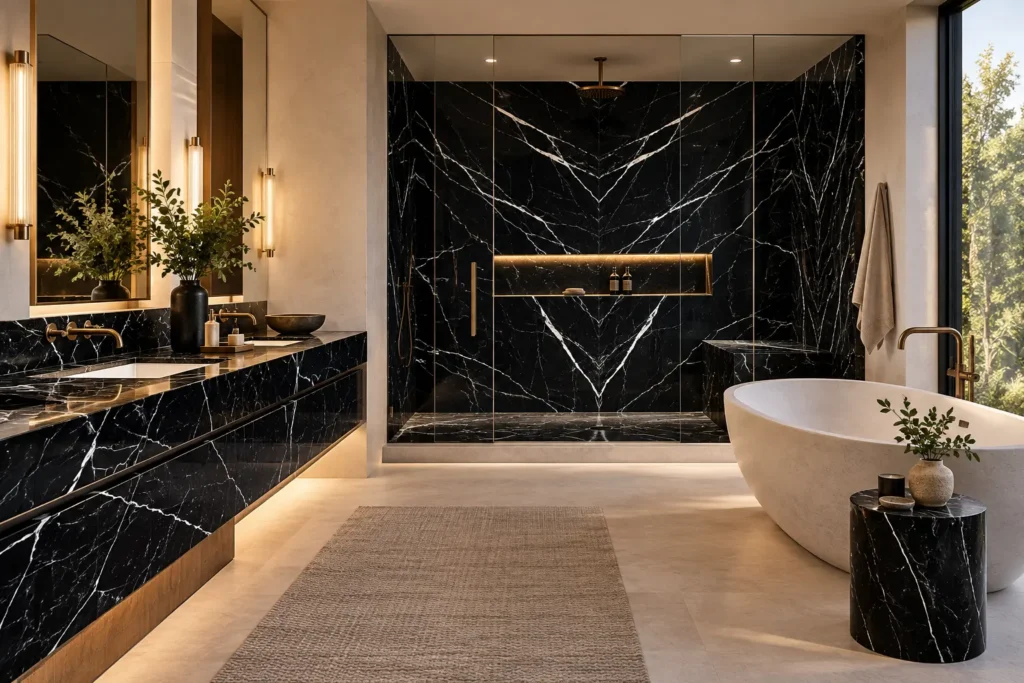
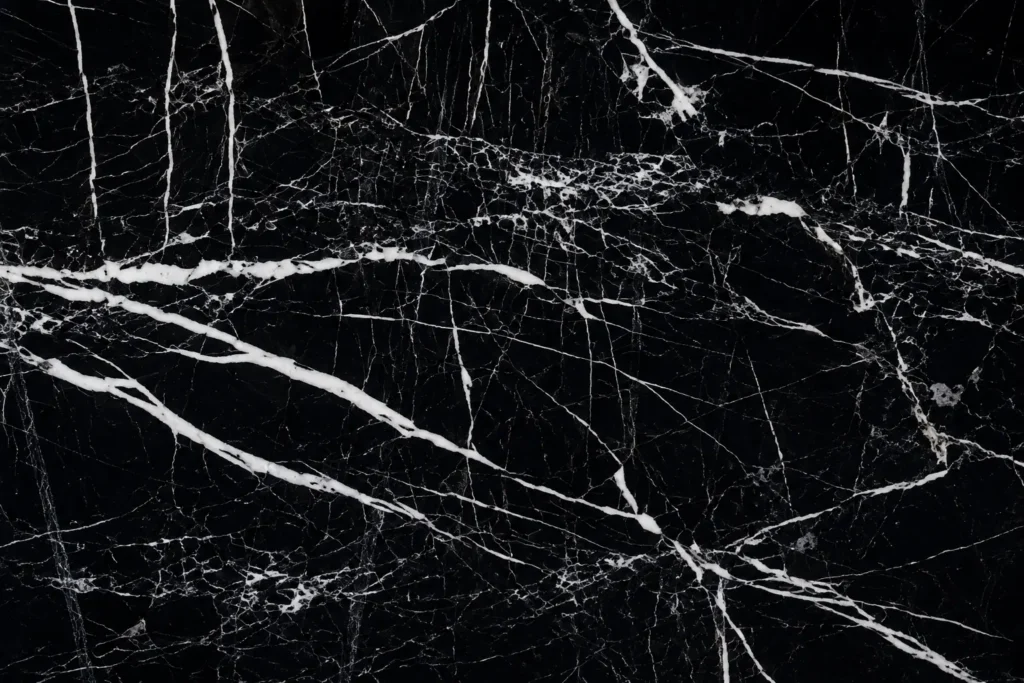
The appeal of Nero Marquina comes from its unmistakable contrast. A deep black background provides the canvas for white calcite veins that move naturally across the surface, ranging from fine linear markings to broader, more expressive formations. No two slabs are exactly alike, giving installations a character that cannot be replicated by manufactured materials.
Unlike black stones chosen primarily for uniformity, Nero Marquina is valued for its movement. The white veining breaks through the dark background and becomes an important part of the design, particularly across large surfaces such as feature walls, fireplaces, islands and bookmatched installations.
The stone can feel bold and dramatic when used extensively, yet refined when introduced as an accent. Against warm woods, brushed metals and soft neutral finishes, the black-and-white contrast becomes sophisticated rather than severe. Paired with white or light-colored natural stone, it can create a striking monochromatic palette.
This combination of depth, contrast and natural variation is what has made the Nero Marquina look enduring. It works comfortably in contemporary, modern European, transitional and classic interiors, allowing the surrounding architecture and materials to determine whether the finished space feels dramatic, restrained or elegant.
Nero Marquina Character, Italian Production
With Nero Marquina, the quality of the finished slab depends on more than the appearance of the raw stone. Dense black limestones with strong calcite veining can contain natural fractures and areas of weakness, making careful block selection, reinforcement, cutting and finishing especially important.
This distinction is particularly important when comparing Nero Marquina slabs in the marketplace. A significant amount of black-and-white stone sold commercially under the Nero Marquina name is processed in China, regardless of where the original block was quarried. Production methods, reinforcement and slab sequencing can vary considerably from one producer to another.
One of the easiest differences to recognize is matching capability. Properly produced consecutive slabs allow the natural veining to continue, mirror or interact intentionally across adjoining surfaces. When slabs cannot be supplied in sequence or bookmatched, designers and fabricators lose an important part of what makes Nero Marquina so effective on feature walls, fireplaces, bathrooms and other large architectural installations.
For this reason, The World of Stone focuses not only on the Nero Marquina appearance, but also on how the material is processed. Italian production, careful reinforcement and access to consecutive slabs allow the stone to be treated as an architectural material rather than simply as an individual black slab with white veins.

Where Does Nero Marquina Come From?
Our material is processed in Italy by an experienced natural stone producer using methods developed for working with blocks that require additional care during production. Blocks can be stabilized and reinforced before and during sawing, helping preserve the integrity of the stone and allowing consecutive slabs to be produced with greater consistency. The resulting slabs retain the natural movement of the material while providing the continuity needed for vein matching and bookmatched installations.
Traditional Nero Marquina originates in the Basque Country of northern Spain, near the town of Markina-Xemein in the province of Biscay. The stone became internationally recognized for its dense black background and contrasting white calcite veins, eventually making Nero Marquina one of the best-known names in black natural stone.
Today, however, the name Nero Marquina is used much more broadly within the international stone industry. Black limestones with similar color, density and white veining are quarried in several regions of the world and are frequently marketed as Nero Marquina or Marquina-type stone because of their resemblance to the original Spanish material.
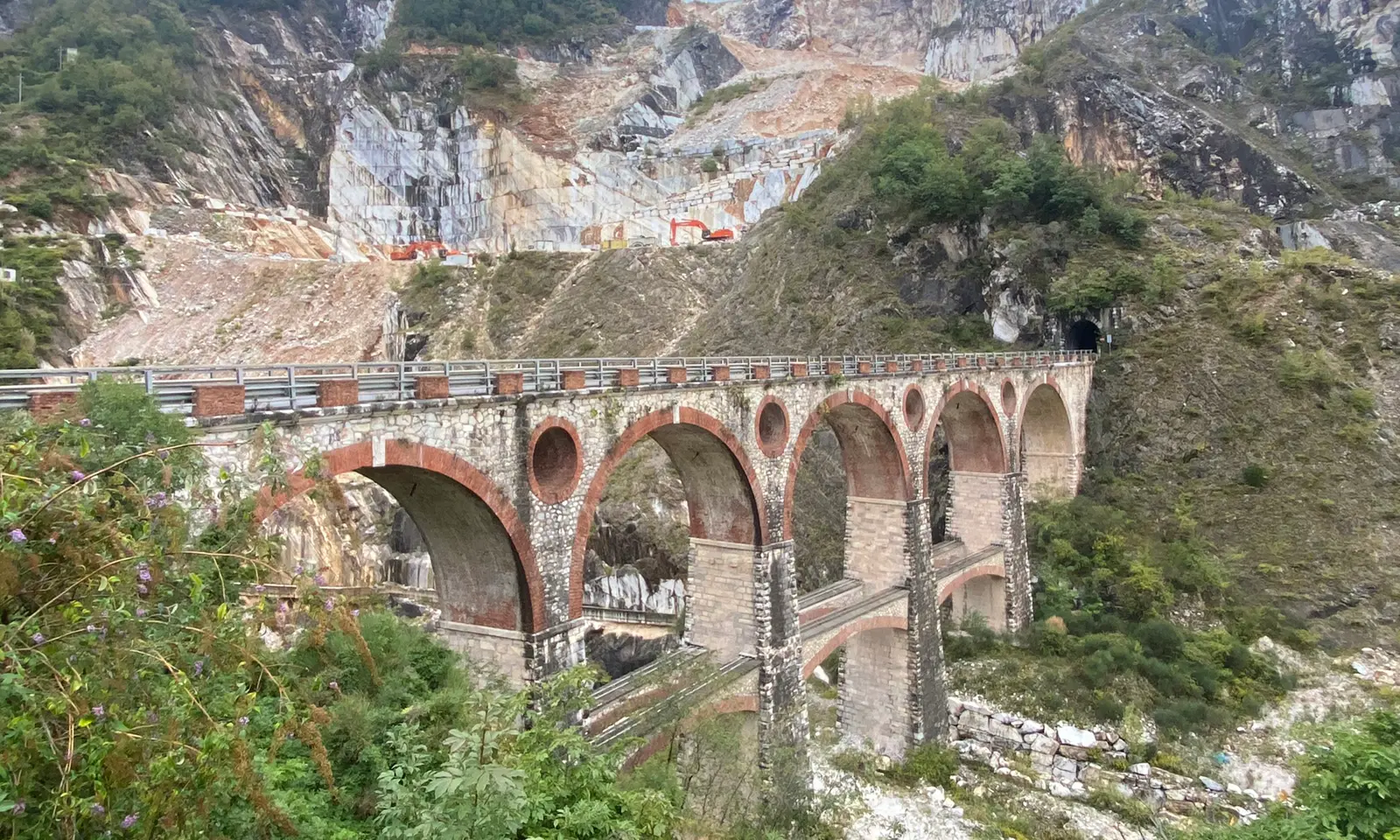
The Nero Marquina offered by The World of Stone is one of these closely related natural stones rather than material from the historic Spanish quarrying area. Italian stone producers source high-quality blocks from quarrying regions around the world, including Africa, selecting blocks for color, structure and veining before processing them in Italy. Our material is selected for the deep black background and distinctive white calcite veining associated with classic Nero Marquina, then processed and finished into slabs in Italy.
For designers and fabricators, this distinction is important: where a stone is quarried and where it is processed are not necessarily the same place. A block may travel internationally before being cut, reinforced, finished and matched into slabs. In the case of our Nero Marquina, it is the combination of the classic Marquina character and high-quality Italian slab production that defines the material we offer.

Geological Characteristics
Nero Marquina is commonly called a marble in the natural stone industry, but geologically it is more accurately described as a dense black limestone. Its dark color comes from the organic-rich carbonate material from which the stone was formed, while the contrasting white veins are primarily calcite deposited within natural fractures over the course of its geological history.
The stone has a compact, fine-grained structure that allows it to take a high polish, producing the deep, almost reflective black appearance for which Nero Marquina is known. Polishing also increases the visual contrast between the dark background and white calcite veining. A honed finish softens that contrast and creates a quieter, more contemporary appearance.
White veining can range from very fine lines to larger, irregular calcite formations. These veins are not surface markings; they extend through the stone and record natural fracturing and mineral deposition within the original limestone formation. Their direction, frequency and width can change considerably from one block—and even one section of a block—to another.
The same geological processes that create Nero Marquina’s dramatic appearance can also introduce natural fissures and areas of structural weakness. For this reason, careful block selection, reinforcement and slab processing are particularly important. When properly produced, the result is a dense, highly decorative natural stone capable of creating striking matched and bookmatched installations.
As a calcite-based stone, Nero Marquina is sensitive to acids. Citrus, vinegar, wine and acidic cleaning products can etch a polished surface, making appropriate sealing, cleaning and maintenance important when the material is used for countertops, bars and other working surfaces.
Why Choose Nero Marquina?
Nero Marquina offers something few natural stones can achieve: dramatic contrast with a remarkably simple palette. Its combination of a deep black background and expressive white veining allows it to become a focal point without introducing additional color into a space.
Designers choose Nero Marquina for both its visual strength and its versatility. It can anchor a light interior, add depth to a neutral palette, or create a sophisticated monochromatic composition when paired with white marble and other pale materials.
- Deep, dramatic black background – Creates visual depth and a strong architectural presence.
- Natural white calcite veining – Each slab has individual movement and character that cannot be duplicated by manufactured surfaces.
- Excellent for bookmatching – Consecutive slabs can create dramatic mirrored compositions for feature walls, fireplaces, showers and other large installations.
- Polished or honed finishes – Polished surfaces emphasize depth and contrast, while honing creates a softer, more understated appearance.
- Pairs beautifully with other materials – Particularly effective with white marble, warm woods, brass, bronze, stainless steel and other metals.
- Works across multiple design styles – Equally appropriate in contemporary, modern European, transitional and classic interiors.
- Strong architectural presence – Effective for everything from a single vanity or tabletop to expansive walls and hospitality installations.
- Italian slab production – Careful processing and reinforcement help preserve the integrity of the stone while allowing consecutive slabs to be selected for matched installations.
Nero Marquina can be used as either the dominant material in a room or as a carefully placed contrast. Its enduring appeal comes from the simplicity of black and white combined with the movement, variation and individuality of natural stone.
Nero Marquina Slabs Available in Los Angeles
The World of Stone offers Nero Marquina slabs in Los Angeles for residential, hospitality and commercial projects. Our slabs are selected for a rich black background, distinctive white veining and the classic high-contrast appearance associated with Nero Marquina.
Because the movement and veining vary naturally from slab to slab, we encourage designers, architects, fabricators and homeowners to view the material in person whenever possible. Seeing the slabs together makes it easier to evaluate background color, vein direction and overall movement, particularly when selecting material for a prominent architectural application.
Consecutive slabs may also provide opportunities for bookmatching and vein matching, allowing the natural pattern to continue across fireplaces, feature walls, showers, vanities, islands and other large surfaces. For projects requiring multiple slabs, reviewing the complete sequence is an important part of the selection process.
Nero Marquina slabs can be viewed at our Van Nuys slab warehouse and showroom by appointment. We also supply natural stone for projects throughout Southern California and nationwide. Please contact The World of Stone for current availability and to arrange a slab viewing.

Selecting Nero Marquina Slabs
Selecting Nero Marquina is about more than choosing a slab with attractive white veining. The distribution, direction and scale of the veins can change throughout a block, so the best selection depends on how the stone will be used and how multiple pieces will relate to one another in the finished installation.
For a countertop, vanity or tabletop, an individual slab can often be selected for the balance of black background and veining that best suits the design. Larger architectural applications require a different approach. Feature walls, fireplaces, showers, islands and other multi-slab installations should be planned around consecutive slabs and vein movement rather than selecting each slab independently.
When consecutive slabs are available, they can be opened like the pages of a book to create a mirrored bookmatch or arranged to allow veins to flow naturally from one surface to another. Reviewing the entire slab sequence before fabrication gives the designer and fabricator greater control over the final composition.
It is also important to inspect the character of the black background. Natural variation, fine calcite markings, larger white veins and occasional areas of concentrated movement are all part of the stone. These characteristics should be considered intentionally rather than treated as imperfections.
Whenever possible, The World of Stone encourages in-person slab selection. Viewing the material at full scale makes it much easier to understand the veining, identify matching opportunities and determine which slabs are best suited to the project’s most visible surfaces. For complex installations, slab selection can become part of the design process itself.
Architectural Applications
Nero Marquina’s combination of a deep black background and expressive white veining gives it a strong architectural presence. It can be used as a dramatic focal point, a contrasting accent, or across larger surfaces where the natural movement of consecutive slabs becomes part of the design.
The stone is particularly effective in applications where its veining can be viewed at scale. Bookmatching and careful vein placement can transform walls, fireplaces and other large surfaces into architectural features, while smaller applications such as vanities, countertops and custom furniture introduce the same character in a more restrained way.
Kitchen Countertops & Islands

Luxury Bathrooms

Fireplace Surrounds

Feature Walls

Flooring & Wall Cladding

Bars & Hospitality

Custom Furniture & Architectural Elements

Bookmatching & Vein Matching

Polished vs. Honed Nero Marquina
The finish has a significant effect on the appearance of Nero Marquina. With its deep black background and contrasting white calcite veining, changing from polished to honed can give the same stone an entirely different character.
A polished finish produces the deepest and most saturated black appearance. The reflective surface increases the contrast between the black background and white veining, emphasizing the stone’s movement and giving it greater visual depth. Polished Nero Marquina is particularly effective for feature walls, fireplaces, vanities, bars and other applications where a dramatic, refined appearance is desired.
A honed finish removes the high reflection and creates a softer, more understated surface. The black typically appears slightly lighter and more charcoal in character, while the white veining becomes less sharply contrasted. This quieter appearance works particularly well in contemporary and modern interiors where the stone is intended to feel architectural rather than highly decorative.
Finish can also affect how the stone performs visually in everyday use. Because Nero Marquina is calcite-based, acidic substances can etch the surface. On polished black stone, etching can be particularly noticeable because it interrupts the uniform reflection of the polished surface. Honing does not prevent etching, but its lower sheen can make minor surface changes less visually apparent.
For countertops, bars and other frequently used surfaces, this difference should be considered during material selection. A polished finish provides the richest black and strongest contrast, while a honed finish offers a softer appearance that can be somewhat more forgiving in daily use.
Neither finish is inherently better. The choice depends on the design intent, application and expectations for how the stone will age. Both allow the natural white veining and individual character of Nero Marquina to remain the defining feature of the material.

Pairing Nero Marquina With Other Materials
Nero Marquina vs. Other Black Natural Stones
Black natural stones can appear similar at first glance, but their geology, veining, finish and overall character can be very different. Nero Marquina is distinguished by the combination of a deep black background and expressive white calcite veining. Rather than providing a completely uniform black surface, the movement of the veins becomes an important part of the design.
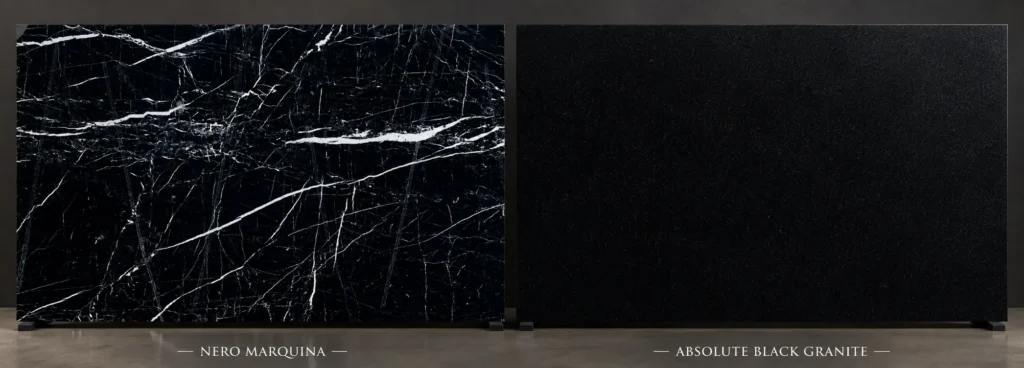
Nero Marquina vs. Absolute Black Granite
Absolute Black granite is typically selected for consistency and uniformity. Its fine-grained surface provides a nearly uninterrupted black appearance with very little movement. Nero Marquina offers the opposite aesthetic: white calcite veins move across the black background, giving each slab an individual character. Granite is also considerably more resistant to acids and everyday wear, making Absolute Black a practical choice when performance and uniformity are more important than dramatic veining.
Nero Marquina vs. Black Soapstone
Black soapstone has a softer, quieter appearance and is generally characterized by subtle veining and a smooth, almost tactile surface. Its color can deepen with oiling and use, developing a natural patina over time. Soapstone is nonporous and resistant to acids, but it is considerably softer and can scratch or dent more readily. Nero Marquina provides a more formal appearance, stronger contrast and significantly more pronounced white veining.

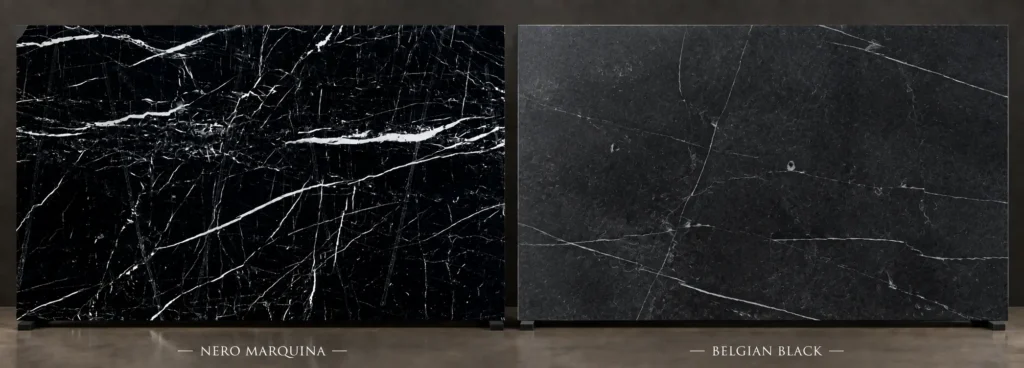
Nero Marquina vs. Belgian Black
Belgian Black is another historic black limestone, but it is prized primarily for the depth and uniformity of its dark background rather than dramatic veining. Nero Marquina has considerably more movement, making it better suited when the stone itself is intended to become a prominent visual element within the architecture.
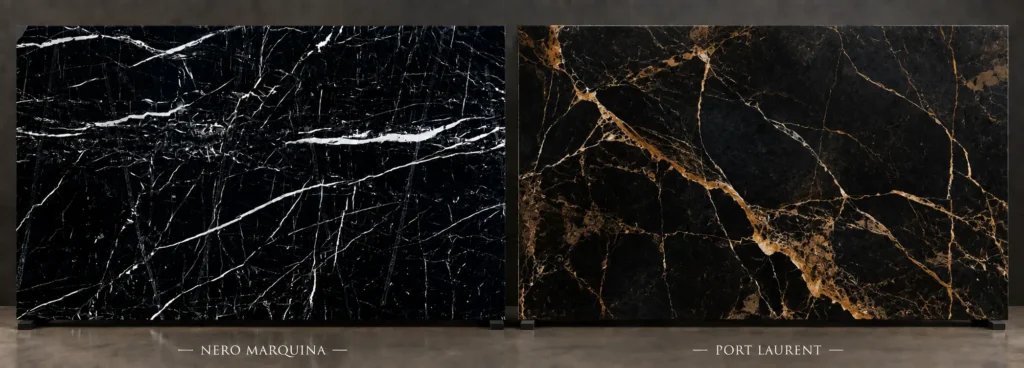
Nero Marquina vs. Port Laurent and Other Veined Black Stones
Highly veined black stones such as Port Laurent can share Nero Marquina’s dramatic movement, but their character is distinctly different. Port Laurent commonly introduces gold, bronze, cream and warm-colored veining into the black background. Nero Marquina remains much closer to a pure black-and-white palette, making it particularly effective in interiors where strong contrast is desired without introducing additional color.
The choice between black natural stones ultimately depends on what the material needs to contribute to the design. For a quiet, uniform surface, granite or a minimally veined black limestone may be more appropriate. Soapstone offers a softer surface that develops character with use. More colorful black marbles and limestones can introduce warmth and additional movement.
Nero Marquina occupies a distinctive position between these materials. Its appeal comes from combining the simplicity of black and white with the unpredictable movement of natural calcite veining. This allows it to function as a sophisticated dark background when used sparingly—or become one of the defining architectural elements of a space when the veining is deliberately matched across larger surfaces.
Care & Maintenance
Nero Marquina is a beautiful natural stone, but its deep black background makes proper care particularly important. Like other calcite-based stones, it is sensitive to acids and can etch when exposed to acidic foods, beverages or cleaning products.
Etching is different from staining. A stain occurs when a substance is absorbed into the stone and changes its color. Etching is a chemical reaction between acid and the calcium carbonate in the stone that physically alters the surface finish. On polished Nero Marquina, an etched area typically appears as a dull, lighter or cloudy spot where the polish has been affected.
This is especially noticeable on black stone. On white and light-colored marble, minor etching can visually blend into the background and may be difficult to see except under certain lighting. Against the deep black surface of Nero Marquina, however, the difference between a polished surface and an etched area can be much more apparent.
Common causes include lemon and citrus juice, wine, vinegar, carbonated beverages and acidic household cleaners. Spills should be wiped up promptly, particularly on countertops, vanities, bars and other working surfaces.
Nero Marquina should be cleaned with a pH-neutral cleaner formulated for natural stone and a soft cloth. Avoid vinegar, acidic bathroom cleaners, abrasive powders and harsh general-purpose cleaning products. Periodic sealing can help reduce the absorption of liquids and staining agents, but it is important to understand that a sealer does not prevent etching.
For applications where everyday use is expected, the choice of finish should also be considered. A polished finish creates the deepest black appearance and strongest contrast with the white veining, but it also makes changes in the surface sheen easier to see. A honed finish has a softer, more matte appearance and can make minor etching less visually apparent.
Nero Marquina should therefore be selected with an understanding of how the surface will age. In decorative applications such as feature walls and fireplace surrounds, etching is rarely a significant concern. On kitchen countertops, bars and other frequently used surfaces, owners should expect more maintenance—and, over time, the possibility of developing a natural patina.
Technical Data
Because natural stone varies from quarry to quarry and even between different areas of the same deposit, technical properties should be evaluated using test data that applies to the specific material being supplied.
Nero Marquina is a dense, fine-grained, calcite-based limestone that is commonly classified commercially as marble. Its compact structure allows the stone to accept a high polish, producing the deep black surface and strong contrast with the white calcite veining for which the material is known.
The stone’s calcite composition is also important when specifying it. Like marble and other calcium-carbonate stones, Nero Marquina is acid sensitive. Contact with acidic substances can etch the surface, particularly when polished. This characteristic should be considered when specifying the material for kitchens, bars, vanities and other working surfaces.
Natural fissures and calcite veins are inherent characteristics of this type of stone. Depending on the block, reinforcement may be used during slab production to improve stability and preserve areas of natural movement. Proper reinforcement should not be considered a defect; it is part of the production process for many highly veined natural stones.
Physical properties such as water absorption, density, compressive strength, flexural strength and abrasion resistance can vary by quarry and block. For projects requiring specific ASTM, EN or other performance criteria, current test data should be reviewed for the material being considered rather than relying on generic values published for stones sold under the Nero Marquina name.
The World of Stone can provide available technical information for project-specific specification and evaluation.



Test Data
- Water absorption – .92%
- Bulk Density – 2720 kg/m³
- Compressive Strength – 72.11 MPa
- Abrasion Resistance – 13–15 cm³/50cm² loss
- Porosity – ~0.5%–1.0%