
There are no stupid questions. Only expensive assumptions.
After 35 years in the natural stone business, I’ve learned that selecting the right material involves considerably more than finding something beautiful.
Natural stone offers an extraordinary range of colors, textures, and geological characteristics. But every stone has its own physical properties, and those properties matter.
A material that performs beautifully as an interior feature wall may require an entirely different approach when used on an exterior façade. A polished marble that looks magnificent in a residential bathroom may need additional consideration before being specified for a heavily trafficked commercial floor.
The stone itself isn’t necessarily the problem.
The application may be.
And sometimes the difference between a successful installation and a very expensive mistake comes down to asking a question that seems almost too obvious to ask.
An $80 Million Lesson in Chicago
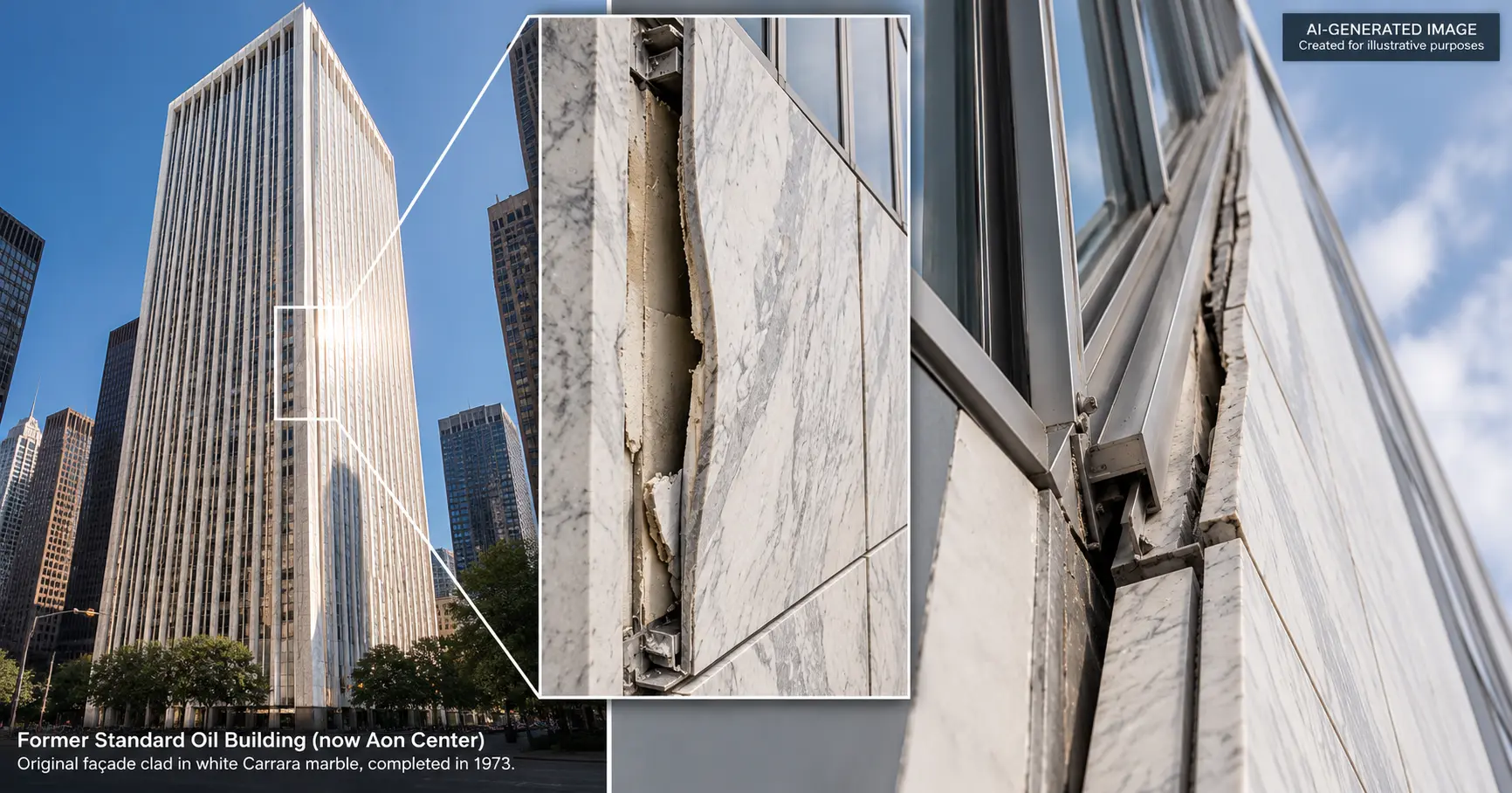
One of the most instructive examples of improper stone specification is the former Standard Oil Building in Chicago, now known as the Aon Center.
Completed in 1973, the 83-story building was originally clad in approximately 44,000 panels of beautiful white Italian Carrara marble.
The panels were approximately 1¼ inches thick.
If you’ve ever visited Chicago in winter, you may have noticed it can get a bit chilly.
I once visited Chicago with friends in late October. It was remarkably cold, even by Chicago standards.
A local suggested I should have brought my winter clothes.
I was wearing a flannel shirt.
“I’m from Los Angeles,” I told him. “These are my winter clothes.”
Chicago’s weather is no joke, particularly when you’re selecting materials for an 83-story building.
The marble façade was exposed to significant temperature fluctuations, intense summer sun, freezing winters, and high winds.
Over time, the panels began to bow and crack. The repeated heating and cooling produced a phenomenon known as thermal hysteresis.
In simplified terms, repeated temperature changes can cause permanent deformation in certain marbles as their mineral crystals expand and contract differently. The panels gradually bowed and lost strength.
Eventually, the entire façade had to be replaced with thicker granite panels from North Carolina.
The cost was approximately $80 million.
But here’s the important distinction.
The problem wasn’t simply that Carrara marble had been selected. The approximately 1¼-inch-thick panels were particularly vulnerable to the thermal stresses of that installation.
Thicker panels would have provided greater resistance to deformation and may have significantly extended the façade’s service life. However, thickness alone is not a guarantee. The marble’s mineral structure, exposure conditions, anchoring system, and long-term performance all require consideration.
The lesson isn’t that marble cannot be used on exterior buildings.
It’s that the material, thickness, installation system, and environment must be considered together.
And that brings me to one of the first questions I ask when discussing a new project.
Where Is the Project?
When someone contacts me about supplying stone for an exterior application, one of my first questions is remarkably simple.
“Where is the project?”
It may seem obvious. After all, we’re based in Los Angeles, and many of our customers are local.
But I never assume the project is in Southern California.
It could be in Chicago, New York, Las Vegas, Nashville, or somewhere with an entirely different climate.
And that matters.
A limestone that performs well in a relatively mild climate may require additional evaluation before being specified for a building exposed to severe freeze-thaw conditions.
A stone used for exterior paving in Southern California may face entirely different challenges when installed in a region with freezing temperatures, snow, and deicing salts.
Even within the same region, exposure can vary considerably.
Is the material going on a shaded wall or a sun-exposed façade? Will it be installed horizontally or vertically? Is it near saltwater? Will it be subjected to heavy pedestrian traffic?
These aren’t minor details.
They influence material selection, thickness, finish, anchoring, installation methods, and long-term performance.
The same stone may be perfectly appropriate for one application and require an entirely different approach for another.
That’s why I ask where the project is.
And then I usually ask several more questions.
Some of them may seem stupid.
I’ve learned to ask them anyway.
Understanding the Material
Every natural stone has characteristics that influence where and how it should be used.
Marble, limestone, granite, quartzite, travertine, slate, and onyx are not interchangeable simply because they can all be cut into slabs or tiles.
Their physical properties can differ considerably.
Among the characteristics worth evaluating are:
- Water absorption and porosity: How readily the material absorbs moisture and how that may affect staining, weathering, or freeze-thaw performance.
- Flexural strength: The stone’s resistance to bending, particularly important for cladding and spanning applications.
- Compressive strength: Its ability to withstand loads.
- Abrasion resistance: How well a surface withstands wear from foot traffic and other use.
- Slip resistance: An important consideration for flooring, particularly in wet or exterior environments.
- Chemical sensitivity: How the material responds to acids, cleaning products, and other substances.
Finish selection also matters.
A polished stone may be appropriate for a wall but unsuitable for a wet walking surface. A textured finish may improve traction, but it can also affect maintenance and appearance.
These decisions should be made with an understanding of the material’s properties, the installation conditions, and the applicable performance requirements.
Not simply because a particular photograph looked beautiful.
It’s Not Always a Question of Can or Can’t
One assumption I particularly dislike is that a stone simply cannot be used in a particular application.
In reality, there are relatively few situations where the answer is an automatic no.
More often, the question is what the client is willing to accept in terms of maintenance, appearance, performance, and cost.
Consider a gray limestone specified for an exterior wall exposed to direct sunlight.
Depending on the particular limestone, prolonged UV exposure and weathering may change its appearance or cause the color to fade.
Does that mean the stone cannot be used?
Not necessarily.
It means the client should understand what may happen and what maintenance might be required to preserve the desired appearance.
If a suitable, tested UV-protective treatment is available for that particular stone, periodic reapplication may be part of the maintenance program. The frequency should be based on the product manufacturer’s recommendations and actual exposure conditions.
Some clients will decide that the maintenance isn’t worth the trouble.
Others will love the material enough to accept it.
And some may actually prefer the appearance of stone as it naturally weathers.
My job is to explain the consequences, not make the aesthetic decision for them.
Of course, there are exceptions.
One application I would strongly advise against is unfilled travertine exposed to severe freeze-thaw conditions.
Its open voids can collect water. When that water freezes, expansion can damage the stone. Surface sealing alone cannot reliably eliminate that risk.
In that situation, I’d recommend choosing a more appropriate material rather than promising a maintenance solution that may not work.
There’s an important difference between a stone that requires additional care and one that presents an unacceptable performance risk.
The objective isn’t to tell clients what they cannot have.
It’s to help them understand what they’re choosing.
Sometimes the Stupid Question Is the Most Important One
Not every expensive mistake involves a skyscraper.
Sometimes it involves something as simple as the direction of a vein.
Years ago, we were supplying vein-cut travertine panels for a feature wall.
The panels were to be cut 18 inches by 36 inches.
With vein-cut travertine, the orientation of the natural veining is an important part of the finished appearance.
In this case, the conventional assumption would have been to run the veins parallel to the longer, 36-inch dimension.
That’s what most people would expect.
But before proceeding, I asked what seemed like a rather stupid question.
“I assume you want the veins running along the 36-inch length?”
The answer was no.
The design called for the veins to run along the shorter, 18-inch dimension.
The designer was glad I’d asked.
When the wall was eventually installed, the orientation made perfect sense. It was an intentional part of the overall design.
But imagine what would have happened if we’d simply assumed the conventional orientation was correct.
Every panel could have been cut with the veining running in the wrong direction.
The dimensions would have been correct. The material would have been correct. The quantities would have been correct.
And the entire installation would have been wrong.
All because of one question nobody thought needed asking.
Learning From Other People’s Mistakes
My dad and granddad spent a lifetime reminding me of an old saying:
“Measure twice, cut once.”
It’s good advice, and not just for carpenters.
I’ve spent 35 years in the natural stone business, and some of the most valuable lessons I’ve learned came from watching other people make mistakes.
That doesn’t mean I haven’t made a few of my own. I’ve stepped in it more than once.
In one case, I asked the right question but failed to insist on an answer. As it turned out, asking the question wasn’t enough.
At another company where I worked, I overheard a conversation about a material order. Something didn’t sound right, so I interrupted with what I thought was a reasonable question.
My boss dismissed it as a stupid question.
I didn’t argue.
When the material arrived incorrectly, I just shook my head.
The question hadn’t been stupid after all.
Both experiences reinforced something I’ve believed for years: it’s better to ask a question that seems unnecessary than to discover afterward that nobody asked it. And once you’ve asked, make sure you get an answer.
My dad and granddad had it right. Measure twice, cut once.
Over the years, I’ve developed my own version:
“You can’t uncut the stone.”
Once a slab has been fabricated incorrectly, there’s no putting it back together and starting over. You can replace it, of course, but that involves additional material, labor, expense, and time.
A question that takes ten seconds to ask can prevent a mistake that takes weeks to correct. But only if someone answers it.
The Cost of an Assumption
There is a tendency in any experienced profession to assume that certain things are understood.
After enough years in the business, you develop a sense of what is customary.
But customary doesn’t necessarily mean correct.
A designer may have a particular visual effect in mind that isn’t obvious from a cutting schedule.
An architect may be specifying material for a climate the supplier hasn’t considered.
A fabricator may interpret a drawing differently from the person who created it.
And a homeowner may have expectations about maintenance or durability that have never been discussed.
None of these situations necessarily involves incompetence.
They involve assumptions.
And assumptions have a remarkable ability to become expensive once the material has been cut.
It’s considerably easier to clarify a detail before fabrication than to explain afterward why several thousand square feet of stone don’t look the way someone expected.
Selecting Stone Is a Collaborative Process
Good stone selection involves more than the supplier presenting attractive slabs and the designer choosing a favorite.
It requires communication between the designer, architect, supplier, fabricator, installer, and sometimes the engineer.
Each brings a different perspective.
The designer understands the visual objective.
The architect understands the building and its intended use.
The engineer evaluates structural requirements.
The fabricator understands how the material will be cut and assembled.
And an experienced stone supplier should understand the material itself, its characteristics, and where it is likely to perform successfully.
No single participant necessarily has every answer.
That’s why questions matter.
Sometimes the most useful contribution a supplier can make isn’t recommending a more expensive stone.
It’s explaining what will be required to use the material the client actually wants.
Or asking whether the project is in Los Angeles or Chicago.
Or confirming which direction the veins are supposed to run.
There Are No Stupid Questions
Natural stone is an extraordinary building material.
Properly selected, fabricated, installed, and maintained, it can provide decades or even centuries of service.
But choosing the right stone isn’t always about finding the material with the highest strength or the lowest absorption.
Sometimes it’s about understanding what a client wants and explaining what will be required to achieve it.
I don’t believe in automatically telling someone they can’t use a particular stone simply because it isn’t the conventional choice.
I believe in asking questions, explaining the risks, and helping them make an informed decision.
Some of the most valuable lessons I’ve learned came from watching other people make mistakes. A few came from making my own.
I’ve learned to ask questions, even the ones that seem stupid. And I’ve learned not to proceed until those questions have been answered.
My dad and granddad had it right when they told me to measure twice and cut once.
Because, as I’ve said for years:
You can’t uncut the stone.
The World of Stone | Los Angeles
35 years in the natural stone business. Still asking questions.