
Sometimes the most valuable advice a stone supplier can give is no.
Natural stone is selected for many reasons. Color, movement, texture, rarity, and the ability to create something that manufactured materials simply cannot duplicate. And, of course, because stone is awesome.
But there is one consideration that should come before all of them: Is this material suitable for the intended application?
A beautiful slab is not necessarily the right slab.
After more than 35 years in the natural stone industry, I’ve learned that some of the most important conversations happen before a material is purchased. Occasionally, those conversations end with a sale. Sometimes they end with a recommendation to consider something else.
And every so often, they end with a supplier declining to participate in a project.
A Grey Limestone and an Exterior Cladding Project
Several years ago, I visited a construction site to discuss natural stone for the interior of a residence.
While we were talking in the construction trailer, I noticed a large sample of grey limestone and asked what it was intended for. (“It’s getting him to shut up that’s the trick.” — Shrek)
I was told it had been selected for the exterior cladding.
That immediately concerned me.
The limestone was known to fade when exposed to direct sunlight. This wasn’t speculation or simply my opinion. The quarry itself specifically identified that limitation in its published material information.
I raised the concern on the spot.
I was told that another supplier had assured them the material would “be fine” for the exterior application.
My warning was essentially dismissed.
The other supplier represented a much larger stone company, and the designer clearly trusted his recommendation. I understood that relationship, but it didn’t change the material’s characteristics.
On a subsequent visit to deliver samples for the interior, I was asked to submit a bid for the exterior limestone.
That presented an interesting situation.
I had already explained why I believed the material was unsuitable for the proposed application. I wasn’t about to disregard that information simply because there was now an opportunity to supply it.
My bid explicitly stated that the limestone would fade and that it would only be supplied at the buyer’s own risk. I also required a signed disclaimer acknowledging the known limitation and accepting responsibility for the anticipated color change.
Ultimately, I declined to proceed. Despite a compelling argument from my bank balance.
The project went ahead with another supplier, and the fading I had warned about subsequently occurred.
The unfortunate part is that the problem was avoidable. The quarry had already provided the relevant information.
The information wasn’t unavailable. It was there for anyone willing to look.
Appearance Doesn’t Establish Suitability
Natural stone is not a uniform manufactured product.
Two materials sold under the same general geological or commercial classification can have substantially different physical properties, mineral compositions, and performance characteristics.
Even stones with similar appearances may respond differently to moisture, ultraviolet exposure, temperature changes, abrasion, or chemical contact.
A polished marble that performs beautifully on an interior feature wall may be a poor choice for a heavily used kitchen countertop.
A limestone that works well on an interior floor may not be appropriate for an exposed exterior installation in a freeze-thaw climate.
A stone selected for its distinctive coloration may change appearance when subjected to environmental conditions that were never considered during selection. But I’m sure it will be fine…
None of these possibilities automatically makes the stone inferior.
They make the application important.
The question is not simply whether a stone is beautiful. It’s whether that beauty—and the material’s physical performance—will meet the expectations of the project.
Supplier Assurances Are Not Test Results
The natural stone industry depends on relationships, experience, and trust.
I have suppliers around the world whose opinions I value. Many have worked with particular materials for decades and know their characteristics extremely well.
That experience is valuable.
But experience and assurance are not the same as documented evidence.
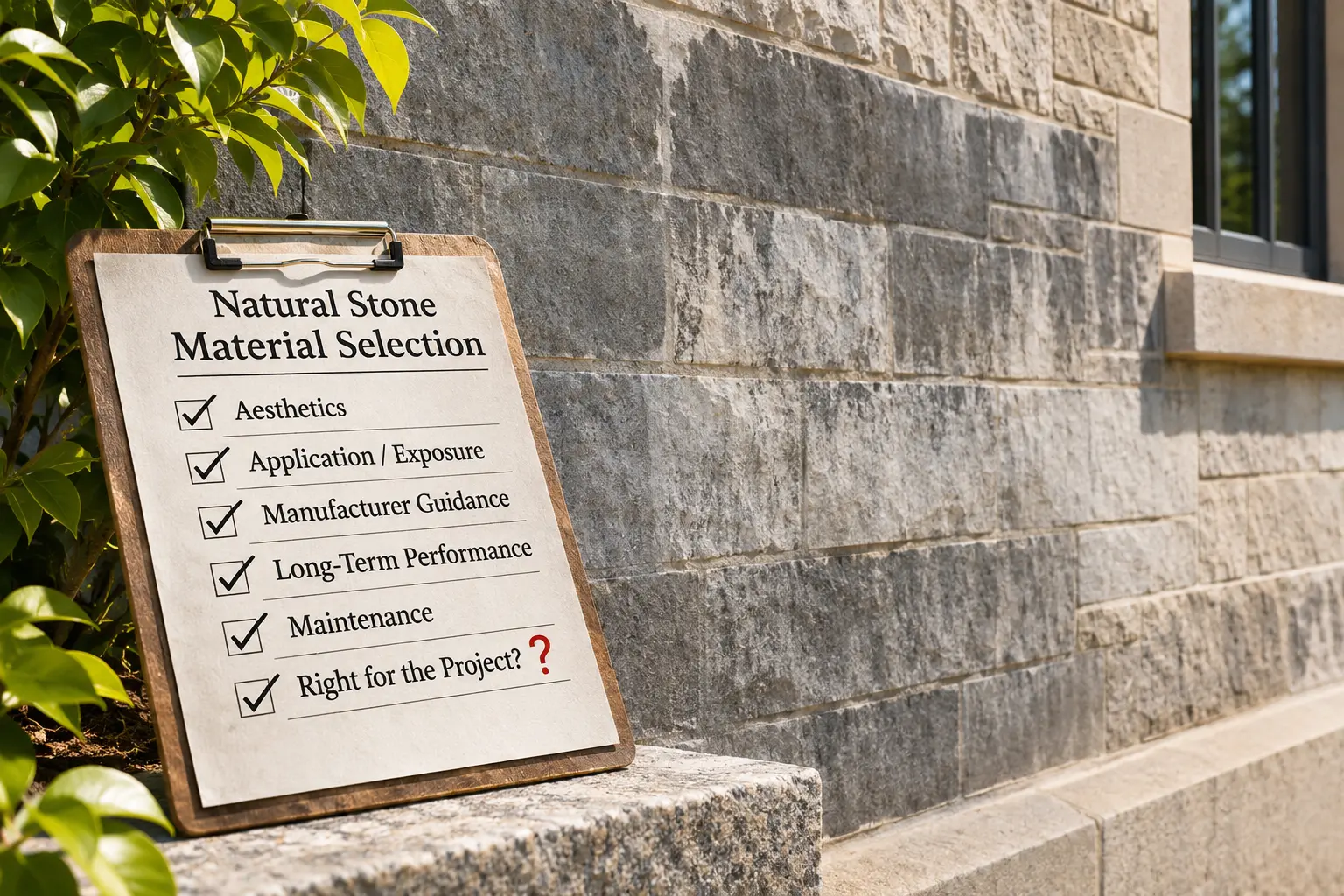
When a material is proposed for a demanding application, particularly an exterior installation, the discussion should include relevant technical information.
Depending on the project, that might involve:
- Water absorption and density
- Flexural strength and anchorage requirements
- Freeze-thaw performance
- Abrasion resistance
- Exposure to sunlight and weathering
- Known changes in color or surface appearance
- Documented performance in comparable installations
Not every test applies to every material or project. And not every important characteristic can be established by a standard physical-property test.
For example, conventional strength and absorption testing does not establish whether a particular grey limestone will retain its color after years of direct sunlight.
That question may require specific weathering or color-stability evidence, an understanding of the stone’s mineralogy and any processing treatments, or a documented history of comparable exterior installations.
In this particular case, the quarry had already identified the limitation.
No elaborate investigation was necessary. Someone simply needed to consult the available information.
A supplier saying we’ve never had a problem can be useful information.
It should not automatically end the investigation.
Understanding the Actual Exposure Conditions
One of the first questions I ask about a stone is where it will be installed.
Not simply whether the project is residential or commercial, but where the material will actually be used.
An exterior wall beneath a deep overhang experiences different conditions from an exposed façade facing the afternoon sun.
A bathroom vanity is subjected to different demands than a commercial bar.
An interior floor in a private residence has different performance requirements from the entrance to a busy hotel.
Even the orientation of the stone, the installation method, and the anticipated maintenance can affect the outcome.
This is why specifications should begin with the application rather than end with it.
Once an end user falls in love with a particular material, changing direction becomes much more difficult.
And once the stone has been fabricated and installed, the cost of discovering a mistake increases dramatically.
Sometimes the Responsible Answer Is No
There is an understandable temptation in any business to make the sale.
A customer wants a material. The material is available. The order may be substantial.
Why complicate things?
Because the consequences of a poor recommendation can extend well beyond the original purchase.
The designer may face an unhappy client. The fabricator or installer may be drawn into a dispute. The contractor may be asked to replace work that was installed correctly but specified incorrectly.
And the property owner may be left with an expensive problem that no one wants to take responsibility for.
In the grey limestone example, I could have submitted a bid without raising objections and relied on someone else’s assurance.
I could have treated the material specification as someone else’s responsibility.
Instead, I documented the known limitation and ultimately declined to proceed.
That decision meant walking away from a potential order.
I call this “missing the Titanic.” Disappointing at the time, but give it a few days.
It also meant I wasn’t knowingly supplying a material for an application in which I expected it to disappoint the customer.
A supplier’s responsibility shouldn’t end with confirming that the stone is available.
It should include speaking up when there is a credible reason to question its suitability.
That doesn’t mean the supplier makes the final design decision. It means the people making that decision deserve the best information available.
A Disclaimer Doesn’t Make an Unsuitable Material Suitable
Disclaimers have a legitimate place in construction and material supply.
Natural stone has inherent variation. Some materials require particular maintenance. Others have limitations that should be acknowledged and understood before installation.
Documenting those limitations helps establish realistic expectations.
But a signed disclaimer doesn’t change the physical characteristics of the stone.
If a material is known to fade, a disclaimer won’t prevent fading.
If a stone is vulnerable to freeze-thaw damage, a signed acknowledgment won’t make it frost-resistant.
And if a material lacks the strength required for a particular installation, transferring responsibility doesn’t solve the engineering problem.
A disclaimer may clarify who accepts a particular risk. It is not a substitute for proper material selection.
There is an important difference between a customer knowingly accepting a manageable characteristic and proceeding with an application that is fundamentally unsuitable.
When the Problem Has Already Happened
There’s little satisfaction in telling someone, “I told you so.” At least for me. Others may disagree, and I could probably provide a few names.
Some time after the limestone was installed, the homeowner contacted me.
Somehow, they had learned that I had raised concerns about the material before it was purchased. That information hadn’t come from me.
Perhaps someone had overheard the discussion in the construction trailer. I never found out.
By then, the fading had occurred.
Rather than revisit who said what, I suggested a possible short-term cosmetic solution involving a color-enhancing sealer and consideration of a UV-resistant protective treatment. Neither would change the underlying characteristics of the limestone, and any proposed treatment would need to be evaluated for compatibility and effectiveness.
It was a possible stopgap measure, not a permanent solution.
The underlying characteristics of the limestone hadn’t changed.
This was a possible stopgap measure, not a correction of the original material selection.
By the time a problem like this becomes apparent, the designer may already be dealing with an unhappy client and some uncomfortable conversations.
Adding embarrassment to the situation accomplishes very little.
I would much rather have someone call me about their next project than avoid the conversation because of what happened on the last one.
That doesn’t always happen. Perhaps embarrassment plays a part.
But the door remains open.
The objective isn’t to win an argument. It’s to help people make better decisions, even when the opportunity to prevent the original problem has passed.
Ask the Questions Before the Stone Is Ordered
I’ve written before about the importance of asking the so-called stupid questions.
Where is the stone going?
Will it be exposed to sunlight?
What happens when it gets wet?
How will it be supported?
What maintenance is the owner prepared to accept?
What evidence supports the proposed use?
These aren’t obstacles to design. They’re part of making good design work.
A few questions at the beginning of a project can prevent months of disagreements and substantial replacement costs later.
Sometimes the answers confirm that the selected stone is an excellent choice.
Sometimes they reveal that additional testing or investigation is necessary.
And sometimes they tell us that we should find another material.
There is another question worth asking when a supplier assures you that a material is suitable:
What is that assurance based on?
The answer may be years of successful installations, relevant testing, or specific recommendations from the quarry or manufacturer.
Those are useful answers.
“Don’t worry, it’ll be fine” is considerably less useful.
Good Material Selection Is About More Than Making the Sale
Natural stone offers extraordinary possibilities, but understanding its limitations is just as important as appreciating its beauty.
A knowledgeable supplier should be willing to explain both.
At The World of Stone, our role isn’t simply to locate unusual slabs and arrange their delivery. It’s also to help architects, designers, and project teams understand what they’re specifying.
That occasionally means recommending a different material. (Usually stone)
And sometimes it means walking away from an order.
I’ve never believed that every available stone belongs in every application.
The right stone is not necessarily the one that looks best in the showroom. It’s the one that will perform as expected long after everyone involved has moved on to the next project.
The World of Stone | Los Angeles
More than 35 years in the natural stone industry. Still asking questions.