

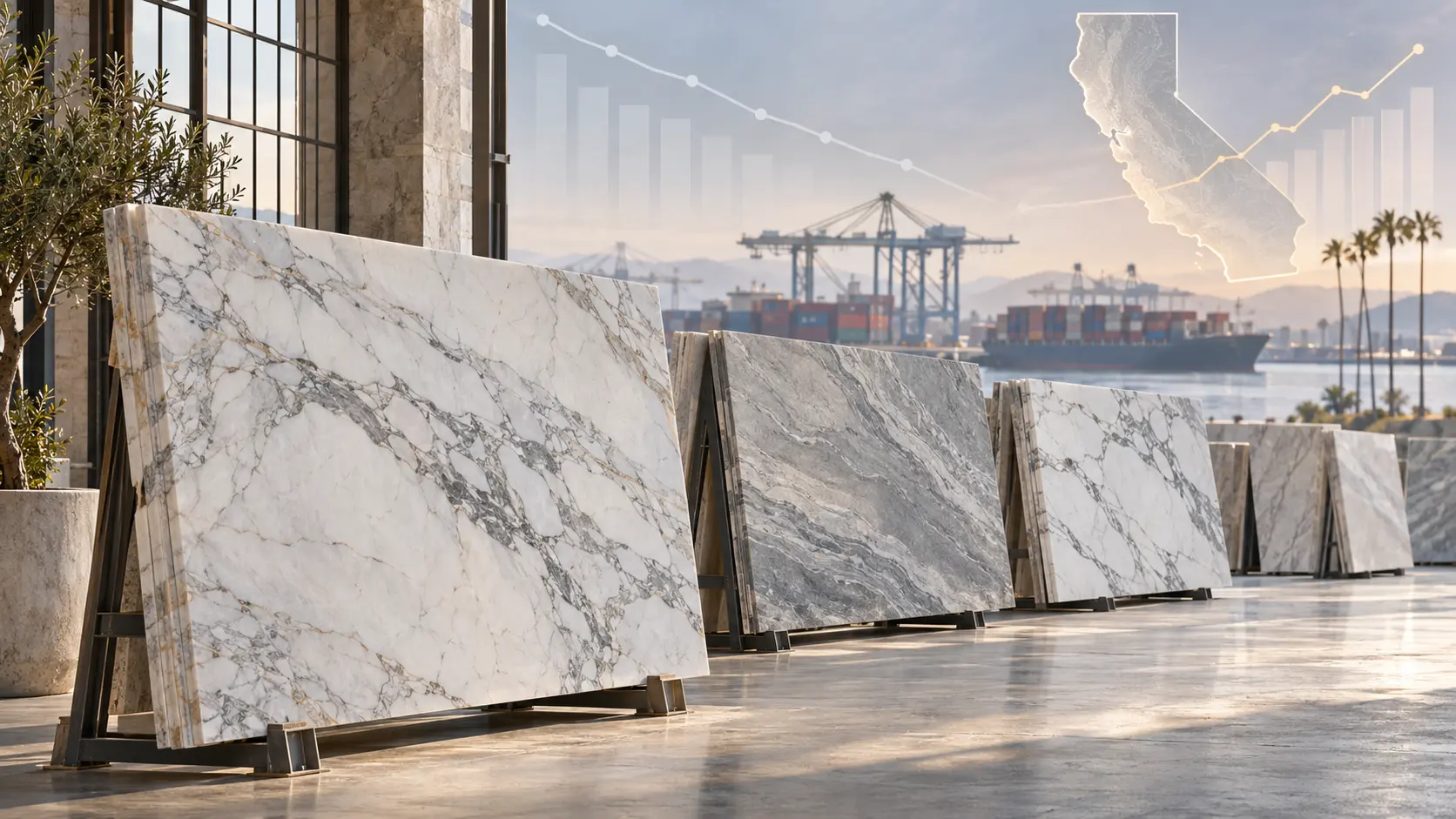
What the first half of 2026 reveals about natural stone imports, pricing pressures, and the growing importance of material selection.
The American natural stone market is changing, but the latest import figures suggest that those changes are far from uniform.
During the first six months of 2026, U.S. imports of finished marble declined by 7.44% in value and 10.44% in volume compared with the same period in 2025.
California, however, moved in the opposite direction.
For international trade purposes, finished marble generally refers to marble that has undergone processing beyond its basic quarry condition. This can include polished or honed slabs, cut-to-size pieces, tiles, and other worked marble products. It does not necessarily mean a completed architectural installation. These statistics therefore represent a much broader market than marble slabs alone.
The state recorded a 17.15% increase in imported marble volume, while the total declared value of those imports increased by only 1.03%.
In other words, considerably more marble entered California, but the total reported value of that material barely increased.
The figures suggest that California importers may be purchasing a greater proportion of lower-priced marble products, and there may be a practical explanation.
From our experience at The World of Stone, rising tariffs and other import costs have placed additional pressure on purchasing decisions. Rather than seeing widespread price reductions from overseas suppliers, we have observed growing sensitivity to the cost of materials entering the United States.
Chinese exporters have shown some willingness to adjust pricing to offset tariff-related costs. European suppliers, however, have generally maintained their pricing.
In our view, the increase in California’s import volume, combined with the decline in average declared value, is consistent with importers shifting some purchases toward less expensive materials rather than comparable products simply becoming cheaper.
While the statistics cannot establish that this is the sole explanation, it reflects what we are seeing firsthand in the international stone market.
California’s Marble Import Market Tells a Different Story
According to trade figures analyzed by StoneNews in October 2026, the average declared import value of finished marble entering California declined by 14.77%, reaching approximately $1,053 per metric tonne.
Nationally, the average declared value actually increased by 2.55%.
The contrast is significant.
California is importing considerably more marble by weight, but the average declared value of each tonne has decreased.
One possible explanation is that a greater proportion of lower-priced commercial marble products is entering the state.
A shipment of standard commercial marble tiles and a carefully selected bundle of premium Italian marble slabs both contribute to the same broad import statistics.
Yet the materials may have little in common beyond their geological classification.
One shipment might consist of thousands of square feet of relatively uniform material intended for repetitive installations. Another might contain a small number of exceptional slabs selected for their color, movement, dimensions, and ability to create a particular architectural composition.
Both add weight to the import statistics. Both contribute to the total declared value. But they serve very different purposes and very different markets.
A decline in average import value does not necessarily mean that premium marble is becoming less expensive. It may simply mean that more lower-priced material is entering the overall product mix.
This is an important distinction for architects, designers, and clients evaluating natural stone.
More Marble Does Not Necessarily Mean Better Selection
For architects and designers, one of the most important distinctions in natural stone is the difference between availability and selection.
Two slabs sold under the same commercial stone name may have substantially different appearances, geological characteristics, dimensions, and suitability for a particular installation.
Even material originating from the same quarry can vary considerably from one block to another.
For projects involving bookmatching, continuous veining, large architectural panels, or custom fabrication, these differences become especially important.
Increasing import volume may expand the total quantity of marble available in the market, but it does not automatically increase the availability of exceptional blocks or carefully matched slab sequences.
This is also where the distinction between general stone distribution and specialized importing becomes more meaningful.
High-end importers often invest considerable time in selecting particular blocks, evaluating slab sequences, and sourcing materials for demanding architectural applications.
The value of that work is not necessarily reflected in import volume or average customs value.
As purchasing decisions become increasingly influenced by price, carefully selected premium materials may become more differentiated from the broader market.
That does not mean commercial-grade marble is inherently inferior. It means that materials purchased primarily for economy and those selected for particular architectural characteristics often serve different purposes.
More marble in the marketplace does not necessarily mean more of the marble a particular project requires.
Italian Marble Continues to Hold an Important Position
Despite the overall decline in U.S. finished marble imports, Italy strengthened its position in the American market during the first half of 2026.
Together, Italy and Turkey represented approximately 66% of the total declared value of U.S. finished marble imports.
Italy’s continued importance reflects an established international stone industry with extensive quarrying, processing, and finishing capabilities.
For architectural projects, the country remains an important source of both traditional marble varieties and materials selected for distinctive color, movement, and decorative character.
Our experience with Italian suppliers also illustrates an important aspect of the current market.
While import costs have changed, we have not observed corresponding widespread reductions in European stone prices.
The cost pressures facing American importers therefore do not necessarily translate into lower purchasing prices for premium Italian materials.
This reinforces the importance of evaluating each stone on its individual merits rather than assuming that broader changes in average import values reflect the pricing of particular marble varieties.
Country of origin alone does not establish quality. Material selection, processing, slab condition, and suitability for the intended application remain essential considerations.
What the Numbers Mean for Architects and Designers
Import statistics provide useful insight into market activity, but they are not a substitute for evaluating the actual material proposed for a project.
Several considerations remain particularly important:
- Block and slab selection: Natural variation can be significant, even within a single quarry.
- Slab sequencing: Consecutive slabs may be necessary to achieve the desired bookmatch or continuous veining.
- Usable dimensions: Nominal slab measurements do not always represent the area available after trimming and fabrication.
- Fabrication requirements: Vein direction, natural characteristics, and installation details can influence both material selection and project cost.
- Project-specific sourcing: Unusual dimensions or substantial quantities may require selecting material directly from a block or arranging special production.
These factors are rarely reflected in broad import statistics, yet they can determine whether a particular stone is suitable for an architectural project.
For designers working on luxury residential and hospitality installations, the challenge is often not simply locating marble. It is finding the appropriate material in the necessary dimensions, quantities, and slab sequences.
That distinction becomes especially important when the stone is intended to be a defining architectural element rather than a standard finish.
A Changing Market, Not Necessarily a Declining One
The first-half figures demonstrate that the American marble market is undergoing an adjustment, with considerable differences between states and supplying countries.
California’s increased import volume is noteworthy, particularly when contrasted with the national decline.
In our view, the combination of higher import costs, relatively stable European supplier pricing, and increasing price sensitivity offers a plausible explanation for part of this shift.
Importers may be choosing a different mix of products to remain competitive, particularly in market segments where price is the primary consideration.
However, the figures alone cannot establish whether demand for premium residential and hospitality materials is growing, declining, or remaining stable.
Nor can they tell us whether individual high-end marble varieties have become more or less available.
For the design community, the distinction is important. More material entering the market does not necessarily mean that every type of marble is more readily available or that individual stones are interchangeable.
If anything, the changing market underscores the value of understanding what is actually being purchased, where it comes from, and whether it meets the requirements of the intended application.
Experience and Selection Still Matter
At The World of Stone, our approach to natural stone has always been based on understanding the material beyond its commercial name.
With more than 35 years of experience in the international stone industry, we recognize that the character of a particular block, the availability of matching slabs, and the requirements of the finished installation often matter more than general market trends.
We specialize in distinctive natural stones for luxury residential and hospitality projects, including materials requiring careful selection, custom fabrication, or specialized architectural applications.
We also understand that not every project requires an exceptional or unusual marble. Commercial materials have an important place in the market, and selecting the appropriate product for its intended application is always the priority.
But when a project requires a particular color, movement, dimensional characteristic, or slab sequence, sourcing becomes much more than a question of price per square foot.
As the import market evolves, the distinction between commodity distribution and specialized natural stone sourcing becomes increasingly relevant.
The quantity of marble entering a market is one measure of supply. Finding the right marble for a particular project is another matter entirely.
Source: StoneNews — “USA: Finished Marble Imports Decline in H1 2026 as the Market Undergoes Restructuring,” October 5, 2026. Figures compare January–June 2026 with January–June 2025. Market interpretations and observations about supplier pricing reflect The World of Stone’s experience and are not conclusions established by the trade statistics alone.