
Nationwide Slab Shipping Available – All 48 Contiguous States

Beyond the Ordinary: Rare Natural Stone, Exceptional Quality, and the Art of Selection

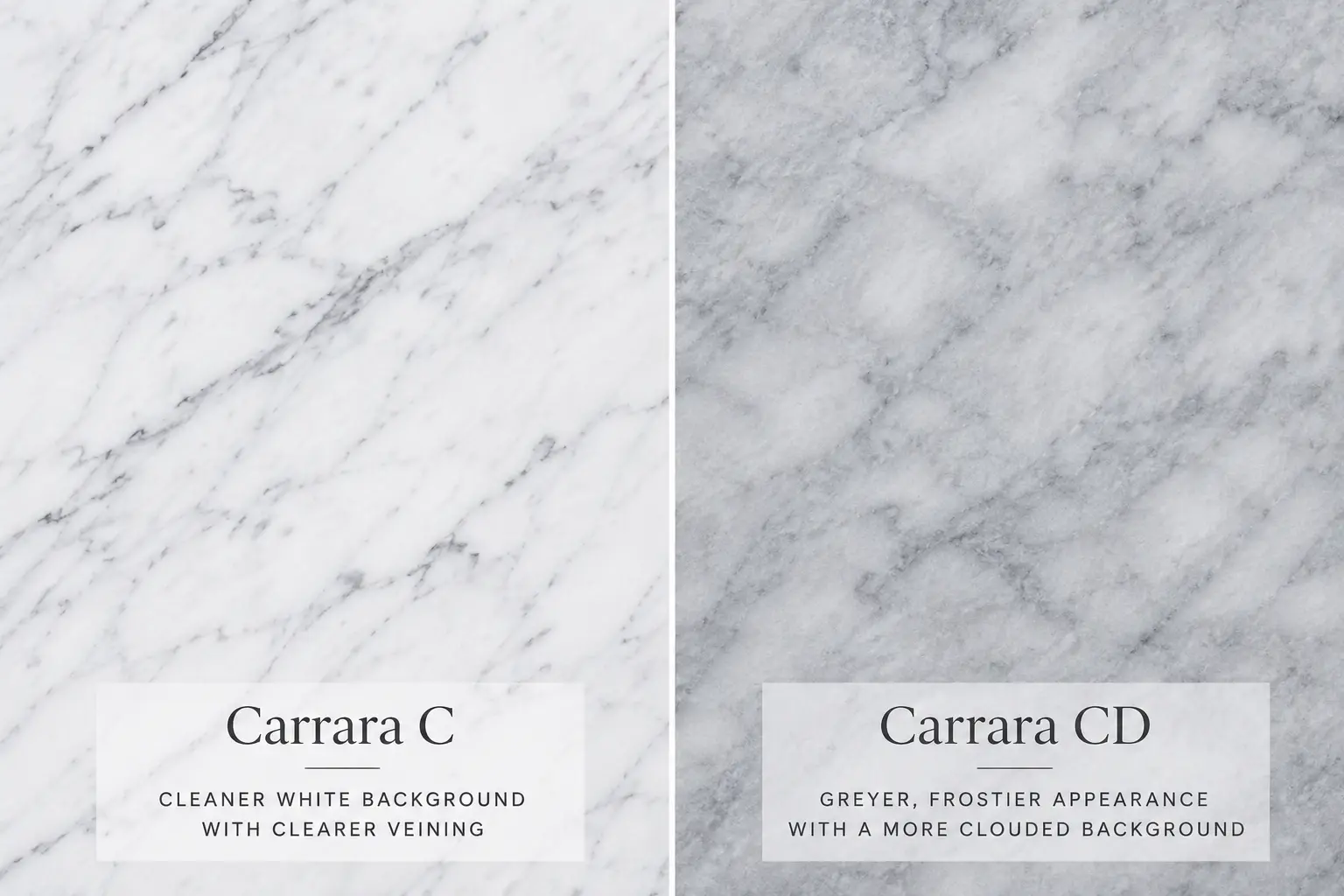
Carrara C and Carrara CD marble comparison showing the cleaner white background and defined veining of Carrara C alongside the greyer, frostier appearance of Carrara CD.

Unusual colors, remarkable geological formations, and the qualities that distinguish exceptional natural stone from the ordinary.

There are thousands of natural stones available around the world, yet walk through enough slab warehouses and you might begin to think there are only a few dozen.

White marble. Grey marble. Beige limestone. Quartzite with dramatic veining.

They are all beautiful. Some are extraordinary.

One of my standard observations after more than 35 years in the stone business is that all stone is beautiful.

It may not be beautiful to you. It may not be appropriate for your particular installation. But somewhere, in the right setting, that same material can be exceptional.

Beauty and suitability are two different things.

And beauty isn’t necessarily determined by rarity or price.

Some of the most interesting materials aren’t the ones everyone is selling. Sometimes it’s an unusual color. Sometimes it’s a geological formation that produces remarkable movement. Sometimes it’s a familiar stone selected from an exceptional block.

And sometimes it’s a material that doesn’t fit neatly into any of the usual categories.

At The World of Stone, finding those materials has always been one of the more enjoyable parts of the business.

Of course, finding them is only the beginning. Understanding what makes them special is where experience becomes important.

What Makes a Natural Stone Rare or Unusual?

Rarity in natural stone can mean several different things.

A material may come from a quarry with limited production. Its particular color or geological characteristics may occur in only a small portion of the deposit. It may be difficult to extract in commercially useful blocks, or it may simply be unfamiliar to the American market.

And sometimes a material isn’t especially rare at all. It’s just rarely selected well.

That’s an important distinction.

A quarry may produce thousands of square feet of a particular marble, but only a relatively small percentage might have the combination of color, movement, consistency, and visual quality that makes it exceptional.

The commercial name doesn’t tell the whole story.

Two slabs can carry exactly the same name and have very different appearances, grades, and prices.

Understanding those differences is part of selecting natural stone.

Color, Depth, and Clarity: What Makes One Stone More Appealing Than Another?

Years ago, when I was teaching an AIA continuing education course, I included a discussion about material quality.

I used three words to explain something that customers recognize almost immediately but often have difficulty describing:

Color. Depth. Clarity.

Carrara White marble is a particularly good example.

Show someone two different selections of Carrara White, and they’ll frequently prefer one over the other.

Ask why, and the answer might be, “I just like this one better.”

Fair enough. But there are usually identifiable reasons.

Color

The background color of a marble has an enormous influence on its appearance.

One selection of Carrara White might have a cleaner, brighter background, while another appears greyer or more heavily clouded.

Neither is necessarily unsuitable. They simply represent different selections of the same general material.

The relationship between background color and veining also matters. Contrast, consistency, and the distribution of color all influence how a stone is perceived.

Depth

Depth is more difficult to explain, but it’s one of the qualities that can distinguish an exceptional marble.

Some stones have a visual richness that seems to extend beneath the polished surface.

Light penetrates the surface and interacts with the crystalline structure, giving the material a sense of dimension that a photograph may not fully capture.

This is particularly noticeable in certain white marbles, where translucency contributes to the impression that the stone has depth rather than simply a pattern on its surface.

Other selections appear comparatively flat.

That difference can be subtle, but once you recognize it, it’s difficult to ignore.

Clarity

Clarity describes how cleanly the stone’s colors and patterns are expressed.

In some marbles, the veining appears distinct and well-defined against the background. In others, the colors blend together, creating a cloudier or muddier appearance.

One of the most revealing characteristics is translucency.

In a marble with good translucency, light penetrates the crystalline structure rather than reflecting entirely from the surface. This can give the background a luminous quality and allow subtle internal features to become visible.

It’s one of the things I look for when evaluating a marble’s visual quality.

Clarity isn’t the same as having fewer veins.

A heavily veined marble can have exceptional clarity, while a relatively quiet stone may lack it.

And translucency isn’t a universal measure of quality. Different minerals, grain structures, and geological formations influence how light behaves within stone.

But in the right marble, it can be a remarkably useful indicator of the qualities we’re discussing.

Why Does One Carrara Marble Cost More Than Another?

I’ve had this conversation with customers many times.

“Why is this one so much more expensive? They’re both Carrara!”

And they’re right. Both are Carrara marble.

But that doesn’t mean they’re the same quality of selection.

One may have a cleaner white background, greater depth and translucency, and more clearly defined veining. Another may have a greyer background, less visual clarity, or characteristics that place it in a different commercial grade.

Those differences can affect how the material is valued long before it reaches a showroom.

At the quarry and during production, blocks and slabs are evaluated and sorted. More desirable selections may be less common, and their prices reflect that difference.

Of course, appearance isn’t the only factor affecting price. Block yield, defects, availability, production costs, and market demand also play a role.

But when comparing two bundles of Carrara White, the answer is often quite simple:

They’re both Carrara. They’re just not the same selection.

Understanding Carrara Marble Grades

In the Carrara trade, you’ll encounter classifications and commercial names such as C, CD, Extra, Gioia, and others.

These terms have traditionally helped distinguish different selections, appearances, and commercial qualities of Carrara marble.

For example, Carrara C is generally associated with a lighter background than the greyer material commonly sold as Carrara CD. Higher selections may be marketed as Extra, while Gioia refers to a recognizable Carrara marble variety with its own characteristic appearance.

These distinctions matter because the visual differences can be substantial.

The problem is that these names and grades haven’t always been used consistently throughout the supply chain.

Over the years, commercial descriptions have become increasingly flexible. What one supplier calls Extra may not be what another supplier considers Extra.

And some traditional distinctions have become blurred by marketing.

How Carrara grading developed, and how those classifications have been stretched over the years, is a story for another day.

For now, the important point is that the commercial name isn’t enough.

The actual material matters.

The Relationship Between Appearance and Physical Quality

Color, depth, and clarity aren’t simply marketing descriptions.

The appearance of marble is influenced by its mineral composition and geological history, including the heat, pressure, deformation, and recrystallization that transformed the original limestone.

Those processes also influence the stone’s crystalline structure and physical properties.

A compact, well-interlocked crystalline structure may contribute to lower porosity and water absorption. Grain boundaries, microcracks, mineral composition, and other factors also affect performance.

In other words, the geological characteristics responsible for a stone’s appearance can also influence how it behaves.

That doesn’t mean translucency or a cleaner background automatically guarantees greater strength or lower absorption. Those properties require appropriate testing.

But appearance and physical characteristics aren’t entirely unrelated. Both originate in the stone’s geological history.

Experienced quarry operators and producers understand the differences between selections. Blocks and slabs are sorted into commercial grades based on appearance, consistency, defects, and other considerations.

That’s one reason a premium selection of Carrara White can cost considerably more than another selection carrying the same name.

You’re not necessarily paying more for a different stone. You’re paying for a different quality of selection.

And that distinction applies to far more than Carrara marble.

Beyond White and Grey: Unusual Colors in Natural Stone

For many years, white and grey stones have dominated contemporary residential design.

They’re versatile, familiar, and beautiful.

But natural stone offers a much broader palette.

Some of the most interesting materials we’ve sourced demonstrate just how varied that palette can be.

Rosso Impero: The Character of Deep Red Marble

Red is an unusual color in architectural stone, particularly when the material has the richness and movement to become a focal point.

Rosso Impero offers a distinctive alternative to the more familiar white and grey marbles.

Its deep red coloration gives it a presence that can work beautifully in furniture, feature walls, and carefully selected architectural details.

It’s not a material that needs to cover an entire room to make an impression.

Sometimes a relatively small application is enough.

Tunisia Chemtou Marble: A Remarkable Historical Palette

Tunisia Chemtou Marble is another example of how unusual color can distinguish a natural stone.

Associated with the historic Giallo Antico marbles prized in ancient Rome, Chemtou is known for its expressive combinations of warm yellow, gold, red, and darker veining.

The movement can be extraordinary.

It’s a material with both visual character and a remarkable historical connection.

For projects seeking something beyond conventional neutral colors, stones like Chemtou demonstrate possibilities that many designers may never encounter in a typical showroom.

Verde Bamboo Quartzite: Natural Green with Distinctive Movement

Green natural stone offers another departure from the usual palette.

Verde Bamboo Quartzite combines green coloration with pronounced linear movement, creating an appearance that can be particularly effective in contemporary architectural settings.

As with any natural stone, the actual slabs matter.

The direction of movement, distribution of color, and relationship between consecutive slabs can influence how the finished installation looks.

Selecting the right material is only part of the process. Planning how it will be used is equally important.

Exceptional Stone Doesn’t Always Have to Be Dramatic

One of the misconceptions about rare or high-quality stone is that it must have extraordinary veining or intense color.

Some of the most beautiful materials are remarkably quiet.

A carefully selected limestone may have subtle movement, a consistent background, and a finish that complements the architecture without competing with it.

Materials such as Gascogne Beige Velvet, Ataíja Blue Storm, and Pietra Serena demonstrate how restrained color and texture can be just as distinctive as dramatic marble.

Their appeal often becomes more apparent when viewed in person.

A photograph can communicate the general color and movement, but it may not fully convey the texture, surface character, or subtle variations that make a material interesting.

In these cases, exceptional quality is less about attracting attention and more about getting the details right.

And sometimes that’s considerably harder.

Geological Character: When the Stone Becomes the Design

Natural stone can also be unusual because of its geological structure.

Breccias, onyx, and heavily patterned marbles can produce formations that are difficult to reproduce in any manufactured material.

Consider Breccia Capraia, with its distinctive movement and contrasting colors, or Silver Grey Onyx, where translucent layers and natural variation create opportunities for dramatic installations.

These materials require thoughtful selection.

Bookmatching, diamond matching, and the arrangement of consecutive slabs can dramatically influence the finished appearance.

A particularly expressive stone can become overwhelming if the layout isn’t considered carefully.

Conversely, a well-planned installation can turn natural variation into an architectural feature.

This is where understanding the material before fabrication becomes especially valuable.

Stoneglass: An Unusual Surface Beyond Natural Stone

Not every interesting architectural material comes from a quarry.

Stoneglass is a good example.

Stoneglass is a manufactured glass-based architectural surface, not natural stone and not conventional engineered quartz.

Its appearance is almost the opposite of the dramatic marbles discussed above.

Rather than relying on elaborate veining or geological movement, white Stoneglass offers a remarkably clean, uniform surface.

Its appeal lies in that consistency and in its performance characteristics.

Stoneglass is nonporous, highly resistant to staining, and resistant to many acids and common chemicals. Those characteristics make it worth considering for applications where maintenance and surface performance are important.

We’ve worked with Stoneglass for projects involving reception desks, bars, furniture, feature walls, and other architectural applications.

It can also be fabricated into custom shapes and details, offering possibilities beyond standard countertop installations.

What makes it unusual isn’t rarity in the geological sense.

It’s that the material offers a different combination of appearance, performance, and fabrication possibilities from many conventional architectural surfaces.

For designers seeking a clean, contemporary aesthetic, that’s worth exploring.

As with any specialty material, the specific application, fabrication requirements, and installation details should be reviewed before specification.

Finding the Materials That Aren’t in Every Showroom

One of the advantages of working with producers and quarries around the world is access to materials that may never become mainstream products in the United States.

Some are available only in limited quantities.

Others require special ordering, block selection, or production specifically for a project.

And some are simply overlooked because they don’t fit the purchasing patterns of large-volume distributors.

At The World of Stone, we’ve spent decades developing relationships with suppliers and producers, particularly in Italy and Portugal, as well as other stone-producing regions.

Those relationships allow us to look beyond standard inventory.

For the right project, that may mean locating an unusual marble, selecting a block, coordinating custom production, or sourcing a material with a particular color, finish, or geological character.

It also means knowing when a material isn’t appropriate for the intended application.

A beautiful stone isn’t automatically the right stone.

Its physical properties, exposure conditions, fabrication requirements, and long-term maintenance expectations still matter.

Our goal isn’t simply to find something different.

It’s to find something exceptional that makes sense for the project.

Selecting Rare and High-Quality Natural Stone for Your Project

If you’re looking for unusual natural stone, rare marble, distinctive limestone, or specialty architectural surfaces, my recommendation is to begin the conversation before the material is specified.

Bring photographs, color references, drawings, or even a general idea of what you’re trying to achieve.

Sometimes the right material is already in our inventory.

Sometimes it’s something we can source.

And occasionally, the best recommendation is a stone you hadn’t considered.

After more than 35 years in the stone business, I still enjoy finding materials that surprise me.

Fortunately, there are plenty left to discover.

The World of Stone | Los Angeles

Rare natural stone, carefully selected marble and limestone, specialty architectural surfaces, and custom sourcing for residential, commercial, and hospitality projects.

Available by appointment. Nationwide shipping and project support.
When the Wrong Stone Is Specified: Why Material Selection Matters More Than Appearance

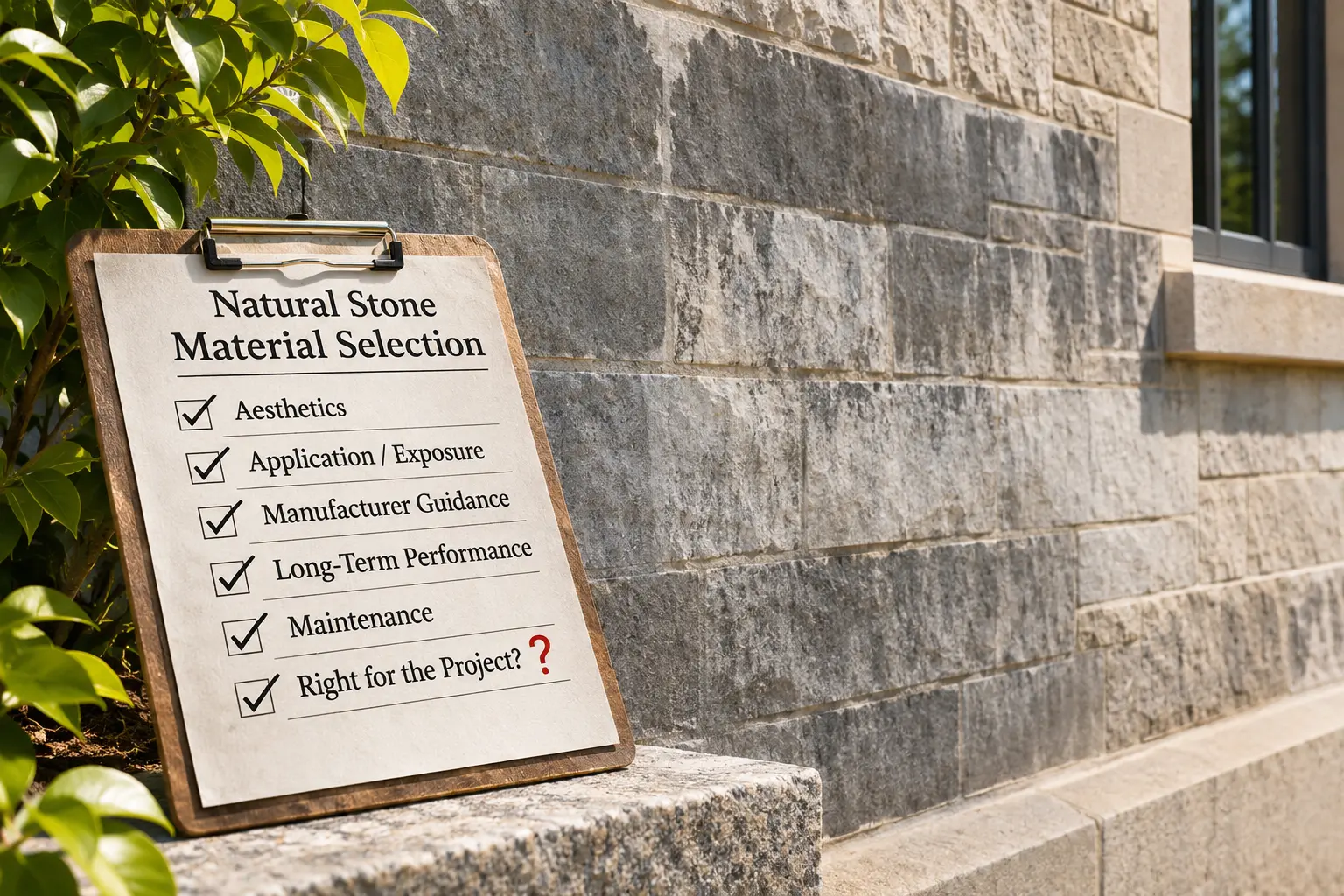
Weathered grey limestone exterior cladding with a natural stone material selection checklist highlighting application suitability and long-term performance.

Sometimes the most valuable advice a stone supplier can give is no.

Natural stone is selected for many reasons. Color, movement, texture, rarity, and the ability to create something that manufactured materials simply cannot duplicate. And, of course, because stone is awesome.

But there is one consideration that should come before all of them: Is this material suitable for the intended application?

A beautiful slab is not necessarily the right slab.

After more than 35 years in the natural stone industry, I’ve learned that some of the most important conversations happen before a material is purchased. Occasionally, those conversations end with a sale. Sometimes they end with a recommendation to consider something else.

And every so often, they end with a supplier declining to participate in a project.

A Grey Limestone and an Exterior Cladding Project

Several years ago, I visited a construction site to discuss natural stone for the interior of a residence.

While we were talking in the construction trailer, I noticed a large sample of grey limestone and asked what it was intended for. (“It’s getting him to shut up that’s the trick.” — Shrek)

I was told it had been selected for the exterior cladding.

That immediately concerned me.

The limestone was known to fade when exposed to direct sunlight. This wasn’t speculation or simply my opinion. The quarry itself specifically identified that limitation in its published material information.

I raised the concern on the spot.

I was told that another supplier had assured them the material would “be fine” for the exterior application.

My warning was essentially dismissed.

The other supplier represented a much larger stone company, and the designer clearly trusted his recommendation. I understood that relationship, but it didn’t change the material’s characteristics.

On a subsequent visit to deliver samples for the interior, I was asked to submit a bid for the exterior limestone.

That presented an interesting situation.

I had already explained why I believed the material was unsuitable for the proposed application. I wasn’t about to disregard that information simply because there was now an opportunity to supply it.

My bid explicitly stated that the limestone would fade and that it would only be supplied at the buyer’s own risk. I also required a signed disclaimer acknowledging the known limitation and accepting responsibility for the anticipated color change.

Ultimately, I declined to proceed. Despite a compelling argument from my bank balance.

The project went ahead with another supplier, and the fading I had warned about subsequently occurred.

The unfortunate part is that the problem was avoidable. The quarry had already provided the relevant information.

The information wasn’t unavailable. It was there for anyone willing to look.

Limestone is not inherently unsuitable for exterior applications. The important distinction is understanding the properties of the particular stone and the conditions it will encounter. Our limestone slabs and tiles page provides additional information about limestone characteristics, testing, and material selection.

Appearance Doesn’t Establish Suitability

Natural stone is not a uniform manufactured product.

Two materials sold under the same general geological or commercial classification can have substantially different physical properties, mineral compositions, and performance characteristics.

Even stones with similar appearances may respond differently to moisture, ultraviolet exposure, temperature changes, abrasion, or chemical contact.

A polished marble that performs beautifully on an interior feature wall may be a poor choice for a heavily used kitchen countertop.

A limestone that works well on an interior floor may not be appropriate for an exposed exterior installation in a freeze-thaw climate.

A stone selected for its distinctive coloration may change appearance when subjected to environmental conditions that were never considered during selection. But I’m sure it will be fine…

None of these possibilities automatically makes the stone inferior.

They make the application important.

The question is not simply whether a stone is beautiful. It’s whether that beauty—and the material’s physical performance—will meet the expectations of the project.

Supplier Assurances Are Not Test Results

The natural stone industry depends on relationships, experience, and trust.

I have suppliers around the world whose opinions I value. Many have worked with particular materials for decades and know their characteristics extremely well.

That experience is valuable.

But experience and assurance are not the same as documented evidence.

When a material is proposed for a demanding application, particularly an exterior installation, the discussion should include relevant technical information.

Depending on the project, that might involve:

  • Water absorption and density
  • Flexural strength and anchorage requirements
  • Freeze-thaw performance
  • Abrasion resistance
  • Exposure to sunlight and weathering
  • Known changes in color or surface appearance
  • Documented performance in comparable installations

Not every test applies to every material or project. And not every important characteristic can be established by a standard physical-property test.

For example, conventional strength and absorption testing does not establish whether a particular grey limestone will retain its color after years of direct sunlight.

That question may require specific weathering or color-stability evidence, an understanding of the stone’s mineralogy and any processing treatments, or a documented history of comparable exterior installations.

In this particular case, the quarry had already identified the limitation.

No elaborate investigation was necessary. Someone simply needed to consult the available information.

A supplier saying we’ve never had a problem can be useful information.

It should not automatically end the investigation.

Understanding the Actual Exposure Conditions

One of the first questions I ask about a stone is where it will be installed.

Not simply whether the project is residential or commercial, but where the material will actually be used.

An exterior wall beneath a deep overhang experiences different conditions from an exposed façade facing the afternoon sun.

A bathroom vanity is subjected to different demands than a commercial bar.

An interior floor in a private residence has different performance requirements from the entrance to a busy hotel.

Even the orientation of the stone, the installation method, and the anticipated maintenance can affect the outcome.

This is why specifications should begin with the application rather than end with it.

Once an end user falls in love with a particular material, changing direction becomes much more difficult.

And once the stone has been fabricated and installed, the cost of discovering a mistake increases dramatically.

Sometimes the Responsible Answer Is No

There is an understandable temptation in any business to make the sale.

A customer wants a material. The material is available. The order may be substantial.

Why complicate things?

Because the consequences of a poor recommendation can extend well beyond the original purchase.

The designer may face an unhappy client. The fabricator or installer may be drawn into a dispute. The contractor may be asked to replace work that was installed correctly but specified incorrectly.

And the property owner may be left with an expensive problem that no one wants to take responsibility for.

In the grey limestone example, I could have submitted a bid without raising objections and relied on someone else’s assurance.

I could have treated the material specification as someone else’s responsibility.

Instead, I documented the known limitation and ultimately declined to proceed.

That decision meant walking away from a potential order.

I call this “missing the Titanic.” Disappointing at the time, but give it a few days.

It also meant I wasn’t knowingly supplying a material for an application in which I expected it to disappoint the customer.

A supplier’s responsibility shouldn’t end with confirming that the stone is available.

It should include speaking up when there is a credible reason to question its suitability.

That doesn’t mean the supplier makes the final design decision. It means the people making that decision deserve the best information available.

A Disclaimer Doesn’t Make an Unsuitable Material Suitable

Disclaimers have a legitimate place in construction and material supply.

Natural stone has inherent variation. Some materials require particular maintenance. Others have limitations that should be acknowledged and understood before installation.

Documenting those limitations helps establish realistic expectations.

But a signed disclaimer doesn’t change the physical characteristics of the stone.

If a material is known to fade, a disclaimer won’t prevent fading.

If a stone is vulnerable to freeze-thaw damage, a signed acknowledgment won’t make it frost-resistant.

And if a material lacks the strength required for a particular installation, transferring responsibility doesn’t solve the engineering problem.

A disclaimer may clarify who accepts a particular risk. It is not a substitute for proper material selection.

There is an important difference between a customer knowingly accepting a manageable characteristic and proceeding with an application that is fundamentally unsuitable.

When the Problem Has Already Happened

There’s little satisfaction in telling someone, “I told you so.” At least for me. Others may disagree, and I could probably provide a few names.

Some time after the limestone was installed, the homeowner contacted me.

Somehow, they had learned that I had raised concerns about the material before it was purchased. That information hadn’t come from me.

Perhaps someone had overheard the discussion in the construction trailer. I never found out.

By then, the fading had occurred.

Rather than revisit who said what, I suggested a possible short-term cosmetic solution involving a color-enhancing sealer and consideration of a UV-resistant protective treatment. Neither would change the underlying characteristics of the limestone, and any proposed treatment would need to be evaluated for compatibility and effectiveness.

It was a possible stopgap measure, not a permanent solution.

The underlying characteristics of the limestone hadn’t changed.

This was a possible stopgap measure, not a correction of the original material selection.

By the time a problem like this becomes apparent, the designer may already be dealing with an unhappy client and some uncomfortable conversations.

Adding embarrassment to the situation accomplishes very little.

I would much rather have someone call me about their next project than avoid the conversation because of what happened on the last one.

That doesn’t always happen. Perhaps embarrassment plays a part.

But the door remains open.

The objective isn’t to win an argument. It’s to help people make better decisions, even when the opportunity to prevent the original problem has passed.

Ask the Questions Before the Stone Is Ordered

I’ve written before about the importance of asking the so-called stupid questions.

Where is the stone going?

Will it be exposed to sunlight?

What happens when it gets wet?

How will it be supported?

What maintenance is the owner prepared to accept?

What evidence supports the proposed use?

These aren’t obstacles to design. They’re part of making good design work.

A few questions at the beginning of a project can prevent months of disagreements and substantial replacement costs later.

Sometimes the answers confirm that the selected stone is an excellent choice.

Sometimes they reveal that additional testing or investigation is necessary.

And sometimes they tell us that we should find another material.

There is another question worth asking when a supplier assures you that a material is suitable:

What is that assurance based on?

The answer may be years of successful installations, relevant testing, or specific recommendations from the quarry or manufacturer.

Those are useful answers.

“Don’t worry, it’ll be fine” is considerably less useful.

Good Material Selection Is About More Than Making the Sale

Natural stone offers extraordinary possibilities, but understanding its limitations is just as important as appreciating its beauty.

A knowledgeable supplier should be willing to explain both.

At The World of Stone, our role isn’t simply to locate unusual slabs and arrange their delivery. It’s also to help architects, designers, and project teams understand what they’re specifying.

That occasionally means recommending a different material. (Usually stone)

And sometimes it means walking away from an order.

I’ve never believed that every available stone belongs in every application.

The right stone is not necessarily the one that looks best in the showroom. It’s the one that will perform as expected long after everyone involved has moved on to the next project.

The World of Stone | Los Angeles

More than 35 years in the natural stone industry. Still asking questions.

Choosing the Right Natural Stone for the Right Application

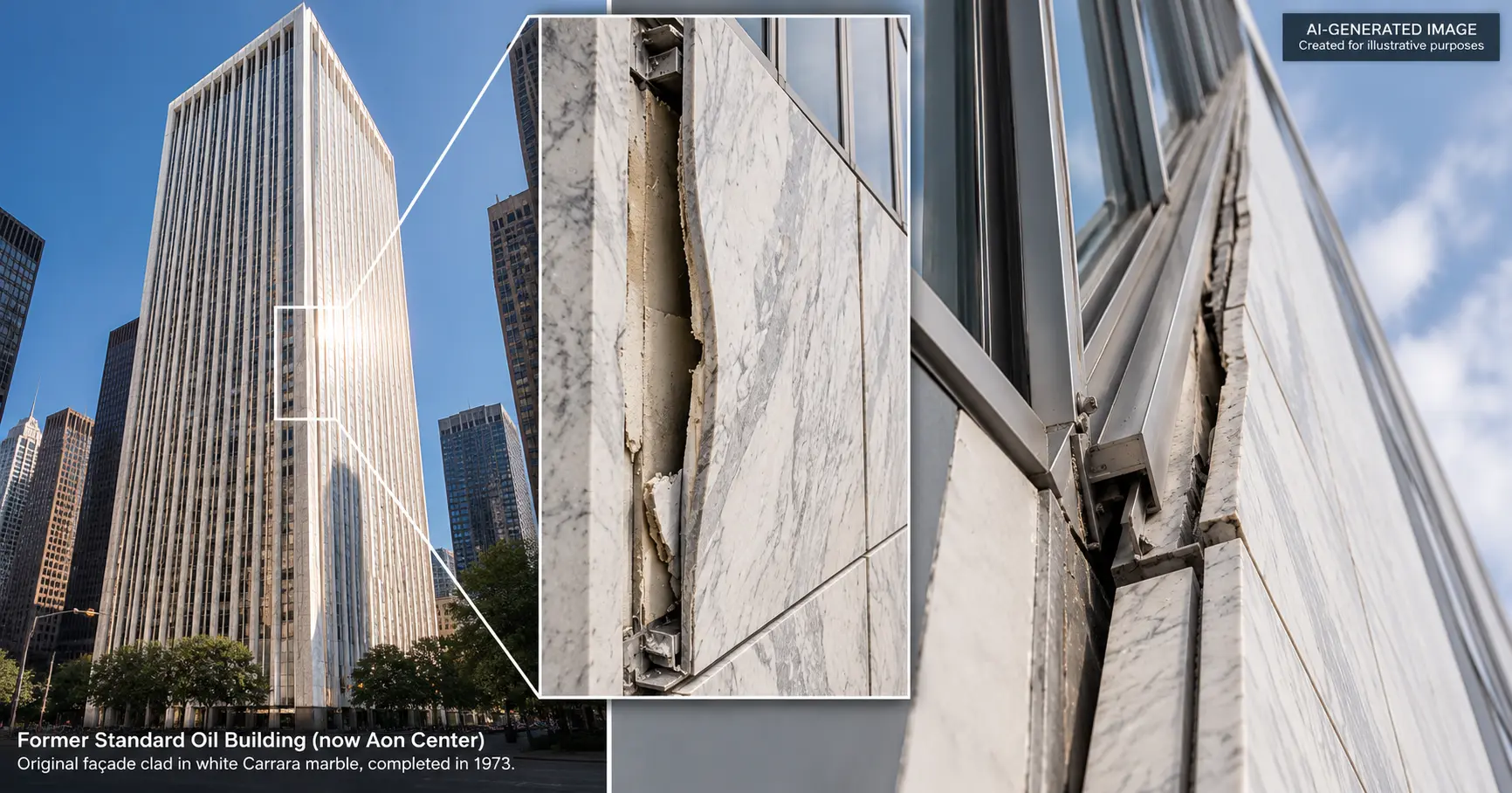
AI-generated illustration of damaged Carrara marble façade panels, showing separation and deterioration caused by improper stone application.

There are no stupid questions. Only expensive assumptions.

After 35 years in the natural stone business, I’ve learned that selecting the right material involves considerably more than finding something beautiful.

Natural stone offers an extraordinary range of colors, textures, and geological characteristics. But every stone has its own physical properties, and those properties matter.

A material that performs beautifully as an interior feature wall may require an entirely different approach when used on an exterior façade. A polished marble that looks magnificent in a residential bathroom may need additional consideration before being specified for a heavily trafficked commercial floor.

The stone itself isn’t necessarily the problem.

The application may be.

And sometimes the difference between a successful installation and a very expensive mistake comes down to asking a question that seems almost too obvious to ask.

An $80 Million Lesson in Chicago

One of the most instructive examples of improper stone specification is the former Standard Oil Building in Chicago, now known as the Aon Center.

Completed in 1973, the 83-story building was originally clad in approximately 44,000 panels of beautiful white Italian Carrara marble.

The panels were approximately 1¼ inches thick.

If you’ve ever visited Chicago in winter, you may have noticed it can get a bit chilly.

I once visited Chicago with friends in late October. It was remarkably cold, even by Chicago standards.

A local suggested I should have brought my winter clothes.

I was wearing a flannel shirt.

“I’m from Los Angeles,” I told him. “These are my winter clothes.”

Chicago’s weather is no joke, particularly when you’re selecting materials for an 83-story building.

The marble façade was exposed to significant temperature fluctuations, intense summer sun, freezing winters, and high winds.

Over time, the panels began to bow and crack. The repeated heating and cooling produced a phenomenon known as thermal hysteresis.

In simplified terms, repeated temperature changes can cause permanent deformation in certain marbles as their mineral crystals expand and contract differently. The panels gradually bowed and lost strength.

Eventually, the entire façade had to be replaced with thicker granite panels from North Carolina.

The cost was approximately $80 million.

But here’s the important distinction.

The problem wasn’t simply that Carrara marble had been selected. The approximately 1¼-inch-thick panels were particularly vulnerable to the thermal stresses of that installation.

Thicker panels would have provided greater resistance to deformation and may have significantly extended the façade’s service life. However, thickness alone is not a guarantee. The marble’s mineral structure, exposure conditions, anchoring system, and long-term performance all require consideration.

The lesson isn’t that marble cannot be used on exterior buildings.

It’s that the material, thickness, installation system, and environment must be considered together.

And that brings me to one of the first questions I ask when discussing a new project.

Where Is the Project?

When someone contacts me about supplying stone for an exterior application, one of my first questions is remarkably simple.

“Where is the project?”

It may seem obvious. After all, we’re based in Los Angeles, and many of our customers are local.

But I never assume the project is in Southern California.

It could be in Chicago, New York, Las Vegas, Nashville, or somewhere with an entirely different climate.

And that matters.

A limestone that performs well in a relatively mild climate may require additional evaluation before being specified for a building exposed to severe freeze-thaw conditions.

A stone used for exterior paving in Southern California may face entirely different challenges when installed in a region with freezing temperatures, snow, and deicing salts.

Even within the same region, exposure can vary considerably.

Is the material going on a shaded wall or a sun-exposed façade? Will it be installed horizontally or vertically? Is it near saltwater? Will it be subjected to heavy pedestrian traffic?

These aren’t minor details.

They influence material selection, thickness, finish, anchoring, installation methods, and long-term performance.

The same stone may be perfectly appropriate for one application and require an entirely different approach for another.

That’s why I ask where the project is.

And then I usually ask several more questions.

Some of them may seem stupid.

I’ve learned to ask them anyway.

Understanding the Material

Every natural stone has characteristics that influence where and how it should be used.

Marble, limestone, granite, quartzite, travertine, slate, and onyx are not interchangeable simply because they can all be cut into slabs or tiles.

Their physical properties can differ considerably.

Among the characteristics worth evaluating are:

  • Water absorption and porosity: How readily the material absorbs moisture and how that may affect staining, weathering, or freeze-thaw performance.
  • Flexural strength: The stone’s resistance to bending, particularly important for cladding and spanning applications.
  • Compressive strength: Its ability to withstand loads.
  • Abrasion resistance: How well a surface withstands wear from foot traffic and other use.
  • Slip resistance: An important consideration for flooring, particularly in wet or exterior environments.
  • Chemical sensitivity: How the material responds to acids, cleaning products, and other substances.

Finish selection also matters.

A polished stone may be appropriate for a wall but unsuitable for a wet walking surface. A textured finish may improve traction, but it can also affect maintenance and appearance.

These decisions should be made with an understanding of the material’s properties, the installation conditions, and the applicable performance requirements.

Not simply because a particular photograph looked beautiful.

It’s Not Always a Question of Can or Can’t

One assumption I particularly dislike is that a stone simply cannot be used in a particular application.

In reality, there are relatively few situations where the answer is an automatic no.

More often, the question is what the client is willing to accept in terms of maintenance, appearance, performance, and cost.

Consider a gray limestone specified for an exterior wall exposed to direct sunlight.

Depending on the particular limestone, prolonged UV exposure and weathering may change its appearance or cause the color to fade.

Does that mean the stone cannot be used?

Not necessarily.

It means the client should understand what may happen and what maintenance might be required to preserve the desired appearance.

If a suitable, tested UV-protective treatment is available for that particular stone, periodic reapplication may be part of the maintenance program. The frequency should be based on the product manufacturer’s recommendations and actual exposure conditions.

Some clients will decide that the maintenance isn’t worth the trouble.

Others will love the material enough to accept it.

And some may actually prefer the appearance of stone as it naturally weathers.

My job is to explain the consequences, not make the aesthetic decision for them.

Of course, there are exceptions.

One application I would strongly advise against is unfilled travertine exposed to severe freeze-thaw conditions.

Its open voids can collect water. When that water freezes, expansion can damage the stone. Surface sealing alone cannot reliably eliminate that risk.

In that situation, I’d recommend choosing a more appropriate material rather than promising a maintenance solution that may not work.

There’s an important difference between a stone that requires additional care and one that presents an unacceptable performance risk.

The objective isn’t to tell clients what they cannot have.

It’s to help them understand what they’re choosing.

Sometimes the Stupid Question Is the Most Important One

Not every expensive mistake involves a skyscraper.

Sometimes it involves something as simple as the direction of a vein.

Years ago, we were supplying vein-cut travertine panels for a feature wall.

The panels were to be cut 18 inches by 36 inches.

With vein-cut travertine, the orientation of the natural veining is an important part of the finished appearance.

In this case, the conventional assumption would have been to run the veins parallel to the longer, 36-inch dimension.

That’s what most people would expect.

But before proceeding, I asked what seemed like a rather stupid question.

“I assume you want the veins running along the 36-inch length?”

The answer was no.

The design called for the veins to run along the shorter, 18-inch dimension.

The designer was glad I’d asked.

When the wall was eventually installed, the orientation made perfect sense. It was an intentional part of the overall design.

But imagine what would have happened if we’d simply assumed the conventional orientation was correct.

Every panel could have been cut with the veining running in the wrong direction.

The dimensions would have been correct. The material would have been correct. The quantities would have been correct.

And the entire installation would have been wrong.

All because of one question nobody thought needed asking.

Learning From Other People’s Mistakes

My dad and granddad spent a lifetime reminding me of an old saying:

“Measure twice, cut once.”

It’s good advice, and not just for carpenters.

I’ve spent 35 years in the natural stone business, and some of the most valuable lessons I’ve learned came from watching other people make mistakes.

That doesn’t mean I haven’t made a few of my own. I’ve stepped in it more than once.

In one case, I asked the right question but failed to insist on an answer. As it turned out, asking the question wasn’t enough.

At another company where I worked, I overheard a conversation about a material order. Something didn’t sound right, so I interrupted with what I thought was a reasonable question.

My boss dismissed it as a stupid question.

I didn’t argue.

When the material arrived incorrectly, I just shook my head.

The question hadn’t been stupid after all.

Both experiences reinforced something I’ve believed for years: it’s better to ask a question that seems unnecessary than to discover afterward that nobody asked it. And once you’ve asked, make sure you get an answer.

My dad and granddad had it right. Measure twice, cut once.

Over the years, I’ve developed my own version:

“You can’t uncut the stone.”

Once a slab has been fabricated incorrectly, there’s no putting it back together and starting over. You can replace it, of course, but that involves additional material, labor, expense, and time.

A question that takes ten seconds to ask can prevent a mistake that takes weeks to correct. But only if someone answers it.

The Cost of an Assumption

There is a tendency in any experienced profession to assume that certain things are understood.

After enough years in the business, you develop a sense of what is customary.

But customary doesn’t necessarily mean correct.

A designer may have a particular visual effect in mind that isn’t obvious from a cutting schedule.

An architect may be specifying material for a climate the supplier hasn’t considered.

A fabricator may interpret a drawing differently from the person who created it.

And a homeowner may have expectations about maintenance or durability that have never been discussed.

None of these situations necessarily involves incompetence.

They involve assumptions.

And assumptions have a remarkable ability to become expensive once the material has been cut.

It’s considerably easier to clarify a detail before fabrication than to explain afterward why several thousand square feet of stone don’t look the way someone expected.

Selecting Stone Is a Collaborative Process

Good stone selection involves more than the supplier presenting attractive slabs and the designer choosing a favorite.

It requires communication between the designer, architect, supplier, fabricator, installer, and sometimes the engineer.

Each brings a different perspective.

The designer understands the visual objective.

The architect understands the building and its intended use.

The engineer evaluates structural requirements.

The fabricator understands how the material will be cut and assembled.

And an experienced stone supplier should understand the material itself, its characteristics, and where it is likely to perform successfully.

No single participant necessarily has every answer.

That’s why questions matter.

Sometimes the most useful contribution a supplier can make isn’t recommending a more expensive stone.

It’s explaining what will be required to use the material the client actually wants.

Or asking whether the project is in Los Angeles or Chicago.

Or confirming which direction the veins are supposed to run.

There Are No Stupid Questions

Natural stone is an extraordinary building material.

Properly selected, fabricated, installed, and maintained, it can provide decades or even centuries of service.

But choosing the right stone isn’t always about finding the material with the highest strength or the lowest absorption.

Sometimes it’s about understanding what a client wants and explaining what will be required to achieve it.

I don’t believe in automatically telling someone they can’t use a particular stone simply because it isn’t the conventional choice.

I believe in asking questions, explaining the risks, and helping them make an informed decision.

Some of the most valuable lessons I’ve learned came from watching other people make mistakes. A few came from making my own.

I’ve learned to ask questions, even the ones that seem stupid. And I’ve learned not to proceed until those questions have been answered.

My dad and granddad had it right when they told me to measure twice and cut once.

Because, as I’ve said for years:

You can’t uncut the stone.


The World of Stone | Los Angeles

35 years in the natural stone business. Still asking questions.