
The peculiar rules of buying and reserving natural stone.
After 35 years in the natural stone business, I’ve learned that the words “sold” and “hold” can have remarkably different meanings depending on which side of the sales counter you’re standing.
To me, the distinction is fairly simple.
If you’ve paid for specific slabs, they’re yours.
If you’ve asked me to hold them while you make up your mind, they’re still mine.
Apparently, this is not universally understood.
And I’ve encountered some rather entertaining examples from both sides of the counter.
Let’s start with the suppliers, because they don’t always get this right either.
Everything Has a Price. Apparently.
Years ago, a designer purchased several slabs from us. They were paid for, marked SOLD, and removed from our available inventory.
Sometime later, a very wealthy customer walked into the yard, saw those slabs, and decided he wanted them.
I explained that they were already sold.
He insisted.
I explained again.
He insisted again.
Finally, he said the three words that apparently resolve every commercial disagreement:
“Name your price.”
So I thought about it.
The designer who had purchased those slabs was an excellent customer. She did more than $100,000 a year in business with us.
If I sold her material to someone else, I would almost certainly lose that relationship.
I estimated it would take approximately three years to replace that business.
So I gave him my price.
“$350,000.”
He looked at me as though I’d lost my mind.
I explained the calculation. Three years of lost business, plus a little something for the inconvenience.
He didn’t buy the slabs.
I’ve told that story many times over the years, always with one additional observation.
Had he actually agreed to pay $350,000, I would have called the designer immediately.
“I have good news and bad news.
The bad news is that I’ve sold your slabs to someone else.
The good news is that I have a check for $100,000 for you.”
I suspect we could have worked something out.
Fortunately, nobody called my bluff, and the slabs went exactly where they belonged.
When It’s Sold, It’s Sold
There is a serious point behind that story.
When a customer purchases specific slabs, those slabs belong to that customer. They’re marked SOLD, removed from available inventory, and held for the purchaser according to the terms of the sale.
It shouldn’t matter whether someone else offers more money, has a more urgent project, or happens to be particularly persuasive.
A supplier has made a commitment, and that commitment should be honored.
Unfortunately, there have been instances in our industry where customers have purchased material only to discover later that it was sold to someone else.
That’s unacceptable.
Once a supplier accepts payment for specific material, the customer should be able to depend on that material being there when needed.
A purchase is a purchase.
Which brings us to the other side of this rather peculiar arrangement.
Now, About Those Holds…
There is a curious practice in the natural stone business known as putting material “on hold.”
For those unfamiliar with the concept, it generally involves a customer selecting a material, expressing considerable enthusiasm for it, and then asking the supplier not to sell it to anyone else while they decide whether they actually want it.
Sometimes this takes a day. Sometimes a week. Occasionally, I suspect, the decision is being passed down to future generations.
We work with designers, architects, contractors, and homeowners every day. We understand that decisions take time, particularly when several people need to approve a selection.
We’re happy to accommodate that process whenever possible.
But a hold is a courtesy, not a purchase.
At The World of Stone, our understanding of a hold is straightforward.
If another customer expresses serious interest in purchasing the same material, we’ll contact the person who requested the hold and give them an opportunity to buy it.
At that point, a decision needs to be made.
Not another week to think about it. Not an emergency meeting to discuss the subtle differences between two shades of beige.
An opportunity to purchase the material.
I’ve never quite understood why someone believes they should be able to reserve thousands of dollars of another person’s inventory indefinitely without making a financial commitment.
I’ve often explained it this way:
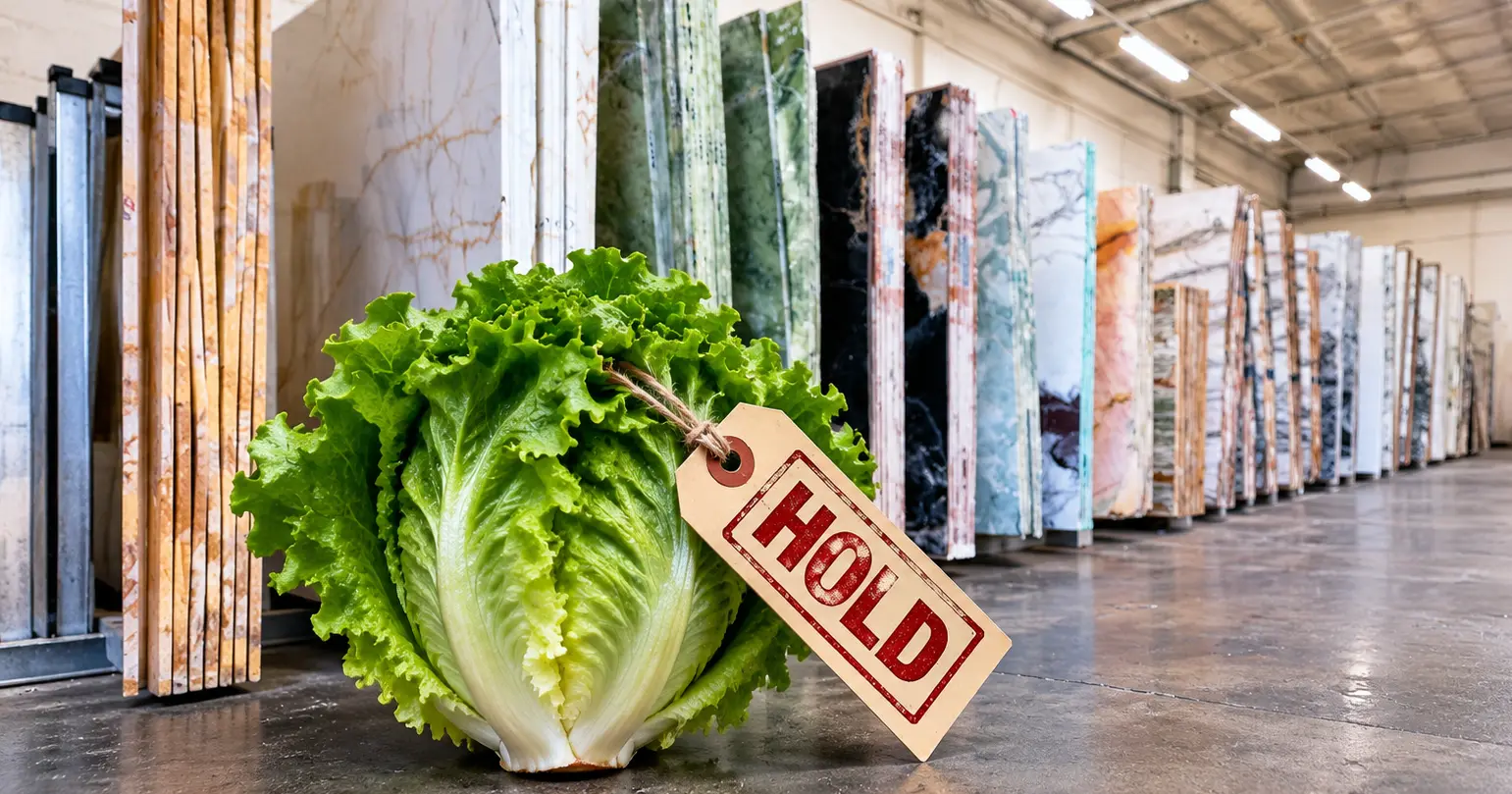
You Can’t Put a Head of Lettuce on Hold
Imagine walking into a supermarket, finding a particularly attractive head of lettuce, and informing the produce manager that you’re considering making a salad.
You haven’t decided what kind of salad. First, you need to consult your spouse, your nutritionist, and your personal trainer.
But you’d like the produce manager to remove that particular head of lettuce from sale until everyone has weighed in.
Naturally, you’d prefer not to pay for it in the meantime.
I suspect the produce manager would have a few questions.
And yet, in the natural stone business, this is a perfectly ordinary Tuesday.
The Hold That Wouldn’t Die
Several years ago, a designer asked me to hold some material for a project.
A week later, I sent her an email asking whether she was still interested.
No response.
Another week passed. I sent a second email, this time explaining that I could no longer hold the material without hearing from her.
Still nothing.
Eventually, the material was sold to another customer. I closed the sales order and moved on.
Six months later, the designer came in to purchase the stone.
Unfortunately, it was gone.
She was furious.
Apparently, we had very different understandings of the arrangement.
I thought a hold was a temporary courtesy. She apparently believed it was a permanent reservation requiring no deposit, no communication, and no particular intention of purchasing anything within the foreseeable future.
I’d sent two emails. She’d answered neither. The second email specifically warned that I could no longer hold the material without a response.
But somehow, I was the one who had failed to honor the arrangement.
Six months.
I’ve seen shorter construction projects.
I suppose I should have kept the material on hold until her grandchildren were ready to remodel.
Inventory Isn’t Free
There is something about stone inventory that seems to create the impression that holding it costs nothing.
After all, the slabs are just sitting there.
But consider what it took to get them there.
Someone purchased the blocks, paid to have them processed, arranged transportation, shipped them across an ocean, paid customs duties, tariffs (don’t get me started—we’ll get to those another day), unloaded them, and placed them in a warehouse that also costs money to operate.
By the time a customer walks into a stone yard, the supplier has already made a substantial financial commitment.
And unlike a bank, we don’t earn interest on the money sitting in the warehouse.
We earn money by selling stone.
When a supplier agrees to hold material indefinitely, they’re essentially being asked to finance someone else’s indecision.
It’s a remarkably generous arrangement, particularly when nobody remembers agreeing to it.
A Little Courtesy Works Both Ways
The point of all this isn’t that suppliers shouldn’t accommodate their customers.
Quite the opposite.
Relationships are important in this business. We’ve held materials for clients, worked around construction delays, accommodated complicated approval processes, and made exceptions when circumstances warranted them.
Good business relationships depend on cooperation.
But cooperation requires a little consideration from both sides.
If you ask someone to hold material, respond when they contact you. If you need more time, say so. If you’ve decided against it, let them know.
We won’t take it personally.
And if a particular stone is essential to your project, purchase it.
If you buy it from The World of Stone, it will be there when you need it.
That’s the surest way to make certain the material is available for your project.
The distinction is simple.
A purchase is a commitment. A hold is a courtesy.
We understand that decisions take time.
We just can’t guarantee that everyone else’s decisions will wait for yours.
So by all means, ask us to hold the stone. We’re happy to help.
Just remember, you can’t put a head of lettuce on hold at the grocery store.
And ours is considerably more expensive than lettuce.
The World of Stone | Los Angeles
35 years in the natural stone business. Apparently, still learning about holds.