
Unusual colors, remarkable geological formations, and the qualities that distinguish exceptional natural stone from the ordinary.
There are thousands of natural stones available around the world, yet walk through enough slab warehouses and you might begin to think there are only a few dozen.
White marble. Grey marble. Beige limestone. Quartzite with dramatic veining.
They are all beautiful. Some are extraordinary.
One of my standard observations after more than 35 years in the stone business is that all stone is beautiful.
It may not be beautiful to you. It may not be appropriate for your particular installation. But somewhere, in the right setting, that same material can be exceptional.
Beauty and suitability are two different things.
And beauty isn’t necessarily determined by rarity or price.
Some of the most interesting materials aren’t the ones everyone is selling. Sometimes it’s an unusual color. Sometimes it’s a geological formation that produces remarkable movement. Sometimes it’s a familiar stone selected from an exceptional block.
And sometimes it’s a material that doesn’t fit neatly into any of the usual categories.
At The World of Stone, finding those materials has always been one of the more enjoyable parts of the business.
Of course, finding them is only the beginning. Understanding what makes them special is where experience becomes important.
What Makes a Natural Stone Rare or Unusual?
Rarity in natural stone can mean several different things.
A material may come from a quarry with limited production. Its particular color or geological characteristics may occur in only a small portion of the deposit. It may be difficult to extract in commercially useful blocks, or it may simply be unfamiliar to the American market.
And sometimes a material isn’t especially rare at all. It’s just rarely selected well.
That’s an important distinction.
A quarry may produce thousands of square feet of a particular marble, but only a relatively small percentage might have the combination of color, movement, consistency, and visual quality that makes it exceptional.
The commercial name doesn’t tell the whole story.
Two slabs can carry exactly the same name and have very different appearances, grades, and prices.
Understanding those differences is part of selecting natural stone.
Color, Depth, and Clarity: What Makes One Stone More Appealing Than Another?
Years ago, when I was teaching an AIA continuing education course, I included a discussion about material quality.
I used three words to explain something that customers recognize almost immediately but often have difficulty describing:
Color. Depth. Clarity.
Carrara White marble is a particularly good example.
Show someone two different selections of Carrara White, and they’ll frequently prefer one over the other.
Ask why, and the answer might be, “I just like this one better.”
Fair enough. But there are usually identifiable reasons.
Color
The background color of a marble has an enormous influence on its appearance.
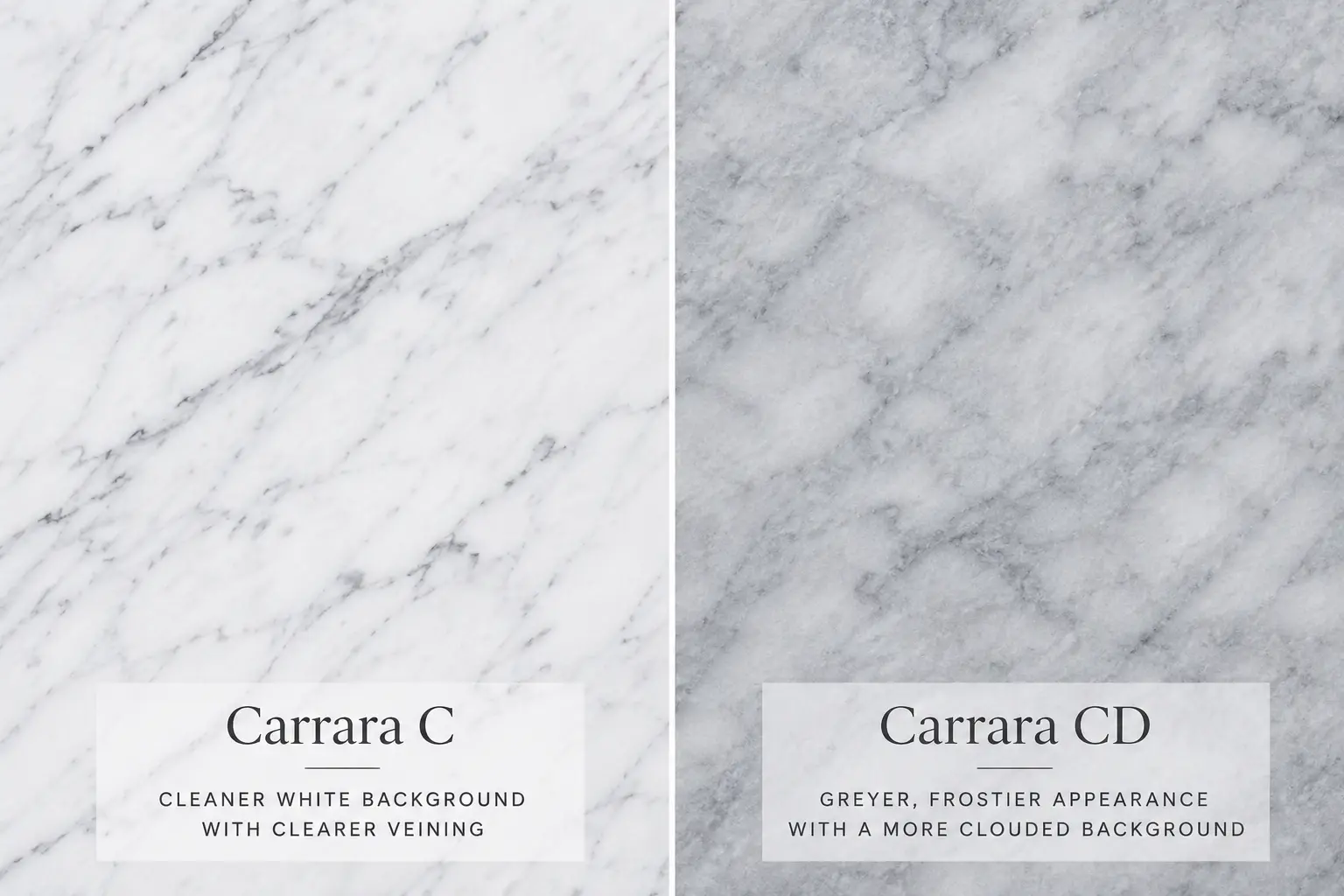
One selection of Carrara White might have a cleaner, brighter background, while another appears greyer or more heavily clouded.
Neither is necessarily unsuitable. They simply represent different selections of the same general material.
The relationship between background color and veining also matters. Contrast, consistency, and the distribution of color all influence how a stone is perceived.
Depth
Depth is more difficult to explain, but it’s one of the qualities that can distinguish an exceptional marble.
Some stones have a visual richness that seems to extend beneath the polished surface.
Light penetrates the surface and interacts with the crystalline structure, giving the material a sense of dimension that a photograph may not fully capture.
This is particularly noticeable in certain white marbles, where translucency contributes to the impression that the stone has depth rather than simply a pattern on its surface.
Other selections appear comparatively flat.
That difference can be subtle, but once you recognize it, it’s difficult to ignore.
Clarity
Clarity describes how cleanly the stone’s colors and patterns are expressed.
In some marbles, the veining appears distinct and well-defined against the background. In others, the colors blend together, creating a cloudier or muddier appearance.
One of the most revealing characteristics is translucency.
In a marble with good translucency, light penetrates the crystalline structure rather than reflecting entirely from the surface. This can give the background a luminous quality and allow subtle internal features to become visible.
It’s one of the things I look for when evaluating a marble’s visual quality.
Clarity isn’t the same as having fewer veins.
A heavily veined marble can have exceptional clarity, while a relatively quiet stone may lack it.
And translucency isn’t a universal measure of quality. Different minerals, grain structures, and geological formations influence how light behaves within stone.
But in the right marble, it can be a remarkably useful indicator of the qualities we’re discussing.
Why Does One Carrara Marble Cost More Than Another?
I’ve had this conversation with customers many times.
“Why is this one so much more expensive? They’re both Carrara!”
And they’re right. Both are Carrara marble.
But that doesn’t mean they’re the same quality of selection.
One may have a cleaner white background, greater depth and translucency, and more clearly defined veining. Another may have a greyer background, less visual clarity, or characteristics that place it in a different commercial grade.
Those differences can affect how the material is valued long before it reaches a showroom.
At the quarry and during production, blocks and slabs are evaluated and sorted. More desirable selections may be less common, and their prices reflect that difference.
Of course, appearance isn’t the only factor affecting price. Block yield, defects, availability, production costs, and market demand also play a role.
But when comparing two bundles of Carrara White, the answer is often quite simple:
They’re both Carrara. They’re just not the same selection.
Understanding Carrara Marble Grades
In the Carrara trade, you’ll encounter classifications and commercial names such as C, CD, Extra, Gioia, and others.
These terms have traditionally helped distinguish different selections, appearances, and commercial qualities of Carrara marble.
For example, Carrara C is generally associated with a lighter background than the greyer material commonly sold as Carrara CD. Higher selections may be marketed as Extra, while Gioia refers to a recognizable Carrara marble variety with its own characteristic appearance.
These distinctions matter because the visual differences can be substantial.
The problem is that these names and grades haven’t always been used consistently throughout the supply chain.
Over the years, commercial descriptions have become increasingly flexible. What one supplier calls Extra may not be what another supplier considers Extra.
And some traditional distinctions have become blurred by marketing.
How Carrara grading developed, and how those classifications have been stretched over the years, is a story for another day.
For now, the important point is that the commercial name isn’t enough.
The actual material matters.
The Relationship Between Appearance and Physical Quality
Color, depth, and clarity aren’t simply marketing descriptions.
The appearance of marble is influenced by its mineral composition and geological history, including the heat, pressure, deformation, and recrystallization that transformed the original limestone.
Those processes also influence the stone’s crystalline structure and physical properties.
A compact, well-interlocked crystalline structure may contribute to lower porosity and water absorption. Grain boundaries, microcracks, mineral composition, and other factors also affect performance.
In other words, the geological characteristics responsible for a stone’s appearance can also influence how it behaves.
That doesn’t mean translucency or a cleaner background automatically guarantees greater strength or lower absorption. Those properties require appropriate testing.
But appearance and physical characteristics aren’t entirely unrelated. Both originate in the stone’s geological history.
Experienced quarry operators and producers understand the differences between selections. Blocks and slabs are sorted into commercial grades based on appearance, consistency, defects, and other considerations.
That’s one reason a premium selection of Carrara White can cost considerably more than another selection carrying the same name.
You’re not necessarily paying more for a different stone. You’re paying for a different quality of selection.
And that distinction applies to far more than Carrara marble.
Beyond White and Grey: Unusual Colors in Natural Stone
For many years, white and grey stones have dominated contemporary residential design.
They’re versatile, familiar, and beautiful.
But natural stone offers a much broader palette.
Some of the most interesting materials we’ve sourced demonstrate just how varied that palette can be.
Rosso Impero: The Character of Deep Red Marble
Red is an unusual color in architectural stone, particularly when the material has the richness and movement to become a focal point.
Rosso Impero offers a distinctive alternative to the more familiar white and grey marbles.
Its deep red coloration gives it a presence that can work beautifully in furniture, feature walls, and carefully selected architectural details.
It’s not a material that needs to cover an entire room to make an impression.
Sometimes a relatively small application is enough.
Tunisia Chemtou Marble: A Remarkable Historical Palette
Tunisia Chemtou Marble is another example of how unusual color can distinguish a natural stone.
Associated with the historic Giallo Antico marbles prized in ancient Rome, Chemtou is known for its expressive combinations of warm yellow, gold, red, and darker veining.
The movement can be extraordinary.
It’s a material with both visual character and a remarkable historical connection.
For projects seeking something beyond conventional neutral colors, stones like Chemtou demonstrate possibilities that many designers may never encounter in a typical showroom.
Verde Bamboo Quartzite: Natural Green with Distinctive Movement
Green natural stone offers another departure from the usual palette.
Verde Bamboo Quartzite combines green coloration with pronounced linear movement, creating an appearance that can be particularly effective in contemporary architectural settings.
As with any natural stone, the actual slabs matter.
The direction of movement, distribution of color, and relationship between consecutive slabs can influence how the finished installation looks.
Selecting the right material is only part of the process. Planning how it will be used is equally important.
Exceptional Stone Doesn’t Always Have to Be Dramatic
One of the misconceptions about rare or high-quality stone is that it must have extraordinary veining or intense color.
Some of the most beautiful materials are remarkably quiet.
A carefully selected limestone may have subtle movement, a consistent background, and a finish that complements the architecture without competing with it.
Materials such as Gascogne Beige Velvet, Ataíja Blue Storm, and Pietra Serena demonstrate how restrained color and texture can be just as distinctive as dramatic marble.
Their appeal often becomes more apparent when viewed in person.
A photograph can communicate the general color and movement, but it may not fully convey the texture, surface character, or subtle variations that make a material interesting.
In these cases, exceptional quality is less about attracting attention and more about getting the details right.
And sometimes that’s considerably harder.
Geological Character: When the Stone Becomes the Design
Natural stone can also be unusual because of its geological structure.
Breccias, onyx, and heavily patterned marbles can produce formations that are difficult to reproduce in any manufactured material.
Consider Breccia Capraia, with its distinctive movement and contrasting colors, or Silver Grey Onyx, where translucent layers and natural variation create opportunities for dramatic installations.
These materials require thoughtful selection.
Bookmatching, diamond matching, and the arrangement of consecutive slabs can dramatically influence the finished appearance.
A particularly expressive stone can become overwhelming if the layout isn’t considered carefully.
Conversely, a well-planned installation can turn natural variation into an architectural feature.
This is where understanding the material before fabrication becomes especially valuable.
Stoneglass: An Unusual Surface Beyond Natural Stone
Not every interesting architectural material comes from a quarry.
Stoneglass is a good example.
Stoneglass is a manufactured glass-based architectural surface, not natural stone and not conventional engineered quartz.
Its appearance is almost the opposite of the dramatic marbles discussed above.
Rather than relying on elaborate veining or geological movement, white Stoneglass offers a remarkably clean, uniform surface.
Its appeal lies in that consistency and in its performance characteristics.
Stoneglass is nonporous, highly resistant to staining, and resistant to many acids and common chemicals. Those characteristics make it worth considering for applications where maintenance and surface performance are important.
We’ve worked with Stoneglass for projects involving reception desks, bars, furniture, feature walls, and other architectural applications.
It can also be fabricated into custom shapes and details, offering possibilities beyond standard countertop installations.
What makes it unusual isn’t rarity in the geological sense.
It’s that the material offers a different combination of appearance, performance, and fabrication possibilities from many conventional architectural surfaces.
For designers seeking a clean, contemporary aesthetic, that’s worth exploring.
As with any specialty material, the specific application, fabrication requirements, and installation details should be reviewed before specification.
Finding the Materials That Aren’t in Every Showroom
One of the advantages of working with producers and quarries around the world is access to materials that may never become mainstream products in the United States.
Some are available only in limited quantities.
Others require special ordering, block selection, or production specifically for a project.
And some are simply overlooked because they don’t fit the purchasing patterns of large-volume distributors.
At The World of Stone, we’ve spent decades developing relationships with suppliers and producers, particularly in Italy and Portugal, as well as other stone-producing regions.
Those relationships allow us to look beyond standard inventory.
For the right project, that may mean locating an unusual marble, selecting a block, coordinating custom production, or sourcing a material with a particular color, finish, or geological character.
It also means knowing when a material isn’t appropriate for the intended application.
A beautiful stone isn’t automatically the right stone.
Its physical properties, exposure conditions, fabrication requirements, and long-term maintenance expectations still matter.
Our goal isn’t simply to find something different.
It’s to find something exceptional that makes sense for the project.
Selecting Rare and High-Quality Natural Stone for Your Project
If you’re looking for unusual natural stone, rare marble, distinctive limestone, or specialty architectural surfaces, my recommendation is to begin the conversation before the material is specified.
Bring photographs, color references, drawings, or even a general idea of what you’re trying to achieve.
Sometimes the right material is already in our inventory.
Sometimes it’s something we can source.
And occasionally, the best recommendation is a stone you hadn’t considered.
After more than 35 years in the stone business, I still enjoy finding materials that surprise me.
Fortunately, there are plenty left to discover.
The World of Stone | Los Angeles
Rare natural stone, carefully selected marble and limestone, specialty architectural surfaces, and custom sourcing for residential, commercial, and hospitality projects.
Available by appointment. Nationwide shipping and project support.